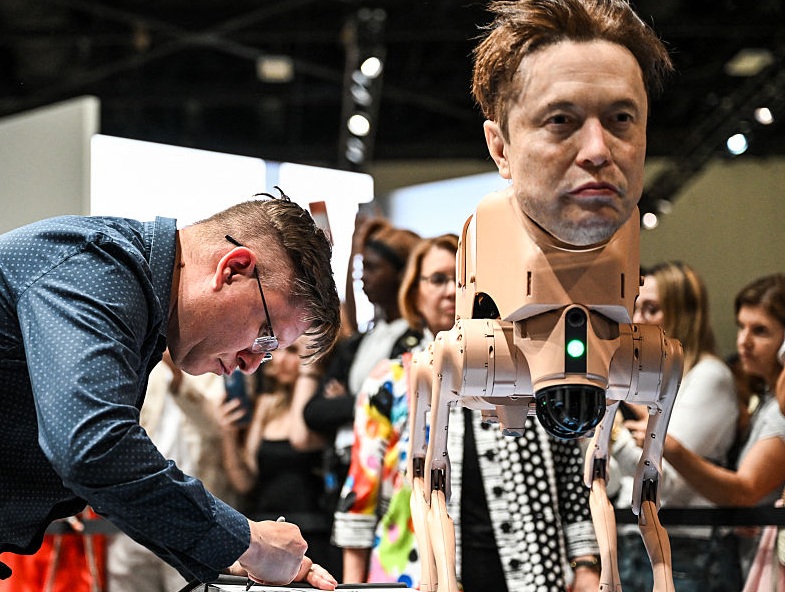
In Miami, one of the world’s richest art festivals, this year’s Art Basel Miami Beach hosts a more than intriguing art project. The performance art brings together a group of four-legged robots wearing hyper-realistic silicone faces of tech billionaires and world-famous artists. These half-human, half-canine creatures seem to have stepped straight out of a video game or a real-life nightmare, mixing dreams and reality. At the heart of this project is an artist by the name of Beeple, whose real name is Mike Winkelmann: on the very first day of the fair, he can be found in the robot enclosure, picking up works of art from the ground and handing them to visitors, as well as in his own project with two robots bearing his face.
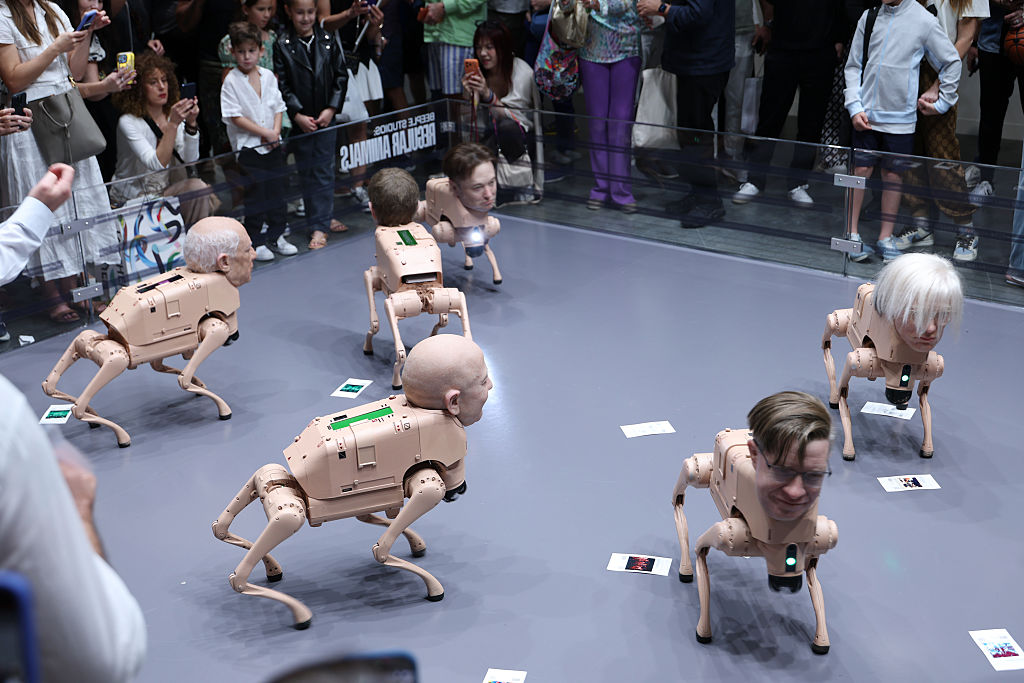
The name of the concept: « Regular Animals. » The behavior of these creatures is as fascinating as it is disturbing. They wander around an enclosure, sometimes nearly colliding with each other. Musk puckers his lips, Picasso stares into space. But the most provocative aspect lies in their creative process: at random, the robots tip backwards and, via a screen displaying poop mode, physically expel a work printed from their hindquarters. Beyond the scatological provocation, the work conceals a sophisticated critique of our relationship with technology and information. Each robot is equipped with cameras and operates autonomously. They capture images of their environment (visitors, the fair) and use artificial intelligence to reinterpret this visual data according to the personality they embody:
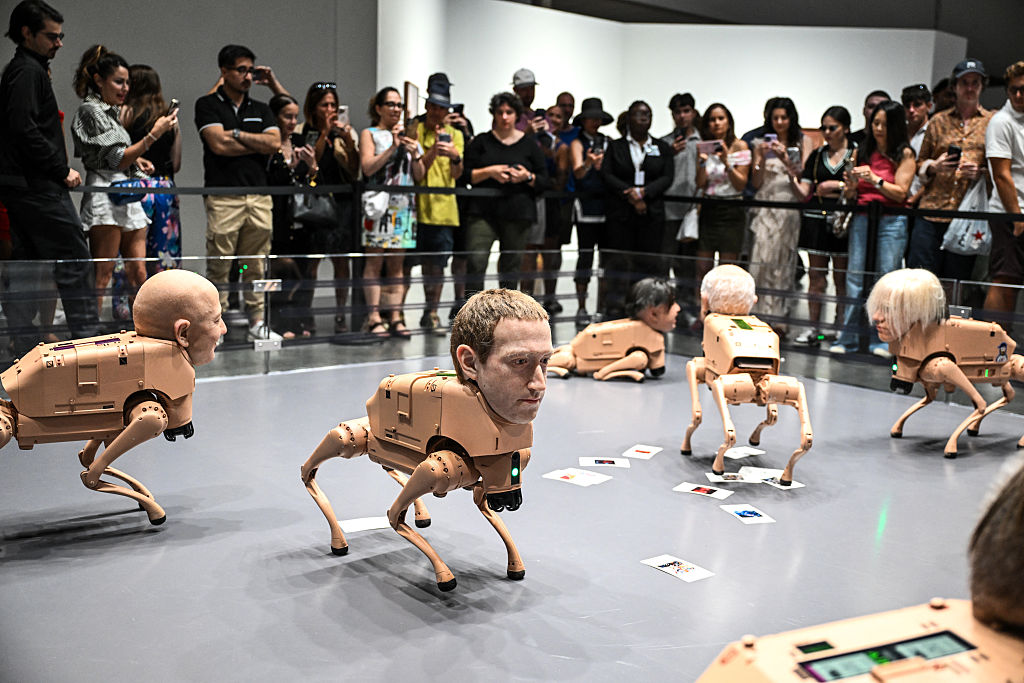
Herein lies Beeple’s central message: the one-sided control of perception. The artist explains that these billionaires, via their super-powerful algorithms, decide what we see and influence our reality. They have become the main filters through which humanity consumes information. Beeple’s warning is clear: « We are not ready for the future. » The return of the NFT Beeple, who became the third most expensive living artist after his record sale of $69.3 million at Christie’s in 2021, is lucid about the evolution of the market. He acknowledges that the collapse of the NFT bubble was inevitable due to the massive production of uninteresting projects. However, Art Basel 2025 marks a resurgence of digital art. The prints « defecated » by the robot dogs are not mere papers: they are NFTs linked to the blockchain. Beeple plays with irony here, materializing the common criticism that NFTs are just bullsh**, by having his sculptures literally defecate these digital assets.
The public’s reception oscillates between disgust, unease, and admiration. The boundary between the real and the artificial was even tested when real dogs started barking at the robots, an interaction that delighted the artist. For Beeple, these dynamic sculptures foreshadow the future of art, where works will be alive with simulated emotions. However, the experiment has a programmed end: although the robots will continue to move, their creative capacity (generating and storing images on the blockchain) will stop after three years. Despite the grotesque nature of the installation, it was an immediate commercial success. Within the first hour of the fair, all the animals, including the little Musk, Zuckerberg, and Beeple, had found buyers, proving that provocation remains a sure bet in contemporary art.