Our editorial team independently selects these products. If you choose to buy any, we may earn a commission that helps fund our content. Learn more.
Fall is in full swing! To celebrate the change in seasons, we’re rounding up the best jackets to sport at the cottage with staple styles that are warm, cozy, and on-trend for autumn.
Seymour Shacket
This cozy fall “shacket” is a cross between a shirt and a jacket making it a must-have transition piece for the season. Made from a cozy wool blend, it features an oversized fit and stylish plaid pattern that you can comfortably sport indoors or outdoors.
This functional and fashionable jacket features the brand’s advanced thermal-reflective lining technology which ensures breathability while being able to retain body heat. It’s also made with recycled synthetic down which makes it ultra comfortable and warm. It’s a must-have for any outdoor adventures at the cottage.
Stay stylish and cozy all cottage weekend long with this teddy jacket from Joe Fresh. The dark brown colour combined with the faux suede and teddy fleece ensures an overall fashion-forward yet comfortable fit.
Puffer jackets are a must-have for the season because they’re designed with an insulated build to ensure you stay warm and cozy—even during the harsh fall conditions. Details such as a full zip and high neck are perfect for long cottage days spent outdoors with family and friends.
Specially designed to combat those rainy cottage days, this light, packable jacket is protective, durable, and breathable. It also features a Recco reflector and comes in a range of colours, so you can choose the one that best suits your style!
This sherpa-lined denim jacket was created with durability and comfort in mind. Not only is it stylish in design, but it also features adjustable hems and various pockets to store everyday essentials.
From hiking up a trail to sitting by the campfire to everything in between, this jacket will ensure you stay warm and stylish wherever the day takes you! As a must-have for any cottage stay, this jacket features handwarmer pockets and a plush zip-through collar to ensure a cozy yet comfortable fit.
This is the ideal transition jacket to add to your fall collection. It’s rugged, warm, and durable, making it a wardrobe staple for your next trip to the cottage. It features thoughtful details such as a comfortable modern fit and a wind and water-resistant shell to protect you from the elements.
This multi-functional outerwear piece is three jackets in one and is specially designed to provide full weather protection. It’s breathable and waterproof and can be worn in three ways; an outer waterproof shell, an inner warm, lightweight jacket, or together for an all-over protected and ultra-warm fit.
This functional and fashionable bomber is perfect for a cottage weekend getaway. It features a classic bomber-style design and tactical details made for outdoor activities. For instance, it’s windproof, water-repellant, and warm, making it a must-have for this season and beyond.
To many, the Dodge Estate needs no introduction; it is a part of Manitoulin folklore and mystery. Originally built in the 1920s, the lodge has been preserved by various owners and is in great condition nearly 100 years after its construction. The main lodge features a large double-sided fireplace with a sunroom on one side and the great room on the other. Several of the lodge’s keepsakes can be viewed in the great room, which looks out over the North Channel of Lake Huron. Two large wings flank the main lodge with several bedrooms that all have views of the channel. A covered veranda wraps around the entire facility, providing cover from the elements and shade on hot summer days. The covered veranda extends toward the former caretakers’ quarters, which is now a three-bedroom winterized home with a screened-in porch. The lodge has an elevated view with one of the nicest sand shorelines on Manitoulin. The waters are typically calm and perfect for watersports.
What makes this property unique?
The property was purchased by Daniel Dodge, of Dodge automotive fame, in the 1920s. The grounds contain a log lodge with 4,000-plus feet of indoor living space and one of the nicest sand beaches on Manitoulin Island. A tragic accident at the property resulted in a flee via boat to the closest hospital. Mr. Dodge went overboard in a storm and his body was discovered by fishermen weeks later. The events have been shrouded in mystery for decades.
What are the key selling features?
Dodge Estate has been well maintained and preserved in its original state. The beachfront is pristine, and the lot has direct access to the North Channel, one of the best sailing/yachting destinations on the Great Lakes. The property has been used as a private family compound for two decades. However, it also carries commercial zoning which would make it and excellent location for a rental lodge.
Would you like to list your cottage on our website? Email listingoftheweek@cottagelife.com.
Sign up for our free enewsletter, The Key
Want more cottage real estate news? You’ll receive timely stories about buying, selling, and renting to help make your cottage dream a reality.
A grainy cellphone video of a leggy black cat sauntering through a residential yard near Whitehorse in August of 2020 was a lucky discovery for a Yukon biologist. The footage clearly reveals the distinctive pompom tail and oversized, cartoon-like hindquarters of a Canada lynx, a relatively common year-round resident of the boreal forest across the Canadian north. Only in this case, the lynx’s coat was soot-coloured, a first according to Yukon government senior wildlife biologist Thomas Jung.
Jung documented the sighting in arecent paper in Mammalia Journal, exploring the significance of variation in coat colour as a positive or negative trait in wildlife. Canada lynx are typically “silver grayish in winter and reddish brown in summer with dark spots,” Jung writes, “[with] black hairs on the tips of their tails and ears.” Paler-coloured individuals are occasionally observed, Jung adds, “suggestive of partial albinism.”
Wider variations in colour occur in other mammals, such as the cream-coloured “Spirit Bear” variation of black bears on the British Columbia coast, with possible benefits such as temperature regulation or being better camouflaged. Jung says black bears in the Yukon are often tan or cinnamon-coloured, to better blend in with the region’s sparse forests. “It comes down to which colour works best in the habitat,” he says.
So-called “melanism” is caused by a genetic mutation causing the individual to produce an excess of melanin, a dark-coloured pigment. Dark-coloured big cats occur in humid tropics, where they may blend in better with the surrounding jungle. Jung’s literature review uncovered accounts of black ground squirrels sighted in burned over patches of boreal forest and similar occurrences in bobcats in New Brunswick, suggesting this melanism enables individuals to be camouflaged with charred timber.
The melanistic lynx spotted near Whitehorse was the first record of such for the species, possibly for good reason. Jung doesn’t expect to see black lynx flourishing in the Canadian subarctic where a dark-coloured feline would be at a distinct disadvantage when stalking hares in the snowy winter. “It doesn’t matter whether you’re in the Yukon or northern Ontario,” he says, “lynx are grayish white because it works. To stalk and ambush their prey they need to be well camouflaged.”
Our editorial team independently selects these products. If you choose to buy any, we may earn a commission that helps fund our content. Learn more.
Fanny packs are the ultimate hands-free essential for outdoor activities or day trips. This is because they’re stylish in design and offer tons of space to store all of your daily must-haves.
We’re rounding up the top fanny packs to shop from your favourite brands that will meet your travel and outdoor activity needs!
This budget-friendly fanny pack is lightweight and durable making it the perfect companion for your next outdoor outing. The adjustable waist belt ensures a comfortable fit while the bag itself weighs just 4 oz, making it ideal for taking on the go.
Pack up all of your daily must-haves in style with this lifestyle waist bag from adidas made out of recycled materials. It merges functionality with fashion.
Are you always on the go? This running belt from alo is specially designed for those with an active lifestyle. Now, you can go the distance with a sleek and ultra-light fanny-pack style bag that’s made from water-resistant, rip-stop fabric. Plus, it easily stores everyday items such as keys and your phone in its large main pocket.
Available in two colourways, this unisex fanny pack will comfortably store all of your daily must-haves with ease, thanks to organized compartments. Design details also include compression straps that help secure your belongings closer to your body for enhanced carrying comfort, as well as side access zips.
This stylish hip pack is a must-have for cottage trips this season. It features a casual design in which top handle and waist belt options offer multiple carrying options.
Stay organized and on-trend with this unisex fanny pack. Featuring a large zippered main compartment, a front pocket with a key fob, and an interior mesh pocket for added storage, it’s super versatile in design. This bag can also be worn three ways; as a cross-body, around the waist, or off one shoulder.
It’s produced with 50 per cent recycled content and includes stylish design elements such as an embossed logo and nubuck leather trim for a modern take on the classic hands-free silhouette.
If you’re looking for an elevated daily essential, this unisex fanny pack from Rudsak has it all. The sleek yet sporty design is perfect for any active lifestyle and the adjustable waist strap ensures an all-day comfortable fit. It’s also made with high gloss waterproof zippers and features fashion-forward details such as the iconic Rudsak logo.
The classic everyday essential makes hands-free storage a breeze thanks to zippered compartments and adjustable strap detailing. It’s available in black or camouflage colourways.
On the hunt for a bag that can carry it all without going out of style? Enter the sleek sling bag from Gymshark! Its functional yet sporty style makes it a must-have for your next outdoor trip or adventure.
When the sun goes down, the forest doesn’t sleep. There’s a whole night shift of creatures that use the cover of darkness to survive. For both predators and prey, nighttime has advantages and disadvantages. Early mammals, for example, likely evolved for living in the dark because most dinosaurs were active during the day. But, while moving in the darkness may help you escape the notice of a scary diurnal T. rex, you may miss out on a meal that is visually prominent, such as a brightly coloured fruit. These selective pressures likely helped develop an incredible sense of smell that isn’t dependent on light: you don’t see the fruit, but you can still find it with your nose. We as daytime mammals can’t smell our way to our next meal (unless the neighbour is barbecueing again), but nocturnal animals of all shapes and sizes often use smell or hearing or touch as their major sensory organs. This allows the forest to be active 24/7 and means there is a crew change as the daytime team gives way to the night shift one: hawks to owls, red squirrels to flying squirrels, butterflies to moths.
Flying squirrels
Photo by Agnieszka Bacal/Shutterstock
Next of kin
The best way to tell apart our two species of flying squirrel is by size.
Photo by Tony Campbell/Shutterstock
Next of Kin
Southerns are the size of eastern chipmunks and northerns are larger, almost as big as red squirrels.
While many have a love/hate relationship with most squirrels, flying squirrels, with their big, adorable black eyes, seem to create less anger than other squirrel species. If you are lucky enough to find one, the awws at its cuteness will quickly turn to oohs if it decides to glide away.
Flying squirrels can glide more than 20 m from tree trunk to tree trunk using their patagium, a fold of loose skin along their sides that stretches out when they launch into the air. While it’s not true sustained flight like with birds and bats—which flap their wings to attain upward motion—it certainly works for squirrels making a quick getaway from a predator.
It can be hard to see these amazing aeronautic feats at night. Most sightings are quick glances as one glides across an opening and is silhouetted against a darkening sky. Winter bird feeders can help with observations, as these gliders will visit them for a late night snack. If a flying squirrel becomes tolerant of your presence, you might be able to get a good look at its parachute-like skin flaps.
Nocturnal advantage: By foraging at night, our two flying squirrel species (northerns and southerns) avoid direct competition with diurnal eastern gray and red squirrels as well as eastern chipmunks. But, while they do avoid daytime hunters such as northern goshawks, red-tailed hawks, and broad-winged hawks, they are a favourite prey of barred owls.
An owl’s eerie sounds are as part of the cottage at night as ghost stories, s’mores, and campfires. All owls are chock full of adaptations for a nighttime existence: large eyes; soft, silent flight; and, of course, loud, far-carrying sounds for contacting each other. Most importantly, though, who needs lots of light when you have the best hearing of any animal ever tested? Many owl species have asymmetrical ear openings, with one slightly higher than the other, allowing them to hear not only in a horizontal plane (like us) but also in a vertical plane. To understand how this works, think about keeping your head still and facing forward but with your eyes shut. A bee flies by you and you can hear it go from left to right. An owl, though, would be able to tell that the bee was moving slightly upwards as it flew by. They can pinpoint the location of noise-making prey so well that they can catch it without even seeing it.
Probably the most commonly heard cottage owl, the barred owl (above), makes the distinctive and easily imitated Who cooks for you? Who cooks for you all? call to mark their territory and to keep the love alive between a pair. In fact, if two barred owls are feeling especially amorous, their regular call pattern will break into a loud, eclectic series of laughs and hoots that sound like a troop of clowns that have become a bit tipsy at a far-off campsite. They will sometimes call during daylight hours, especially on overcast days.
Nocturnal advantage: Lots of rodents are out after dark, and owls have evolved to take advantage of this buck-toothed smorgasbord. Plus, by hunting at night, owls also avoid competing with faster hawks, eagles, and falcons.
Butterflies get all the attention, but moths are really where it’s at. For one thing, there are way more species of moths in Canada (more than 5,000) than butterflies (around 300). For another, we are used to thinking of moths as drab, and while some are, there are many with a wild side. In the fall, one group to watch for are the underwings. These moths are masters of camouflage when resting on a tree trunk, but when they open their upper wings, they reveal flashes of pinks, yellows, oranges, and reds on their hindwings—which is where they get their name. One theory to explain these bright colours is that they could be used to startle a potential predator. Imagine a bird getting close to finding a camouflaged moth and then the moth flashes its colourful hindwings as it takes flight—this may startle the bird long enough for the moth to escape and hide somewhere else. It could also work the other way around, where a predator notices a flying underwing with its bright colours but when the moth lands it “disappears.” Because the predator is focussed on finding the pink or orange, it misses out on discovering the now-camouflaged insect.
Whatever the reason, having concealed colourful hindwings is a successful strategy—there are more than 100 moth species in this group in North America.
Nocturnal advantage: By being active at night, moths avoid most insect-eating birds, which are usually diurnal. Moths also can collect nectar from flowers at night without competing with many other pollinators. In fact, some flowers only open at night to take advantage of pollinating moths.
Wolves, coyotes, and foxes
Photo by Thea Boyd
The dog-days of summer may be behind us, but are you ready for the three-dog nights of autumn? We have three members of the canine family that you might hear during fall evenings.
Let’s start with the biggest: the wolf. While howling does occur throughout the year, both eastern (or Algonquin) wolves and timber wolves can be quite vocal in fall when it plays a role in their family dynamics. Howling lets pack members know where its members are and also lets one pack proclaim its territory to other wolves. But the howling also appears to be a bonding activity for the pack in the later summer and fall when adults start to leave their pups for the evening and go out to hunt. Pups at this stage are too big to stay in their dens but too little to go along, so they are left at “rendezvous sites,” where they have to wait until the parents return with food. A lot of social interactions happen at these sites, and when the adults make their deep drawn-out howls, you may hear their chorus interspersed with the coyote-like yapping and yipping of the pups. Once they are old enough to hunt with the pack, the rendezvous sites are no longer used and howling is less frequent.
No wolves nearby? There are likely coyotes, which really are just a small species of wolf (and, thus, deserve the same wow-factor). They make lots of noise at night—including yipping that sounds similar to wolf puppies, but can be heard all year. Wolves or coyotes (or both) will often respond to people’s attempts to wolf call. Even other sounds, like the whistle of a train, can get them going; I’ve heard up to three separate coyote packs call back at once from different directions after a train goes by.
Our third cottage canine is the red fox. This little guy is in the dog family, but isn’t closely related to wolves, coyotes, or domestic dogs. Unlike those bigger cousins, red foxes don’t really howl. Their most common sound is a screaming bark. Imagine saying the word “wow” but with a high-pitched, screechy voice. This noise, often repeated a few times, appears to be an identification call that foxes use for distant communication. Like dogs, foxes make the same sounds for different meanings, depending on the situation. As the autumn turns to winter and as we enter the fox’s breeding season, another call may be heard: a drawn-out scream made by females in heat. Heard in the depths of winter, it can certainly put a chill up one’s spine.
Nocturnal advantage: With their keen noses, these canine hunters are able to detect and surprise their prey before being noticed. Also, communicating is easier for packs at night, when the winds tend to die down, and their howls and barks can carry great distances across the dark landscape.
This story was originally published as “Wild Night Out” in the October 2022 issue of Cottage Life. Wolf Lake, Ont., cottager Chris Earley is the interpretive biologist and education coordinator at the Arboretum at the University of Guelph.
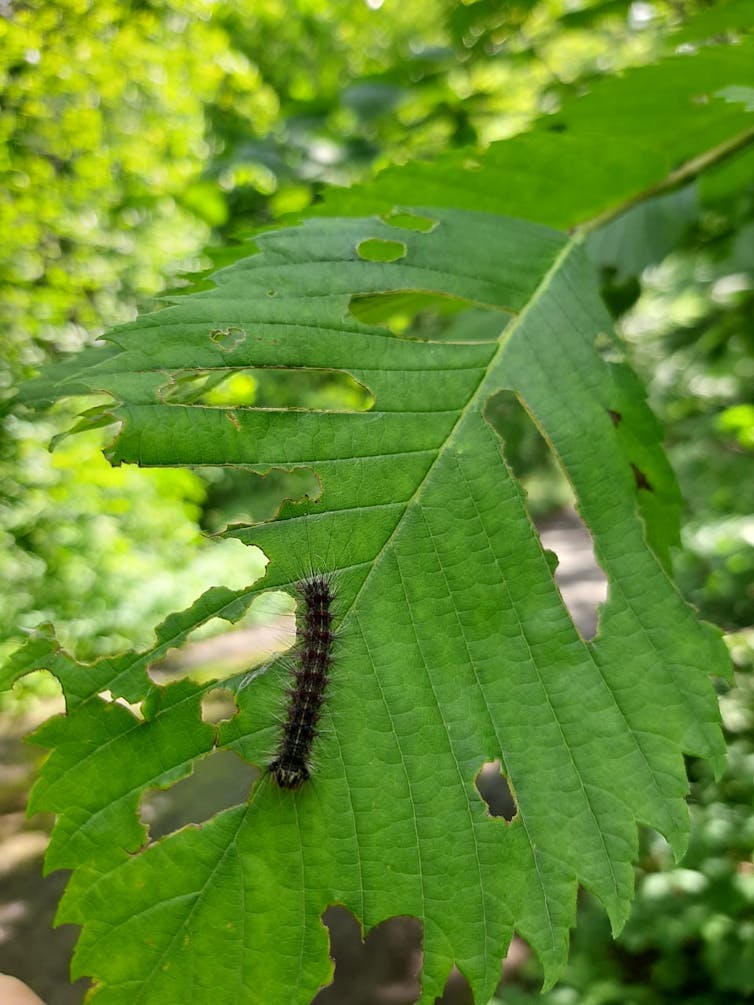
Last year, forests across southern Québec and Ontario and much of New England turned eerily leafless. The air hummed with the sound of munching mandibles and tree trunks were covered with a writhing carpet of caterpillars, while showers of caterpillar poop fell softly on the heads of unsuspecting hikers and campers.
The population of the European spongy moth, which had been gradually increasing since 2019, reached a dramatic peak in 2021 and completely vanished this year.
Insect outbreaks are one of the most important natural disturbances in Canadian forests. As a biologist who has been working on plant-insect interactions for over 20 years, I see that the frequency, intensity and range of insect outbreaks keeps changing. To protect trees in our forests and cities, we need tree diversity.
Insect Outbreaks
An insect outbreak can be frightening. In deserts around the world, vast swarms of locusts can blot out the sun for hours as they fly overhead. In the Rocky Mountains, hillsides are covered with dead trees, killed by the inner-bark-eating mountain pine beetle.
Such insect outbreaks are part of how temperate and boreal forests—as well as semi-arid grasslands and deserts—function. Insect outbreaks stimulate nutrient cycling, accelerate forest succession and can renew forests.
Female insects can produce hundreds of offspring and for the population to remain stable, only two of these need to survive. A small increase in survival, due to factors like favorable weather conditions, can lead to a population explosion and an outbreak.
In the case of the mountain pine beetle and the desert locust, warming temperatures, increased cyclone activity and other such effects of climate change are bringing these favorable conditions more frequently to new areas, thus dramatically increasing the extent of outbreaks.
However, these outbreaks always come to an end because of what ecologists call lagged-density dependent population dynamics. Here, density-dependent means that the insects’ mortality rate depends on the density of its population. As the population increases, mortality also increases and survival rate decreases. Meanwhile, lagged means there is a delay in this process—the insect mortality increases more slowly than population growth, causing an outbreak.
The outbreak crashes when the insect mortality eventually catches up with its population size. This usually happens due to a combination of factors including low food supply and increase in predators, parasitoids— insects that lay their eggs inside other insects—and diseases.
Where did the spongy moth go?
Students in my laboratory have been rearing spongy moth caterpillars for the past three years and have found that the mortality of these caterpillars gradually increased as the population grew.
In 2019, one student, Pamela Yataco Marquez reared over 300 caterpillars and observed an 80 per cent survival rate. However, this year, despite an extensive search, Marie-Eve Jarry, Geovana Demarchi and Victoria Yip were able to find and rear only 97 caterpillars and only six survived to adult.
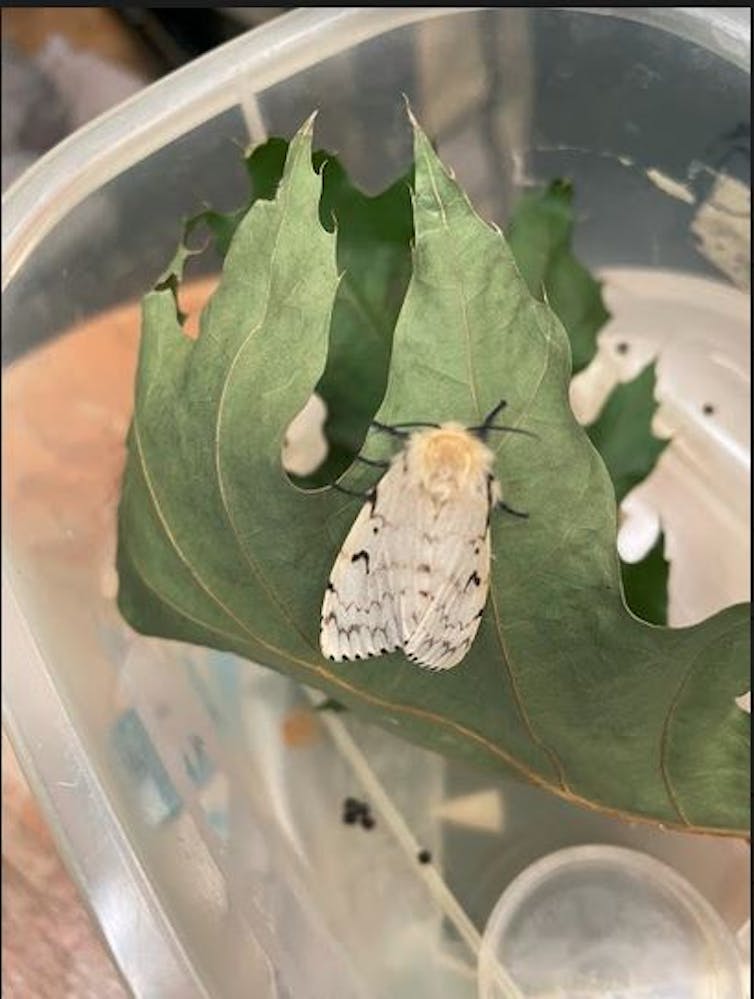
This freshly emerged lab-reared female spongy moth is one of the few survivors of 2022. (Victoria Yip), Author provided
Several mortality agents including a virus Lymantria dispar multiple nucleopolyhedrovirus, the fungal disease Entomophaga maimaiga and two tiny parasitoid wasps called Cotesia melanoscela and Ooencyrtus kuvanae finally caught up with the insect population.
When parasitoids eggs—laid inside either the eggs or the bodies of other insects—hatch, they devour their host from the inside and eventually emerge from the dead host, ready to start the life-cycle anew.
They are more like predators than parasites because they kill their host, and are efficient biocontrol agents that decrease pest insect populations.
While the spongy moth is native to Europe, it has been in eastern North America since the 1860s and is part of our fauna now.
It has not reached the western part of the continent yet and the best way to stop this is to inspect outdoor gear for caterpillars or egg masses before travelling and not to move firewood.
The current range of the spongy moth distribution in North America extends up to southern Canada. (Geovana Demarchi), Author provided
In the past 150 years, many of the European spongy moth’s natural enemies, including the fungal disease mentioned above and several parasitoids, have also been introduced, either inadvertently or deliberately. Our findings show that these natural enemies are well established in our region and have been effective in collapsing the outbreak.
Forest managers in Québec and Ontario are on the alert for increases in spongy moth outbreaks—including both more severe and longer duration outbreaks similar to those seen in the U.S.—and a possible northward shift of the distribution range.
Diverse forests
While a tree that is leafless in July may appear dead, many trees can survive a few years of defoliation, drawing on stored reserves to flush out new leaves.
The spongy moth outbreak in the Montréal area in the late 1970s slowed tree growth, but did not cause the widespread death of forest trees. However, tree mortality does occur further south in the U.S. and depends on the diversity of trees in the forest area. The death of tree species preferred by the caterpillar is lower in diverse forests that mix in less-vulnerable species.
Diverse forests are more resilient under various stresses than more homogeneous ones. We need to create and preserve such diverse forests to help prepare for new types of insect outbreaks in our changing world.
The Bank of Canada is once again raising interest rates. On Wednesday, the bank bumped its policy interest rate up 50 basis points to 3.75 per cent. This is the sixth consecutive hike since March, and the highest the rate has been since 2008. Canada’s major banks, including TD, RBC, and CIBC, are expected to follow suit, raising their prime lending rates by the same amount.
The increase will make it more expensive for Canadians to borrow money and pay off loans, including lines of credit, student loans, credit card payments, and mortgages.
Why are interest rates going up?
Inflation remains well above the bank’s target goal of two per cent. By raising interest rates, the bank is attempting to discourage Canadians from overspending, in turn lowering the inflation rate.
In June, inflation hit a 39-year high of 8.1 per cent. Since then, the rate has eased to 6.9 per cent, largely due to a fall in gas prices. But the bank’s governor, Tiff Macklem, says this isn’t enough.
“We have yet to see a generalized decline in price pressures,” he said, during a press conference. “The economy is still in excess demand. It’s overheated. Households and businesses want to buy more goods and services than the economy can produce, and this is driving prices up.”
Countries around the world are seeing similar inflation rates as they emerge from the COVID-19 pandemic. The global supply chain continues to be disrupted by COVID lockdowns in China and energy shortages caused by Russia’s attack on Ukraine. As a result, supply is diminished, which causes prices to rice.
“As economies slow and supply disruptions ease, global inflation is expected to come down,” the bank said in a statement.
How long will the rate hikes last?
The bank predicts that inflation will return to its target of two per cent by the end of 2024. But to make that happen, Macklem said that interest rates will need to increase further. “How much further will depend on how monetary policy is working to slow demand, how supply chains are resolving, and how inflation and inflation expectations are responding to this tightening cycle,” he said.
Macklem pointed out that the higher interest rates are already working. Demand has slowed in interest rate-sensitive parts of the economy, including housing and other big-ticket items, such as vehicles. He added that if current trends continue, future interest rate hikes may be smaller.
“We are getting closer, but we’re not there yet,” Macklem said.
What does this mean for mortgages?
Higher interest rates will put an added strain on mortgage holders, especially those paying off both a home and cottage mortgage.
“If you purchased [a fixed-rate mortgage] during the first part of COVID, or even just before COVID, you would have seen record-low interest rates,” said Robin Dillane, a mortgage broker with Haliburton Mortgage Services. “That’s fine until the mortgage comes due. Then it’s going to be really hard.”
Current fixed-rate mortgage holders could see their interest rates jump by two to three per cent when it’s time to renew, adding several hundred dollars to their monthly payments.
“During COVID, we were down to about 1.9 per cent on some fixed rates. Now you’re seeing percentages in the fives. And if they continue to raise, you’d probably see closer to the sixes,” Dillane said. “It’s going to make it hard for the average person.”
As for variable-rate mortgages holders, their monthly payments are already on the rise. Variable-rate payments fluctuate based on the bank’s interest rates. As rates continue to go up, there’s concern that variable-rate mortgage holders will pass their trigger rates. This is when interest rates have gone up so much that an individual’s monthly payments are only covering the interest and aren’t paying down any of the principal loan.
In August, RBC revealed that 80,000 of its customers were about to pass their trigger rates, adding an extra $200 to customers’ monthly payments.“Everybody’s is different, and you should be checking in your contracts for those trigger rates,” Dillane said.
Higher interest rates will also make it more difficult for people to pass the stress test to secure a mortgage. The stress test determines whether an individual will be able to pay their mortgage if interest rates increase. To qualify, they must show that they can pay the benchmark rate of 5.25 per cent or their lender’s rate plus two per cent, whichever’s higher. Since interest rates are up, it’s likely the lender’s rate will be higher. If the individual can’t afford mortgage payments at this rate, the bank won’t loan the money.
Dillane pointed out that there is a way around this. If the individual opts for a variable-rate mortgage, some banks will offer the loan at below their prime lending rate, making it easier to qualify. The only problem is that a variable-rate mortgage is much riskier as you can’t predict the monthly payments.
How do you prepare for interest rate hikes?
Fixed-rate mortgage holders worried about rising interest rates should calculate how much their monthly payments will go up at the time of renewal, based on current interest rates, Dillane said, then increase their monthly payments to that amount.
“The extra money that you’re putting on your mortgage, because you’re contracted at a low rate, goes directly off the principal, so when that mortgage is renewed, you actually have a lower principal amount,” she said. “If the rates are higher, you’re kind of buffering to still be able to afford that mortgage.”
By choosing to increase payments, it not only helps pay down the principal faster, but also gives the mortgage holder a sense of control over their budget, rather than having the increase forced on them, Dillane said.
While variable-rate mortgage holders can’t operate on the same predictability, they can adjust their payments. Work in round numbers, Dillane suggested. For instance, if the monthly payment is $1,125, round it up to $1,200. “You just built in an extra $75,” she said, “and you won’t even notice it over the course of the mortgage.”
Paying more up front may sound daunting, but according to Dillane: “It’ll reduce the amount of stress that you’re going to have when you have no option but to increase your payments.”
Most cottage renters love access to water and a breathtaking view. But there are many other key features and amenities that can help make your vacation home stand out to prospective guests and inspire new bookings.
Here’s what makes for a Vrbo Canada listing that gets renters’ attention.
A great location
If you have a waterfront property located in an in-demand area of cottage country, you’ll want to highlight that in the listing. But don’t forget to include other relevant location details like its proximity to town or if it’s near a region. Get detailed about the location.
Competitive rates
You’ll want to price your rental competitively, because cost is the most important deciding factor for many travelers. The best way to determine things like base rate pricing and discounts for your vacation home is to use Vrbo’s exclusive MarketMaker online tool. MarketMaker can give you the real-time information and valuable insights that you need for making pricing decisions, including supply-and-demand data, occupancy forecasts and even events happening in the area that might impact bookings.
Inspiring photos
For many renters, it’s the featured photo that will help them decide whether or not to click and learn more about a specific listing. Having a clear, well-lit shot that shows off your vacation home’s best feature—perhaps the cottage exterior, the lake views, or the saltwater pool—is key. Then, you’ll want to include at least 24 other high-resolution photos that showcase the interiors, exteriors, and top amenities. Be sure to declutter and tidy up before taking any photos, and wait for a sunny day for good natural lighting.
Premier Host Status
Premier Hosts on Vrbo consistently offer guests an exceptional experience, and their listings are prominently labelled on the search-results page for easy identification. In order to become a Premier Host, you have to achieve and maintain good review ratings, a high booking-acceptance rate, and a low cancellation rate.
Pools and hot tubs
When travelers are searching for the perfect vacation rental, many are using filters to narrow down the results. Beyond beach or lake access, many are seeking out properties with a pool or hot tub that they can enjoy during a getaway with family and friends. If your cottage has either amenity onsite, consider making it available to your guests and highlighting that information in the listing.
Nearby activities
On Vrbo, travelers can search for vacation homes near specific activities, including shopping, museums, fishing, tennis and rock climbing. The list is fairly comprehensive, and you may want to do some research to see what is now available in your area. If there may be new attractions and activities that would be of interest to prospective renters, you should include them in your listing details.
Pet friendly
According to a recent survey, 58% of Canadian households have at least one dog or cat. For travelers that want to bring their pet on vacation, a whole-home rental that not only allows pets but is pet-friendly would stand out. If you have pet toys or a dog bed available for use at your cottage, add it to your listing.
Looking to rent out your cottage or find the perfect rental this season? Partner with Vrbo to create the ultimate “together” experience.
By the time Hurricane Fiona struck the coast of Atlantic Canada, wind speeds were well above 100 km/h and the rain was pouring so hard you couldn’t see through it. As the storm moved north along the coast, touching down in PEI, Nova Scotia, Newfoundland, and sections of Eastern Quebec and New Brunswick, houses were flattened, trees were uprooted and toppled across roadways, ocean waves devoured the coastline, and lives were lost.
At an estimated $660 million in insured damage, Hurricane Fiona is the most expensive weather event to ever hit the east coast, and the tenth most expensive in Canadian history, according to the Insurance Bureau of Canada.
But a handful of cottagers in PEI and Nova Scotia aren’t included in this insured damage data. That’s because most Canadian insurance companies don’t cover damages caused by storm surge—when the ocean rises above its predicted level.
With the climate changing so quickly, the risk modeling needed to develop prices for coastal flood coverage is highly complex. Without accurate risk modeling, the risk is deemed too high to make the coverage affordable and available, the Insurance Bureau of Canada says.
This means that many of the Atlantic Canada cottagers whose properties were swept away by ocean waves will have to pay out of pocket to rebuild.
A Guelph-based insurance company is trying to change this. In 2015, after watching floods ravage properties in both Calgary and Toronto, Co-operators Insurance introduced its Comprehensive Water coverage.
“We saw that there was an unmet need, and we felt compelled to offer a flood coverage that was more comprehensive and available to all Canadians, regardless of their risk,” says Michelle Laidlaw, Co-operator’s assistant vice president of national product portfolio. “What we’ve seen is that incidents of extreme weather, like flooding, in our country have become more sudden, more frequent, and more severe. This is a cost to Canadians, and we expect this trend to continue as we face a climate crisis.”
Co-operators launched its Comprehensive Water coverage in Alberta in May 2015. It’s since introduced the coverage across the country, making it available to Atlantic Canada in 2018.
The company’s Comprehensive Water coverage protects against storm surge, waves and spray caused by a hurricane or storm, flooding from a natural or man-made body of water, such as a pond or river, flooding from heavy rainfall or snowmelt, sewage, and septic backups, and a rising water table.
It’s not an easy insurance product to provide, Laidlaw admits. With the climate crisis accelerating, the way the company calculates risk and premiums is always changing. “It’s a risk-based pricing model,” she says. “What that means is that some clients who are in higher-risk areas will have a higher cost. So, premiums are based on the client’s specific needs and the risks associated with their property.”
When calculating premiums, the company looks at a complex list of factors, including a property’s proximity to water, its flooding history, its elevation, soil type, and whether it has a loss prevention device, such as a sump pump. Premiums are specific to a customer, meaning someone in a high-risk zone could pay thousands of dollars a year, while someone in a low-risk zone could pay hundreds.
The insurance covers all types of properties, including cottages, regardless of whether the inhabitant owns or rents. According to Laidlaw, 60 per cent of Co-operators’ Atlantic Canada clients have purchased Comprehensive Water insurance. The company is the third largest insurer in Atlantic Canada, accounting for 11 per cent of the market share.
Co-operators’ claims team is on the ground in Atlantic Canada, working to provide support to its clients by processing claims as quickly as possible, including damage caused by storm surge.
“We continue to educate and promote this product in Atlantic Canada and across the nation. We are encouraging our clients to take this product and to be aware of their flood risks,” Laidlaw says. “We know it’s significantly changing the landscape of where Canadians choose to live.”
Related Story Insurance and gov. overlook P.E.I. cottagers affected by Hurricane Fiona
Related Story Hope for Wildlife helps birds caught in Hurricane Fiona
While the cottage real estate market was hot over the summer, literally and figuratively, it’s expected to cool down in the coming fall months, according to Re/Max’s 2022 Fall Real Estate Market Outlook. But you can still expect a strong market, says Rick Laferriere, a Re/Max sales representative based in Barrie, Ont.
What buyers and sellers can expect for the fall 2022 cottage real estate market
Based on his observations, Laferriere notes that there are many buyers, but not enough properties. He estimates there’s been a 30 per cent drop in the number of available properties compared to the summer.
This means that for those looking to sell their cottages, Laferriere says you’re in a strong position to do so. Besides, spring and fall are prime months for selling; while owners typically devote other months to preparing their cottages for sale or rent. He recommends sellers work with a local real estate company familiar with the area’s values and prices. “If you overprice something in today’s market, it won’t sell.” Even if you’re not ready to sell this year, Laferriere recommends owners take photos of their cottages now against the fall foliage, rather than waiting until the winter months when their lawns are covered in ice or snow.
In May, Re/Max forecasted average cabin and cottage prices in recreational markets would rise by 20 per cent for the remainder of the year. The report found around 40 per cent of Canadians living in recreational markets, such as the Kawarthas and Southern Georgian Bay, are drawn to its affordable pricing. But the recreational market in other parts of Ontario could look different depending on how high interest rates go. (The Bank of Canada has two more policy rate announcements left in 2022, one on October 26 and the last on December 7.)
The Muskoka cottage market is still hot, Peterborough cools off
There were two cottage-country areas of note in the fall Re/Max report: Muskoka remains an outlier and affordability has taken a hit in Peterborough. Muskoka region is still expected to experience a five per cent increase in average prices this fall. Over in Peterborough, interest rate hikes and mortgage stress tests may have finally put a damper on the market. The area is expected to see a seven per cent decrease in average sale price for residential and waterfront properties in the next few months.
Will cottage prices go down in Ontario?
If you’re in the market for a cottage, Laferriere says patience is key. With inventory low and prices high, it’ll take time to find a property that is in your price range and one that you actually like. According to Laferriere, a cottage on Lake Simcoe, Ont., costs an average of $1.9 million. “There hasn’t been much change in that price.” Even a waterfront condo in the Lake Simcoe area can cost an average of $790,000.
On the other hand, prices for cottages in areas with weeds or the water nearby is silty have dropped by about 20 per cent from the summer. “Don’t settle for something just because that’s what’s available on the market,” he adds.
Ultimately, the availability of properties can lead to major swings in the recreational market. Laferriere says availability can shift a buyer’s market to a seller’s market or a seller’s market to a buyer’s market.
Looking to keep tabs on the cottage country real estate market? Subscribe to our weekly enewsletter, The Key.
Sign up for our free enewsletter, The Key
Want more cottage real estate news? You’ll receive timely stories about buying, selling, and renting to help make your cottage dream a reality.