Categories
Cottage Life

Don’t do it for the ’gram: why wildlife photography can be dangerous

In the spring of 2019, Cheryl Feldstein was stuck in traffic along Highway 16, leading into Jasper National Park in Alberta. A male elk was standing at the side of the road. Cars pulled over, helter-skelter, while tourists clamoured to get an up-close photo with the beast. Too up-close, in many cases. This was a scene she’d witnessed before. As the former executive director for a wildlife rehabilitation facility, Feldstein has worked alongside community partners and the media to educate the public on the dangers of close-up photography—both for the animal and the human. It was discouraging to see that so many hadn’t received the message. 

One of the worst parts, she says, is knowing that often the people taking these photos love wildlife as much as she does. “I am sure we would be hard-pressed to find a single person doing this who wants to hurt an animal,” says Feldstein. 

The education that Feldstein and others are doing is important now more than ever. A survey conducted by the Nature Conservancy of Canada at the beginning of 2021 showed that an increasing number of individuals, because of the COVID-19 pandemic, are spending more time outside, and they have an increased desire to preserve and connect with nature.

What’s the big deal? 

Taking and sharing photos of wildlife is one way that people can forge that connection. And the fact that everyone has a cell phone at the ready changes the game. Now, wildlife photography isn’t just the purview of professionals. Natalie Robertson, a member of the North American Nature Photography Association Ethics Committee, has spent seven years taking pictures of animals in their habitat as a part-time professional photographer. She knows the risks associated with her work, but for many people, a split-second decision to snap a photo close to wildlife can have grim consequences. Any wild animal, no matter how docile it appears, can be unpredictable and can seriously harm a person. 

“You should never underestimate the fear reaction in these animals,” says Hope Swinimer, a wildlife rehabilitator and the star of Hope for Wildlife on the Cottage Life channel. “They do not want to be near you. They will try to escape.” Some animals may display warning signs—birds will puff up their feathers, or an elk might stomp its hooves. “When an animal tries to make itself bigger, that’s often an indicator that it is fearful and stressed,” she adds. “You may want to see how they’re exhibiting the behaviour, but they want you to back off and leave.” And some people are finding out the hard way—in 2020, a woman in Yellowstone National Park was gored by a bison after she came within three metres of the animal to take its photo. “Some species will feel that their only choice is to fight, others may take off,” says Swinimer.“There’s very few instances where turning your back on a wild animal is a good thing.”

Robertson knows some people will go to extensive lengths to get a good photo. She’s heard of photographers baiting animals, and she’s witnessed people trampling vegetation to get a better shot. Most of the time, these interactions end up being far more deadly for the animals. 

“By being in their territory, we pull them away from hunting, mating, or nesting,” says Swinimer. “It’s like if you were going through your work day, and the phone rang 30 times—you wouldn’t get your work done.” Aside from disrupting the tasks they need to do to survive, feeding wild animals or veering off trails into their habitat can have additional consequences. “Think of a walk in the woods as entering a mini biosphere,” she says. “There’s thousands of living things. You could disrupt the food supply or step on a nest or an underground habitat without knowing it. Every bit of intrusion can have a negative impact on the health of that particular little environment.”

Even less overtly bad behaviour can cause problems. “You might walk past a fox with their babies, stop to take a few pictures, and think nothing of it,” says Swinimer, “but when you leave, that fox may move those pups to another location because it felt threatened in that spot.” That’s a lot of work, energy, and disruption to the foxes’ life. On the East Coast, snowy owls that arrive when winter starts are emaciated, tired, and dehydrated from their journey. By approaching the bird for a photo or to look at it, it will expel its last bit of energy to flee from you, which could be the difference between life and death for that bird. On rare occasions, animals may even leave their family unit out of fear. Harbour seals have been known to abandon their young after seeing a person approach a pup, says Swinimer. And that still may not be the worst-case scenario. Wildlife can suffer from something called “capture myopathy.” Stress or fear can cause an animal to not get enough oxygen, which forces it to use energy stored in its muscles. This leads to a build-up of lactic acid that can go into the bloodstream and cause death instantly, or even weeks after an interaction. “We have to remind ourselves that we’re really big, and these animals are fearful for their lives,” says Swinimer.

There’s another risk of frequently interacting with wildlife—habituation over time. By coming closer to humans, an animal may be injured or killed by off-leash dogs or hit by cars. Many habituated animals, such as bears that come too close to people, are euthanized in order to prevent dangerous interactions.  “I do believe that certain wildlife are more capable of handling interaction,” says Swinimer. “I can walk by ducks, geese, and gulls, and I’m not stressing them. Some foxes are even used to people if they live around the city.” But what’s true for one animal may not be true for another: a city raccoon may react differently to you than a country raccoon. And even though you might be okay seeing them on your property, your neighbour may not be. That “never ends well for the wild animals,” says Swinimer. 

Why are we so drawn to animals?

The reason we find wildlife so compelling may be subconscious. An article in the Journal of Outdoor Recreation and Tourism published in 2017 revealed that nature enthusiasts report having the most memorable experiences when they see large and rare species in close proximity in their natural environment. It’s an emotional pull that sometimes overrides common sense. 

Beyond seeing animals in the wild, posting photos on social media has added another layer. In her research examining the psychology behind wildlife close-ups, Feldstein realized that people tend to take photos not just to connect with wildlife but to connect with each other. Her ideas correspond with findings published in Caitlin Evans’ Colorado State University PhD dissertation. Of 599 college students surveyed, a small portion were likely to post risky wildlife photos if their peers had liked similar pictures in the past. 

Educating the public about the dangers of such photos still plays a big role in getting the point across. And it can be done succinctly—one of Yellowstone National Park’s slogans is “Give them room, use your zoom.” 

But it’s not just ignorance, says Feldstein. People might see the dangers but still really want those photos. “Being close to wild animals, you get overwhelmed with emotions, and you’re in a state of wonderment. It is almost like you get the spark of a kid in you.” 

Where do we go from here?

Feldstein believes that parks and other areas can leverage social reinforcement through signage and other materials—though she admits it’s tricky. They need to provide clear information encouraging best practices without shaming people. “You don’t want to directly tell people they’re being jerks,” says Feldstein. But at the same time, she says, you want them to think about the effects of their behaviour. 

Sara Dubois, the chief scientific officer for the B.C. SPCA and a University of British Columbia adjunct professor in applied biology, agrees that beyond keeping a safe distance from wildlife, individuals can influence others on social media to only photograph using a zoom lens. 

“The longer the lens, the more you can give an animal space,” says Natalie Roberston. Phone cameras these days are good enough that you can zoom in, especially if you rest it on something stationary. Dubois also encourages people to share information about the dangers of habituation and stick to portraying wild animals in their natural habitats. 

“I do think it’s a combination. I think that people need social media feedback to tell them it’s wrong. But very few people will call out their friends and say: ‘Hey dude, that’s a bad idea,’ ” says Dubois. Some platforms, such as Instagram, are helping get the message out. “If a social media platform or a contest’s rules don’t let you upload the photo, maybe that’s a lesson learned.” (See “Social Media Takes a Stand,” below.)

Dubois also thinks that professional photographers and photo contests should emphasize the amount of space between themselves and the photo subject. “Often, it looks really close, but in fact, the image was taken with this type of lens or camera from this distance,” says Dubois. The  B.C. SPCA’s photo contest also bans photographers from baiting animals, tracking them, or posing with them. 

All of our experts agree that no photo is ever worth disrupting an animal or putting yourself in danger. “We, as photographers, whether professional or amateur, have the responsibility to respect wildlife,” says Robertson, “and we must put their welfare ahead of a photograph.” 

Caroline Barlott is a freelance writer from Edmonton, Alta. Her work has appeared in publications such as Discover, Canadian Geographic, and Edify.

Social media takes a stand

Instagram began discouraging irresponsible wildlife photography in 2017 after World Animal Protection pointed out that there had been a 292 per cent increase in users posting wildlife selfies on the platform since 2014. Now, if someone searches for or clicks on a hashtag like #wildlifeselfiea pop-up message in part says: “You are searching for a hashtag that may be associated with posts that encourage harmful behaviour to animals or the environment.” The platform also includes a page with more information about the importance of respecting nature and wild animals. World Animal Protection also has a “Wildlife Selfie Code” on their website, which helps direct people on when it’s safe to snap a photo.

Categories
Cottage Life

These are 2022’s worst roads in Ontario, according to CAA

Tighten those hubcaps, drivers! The Canadian Automobile Association (CAA) has released its 2022 list of Ontario’s worst roads, and there are a number of pot-hole-infested hot spots not far from cottage country.

Topping this year’s list is Hamilton’s Barton Street East. Residents nominated the road, which runs east-to-west through the northern section of the city, for its large potholes and severe cracking that causes the pavement to resemble alligator skin.

“Barton Street East has been on the list before,” says Teresa Di Felice, assistant vice president of government and community relations at CAA. “With no funding announcements being made and no immediate fixes to the problem, it went from fifth place in 2019 to third place in 2021 and now first place in 2022. As time goes on, the infrastructure gets worse.”

CAA’s Worst Roads campaign is run annually and is designed to bring critical road infrastructure to the attention of government officials. The goal is to make the roads safer, Di Felice says. Poor road conditions contribute to accidents. In the case of potholes, people often try to swerve around them, veering into other lanes, or damage their vehicles by hitting one.

Most roads on CAA’s list are overseen by municipalities, but Di Felice says the list is meant to attract the attention of all levels of government. Even if a road falls under municipal jurisdiction, it’s often the provincial and federal governments that can create funding programs for municipalities in need of road repairs.

Di Felice recalls the mayor of Timmins encouraging residents to vote in the Worst Road campaign because he needed funding to tackle critical road infrastructure within the city and wanted to highlight the project’s necessity to senior levels of government.

Residents can nominate a road through CAA’s website, detailing why it’s the worst road in Ontario. This can include issues such as traffic, poor signage, lack of sidewalks or bike lanes, or plain old potholes. The nominations are then voted on, whittling down the list.

Once CAA has a working list, the organization partners with the Ontario Road Builders’ Association, an advocacy group devoted to improving transportation infrastructure in Ontario, to assess whether the roads are as bad as residents’ say they are.

Last year, a Prince Edward County resident put signboards up along Victoria Road, encouraging people to vote for the road through CAA’s website. At the time, Victoria Road was a main thruway for tourists, riddling the road with potholes and cracks.

“[Victoria Road] actually ended up getting so many votes that it climbed to the top of the list,” Di Felice says. It has since managed to remove itself from 2022’s list.

Besides listing the top 10 worst roads in Ontario, CAA also uses its voting system to create a regional list, highlighting the worst roads in eight regions across the province. This year’s regional list includes a number of spots in cottage country, such as Laclie Street in Orillia, Barker Street in Prince Edward County, and Algonquin Boulevard East in Timmins.

This year, 182 municipalities had roads nominated. Drivers accounted for the majority of votes cast, followed by cyclists and pedestrians. Eighty per cent of voters cited potholes as the reason for selecting a road.

The Worst Road campaign has been running since 2003 and has helped sway a number of politicians to take action on poor road infrastructure. Last year, for instance, the mayor of Windsor committed $8.1 million in funding to the Lauzon Parkway, which was named on 2021’s regional list.

“It was a multi-million dollar project that needed to be done,” De Felice says, “and he announced that he was putting the money towards [the road] and that he wanted to see Lauzon off the list.”

Here’s this year’s list of the Top 10 worst roads in Ontario:

  1. Barton Street East, Hamilton
  2. Eglinton Avenue West, Toronto
  3. Barker Street, Prince Edward County
  4. County Road 49, Prince Edward County
  5. Carling Avenue, Ottawa
  6. Eglinton Avenue East, Toronto
  7. Lake Shore Boulevard East, Toronto
  8. Finch Avenue West, Toronto
  9. Bronson Avenue, Ottawa
  10. Queen Street, Kingston

Here are CAA’s worst Ontario roads by region:

  • Central— Laclie Street, Orillia
  • Eastern— Barker Street, Prince Edward County
  • Halton-Peel-York-Durham— Hurontario Street, Mississauga
  • Niagara— Brookfield Avenue, Niagara Falls
  • North— Algonquin Boulevard East, Timmins
  • Southwest— Plank Road, Sarnia
  • Western— Speedvale Avenue West, Guelph
  • Ottawa— Carling Avenue, Ottawa

Categories
Cottage Life

Summer date ideas for when you’re at the cottage

Everyone knows that cottage country is the perfect place for a getaway—cozy cabins, stunning lake views, peace and quiet. Whether you’re looking to plan a romantic day for you and your partner or searching for a first date idea, you’re in luck! There are countless options around cottage country for planning an intimate summer date, and we’ve narrowed down some of our favourite ways to spend quality time with the ones you love.

Go for a hike

Get outdoors and spend some time in the wild with your date. Hiking offers a great opportunity for conversation (and photo-ops). If it’s early in the relationship and you’re still getting to know one another, it’s a fun way to spend time opening up and learning about each other. To avoid awkward silences, playing a game like “never have I ever” or “two truths and a lie” can help you discover something new about your date and keep the mood light. And, if you’re starting to think about popping a certain question to a long-time partner, hiking trails and lookouts are some of the most romantic places to propose.

Taste-test some local brews 

Heading to a brewery to taste-test some cider or beer is a great date idea if you’re looking to cool down on a hot day. Plus, breweries can be some of the most stunning locations for sunny lunches or romantic strolls with your significant other. Going out for patio drinks or a tour is a fun excuse to get out of those cottage sweats and dress up. And, if wine is more your style, there are plenty of options for a boozy outing.

Visit a local farmer’s market or pick-your-own farm

Farmers’ markets and their selection of local produce are basically a cottager’s heaven. If you’re craving a day out, see what deals you can find on fresh foods by driving around to different markets. There are also many pick-your-own farms in and around cottage country to visit, which make great outings for a date in the summer. Even better, choose a recipe to make together and gather the ingredients locally while you’re out! 

Spend the night in

If staying in at the cottage for some alone time is what you’re after, plan to cook dinner or bake with your partner. Choose a recipe, gather local ingredients, throw on some tunes, and you’ve got yourself a date night! After dinner, light up the grill (or firepit) and treat yourselves to a decadent dessert. Spending time in the kitchen is a fun way to figure out whether you enjoy doing the simple things together, like sharing a meal. 

Have a picnic on the dock

Picnics are a classic choice for a summer date and can be as casual or romantic as you want. Just grab a few blankets, some cute decor, and your favourite snacks, and set up on the dock or the shoreline for a picture-perfect setting. Picnics are also easy to plan as a thoughtful surprise for your partner or as a memorable first date. Just make sure to keep it eco-friendly by choosing reusable options for containers and cutlery.

Take a sunset boat ride

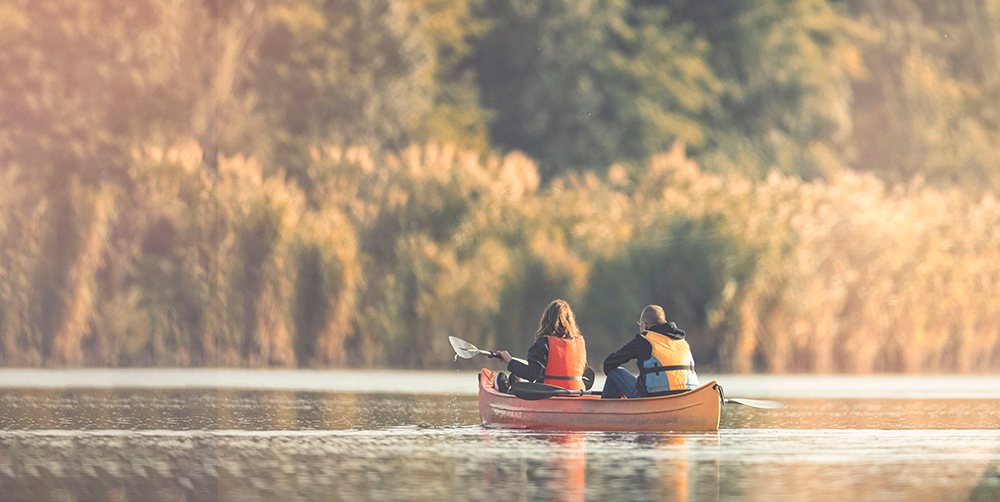
Whether you’re paddling out together in a canoe or taking the pontoon for a spin, watching the sunset on the lake makes for a date you won’t forget. Decorate the boat with some outdoor string lights or DIY mason jar lanterns, and make sure to pack some snacks. Choose a warm, clear summer night for the best views, and bring a camera to capture your favourite moments. 

Visit a drive-in theatre

If you’re up for a movie night, skip the indoor theatre and visit a drive-in instead. Drive-in theatres are an intimate yet casual setting for a date night, and there’s something about watching a movie under the stars that beats visiting a Cineplex. There are plenty of outdoor theatres across Ontario, and opting to go to a drive-in is a great way to support local businesses. Snacks, a cozy atmosphere, and quality time with your date—what more do you need? Just remember to bring your booster cables.

Categories
Cottage Life

How to build the perfect campfire at the cottage

Categories
Cottage Life

How to hang your hammock in the perfect napping spot

Categories
Cottage Life

How to paddle like a pro at the cottage

Categories
Cottage Life

Cottage Q&A: Protecting turtle nests

Our property has become a favourite egg-laying destination for turtles. Unfortunately, the eggs are being dug up and devoured as a midnight snack by raccoons. Is there anything I can do to protect the eggs and increase their chances of survival?—Dan Bedard, Big Rideau Lake, Ont.

There sure is! You can build a nest protector. The folks at the Ontario Turtle Conservation Centre recommend a simple 2-by-2-foot frame covered in mesh and staked to the ground. (If your DIY skills are worse than zero, you can also buy one ready-made from the OTCC.) You’ll need to include escape holes for the hatchlings—roughly one by two inches on all four sides of the frame.

The key is using the right mesh—the OTCC recommends hardware cloth. It lets in the right amount of light. Too much shade, and the cold temperatures that result can make the eggs infertile, says Sue Carstairs, the OTCC’s executive and medical director. “And that would defeat the purpose of protecting the nest.”

The hardest part of protecting a turtle nest is “knowing if you’re protecting the right area,” says Carstairs. Mama-to-be turtles are very choosy about where to dig and will sometimes make test holes. A female may start to dig (very…slowly…) then give up after a while; find another spot, dig a little, give up again; find a third spot, dig, give up. Then—plot twist!—come back to that spot and keep digging. Make up your mind, lady.

“It could take a whole day of observation,” says Carstairs. And it won’t be exciting. (Someone should probably replace the expression, “It’s like watching grass grow” with, “It’s like watching a turtle dig a hole.”)

Once Mom lays her eggs, covers them, and leaves, you can install the nest protector. Monitor it over the next several weeks, and remove any vegetation that could block the exit holes

Turtle eggs—they’re laid in June—typically hatch around August. “You’ll know,” says Carstairs. “There will be a little hole in the dirt.” If the summer comes to an end and no turtles have emerged, don’t dig up the nest. “People think, ‘Something’s wrong, we must rescue them,’ ” says Carstairs. But that’s a mistake. (It’s also illegal.) Some species overwinter in the nest and don’t come out until spring; the timing of turtle hatching is variable, says Carstairs. 

 Regardless of when the babies enter the world, “it is legal to help them to the nearest water body,” says Carstairs. If Mother Turtle chose her nest correctly, that should be somewhere marshy, not a rushing river. 

Place the hatchlings in a Tupperware container and carry them to the water. Your work is done. No, really, it’s done—no matter how badly you want to take these wee babies to a turtle rescue centre. That would be interfering. And it’s not necessary. “They have to be babies at some point,” says Carstairs. For more info on protecting turtle nests, and tips on how to make your property turtle-friendly, visit ontarioturtle.ca.

Got a question for Cottage Q&A? Send it to answers@cottagelife.com.

This article was originally published in the June/July 2022 issue of Cottage Life magazine.

Categories
Cottage Life

Avian flu showing up in mammals

After several skunks and foxes were found sick in the Medicine River area, Alberta wildlife specialists were stumped. The animals were all experiencing blindness, seizures, and cloudy eyes. Eventually, three foxes died. Alberta Fish and Wildlife later confirmed with lab tests that five skunks had the avian flu.

“The avian flu here in Alberta hit everybody suddenly and there’s still an awful lot of unanswered questions,” says Carol Kelly, wildlife rehabilitator and executive director at the Medicine River Wildlife Centre in Spruce View, Alberta. “Animals and birds that scavenge dead birds can contract it.”

Two of the five sick foxes did eventually recover and were released, Kelly says. “The difference that we know so far is that mammals can recover from it and they do not pass it on the way birds do,” Kelly says.

The contagious strain of the avian influenza virus has been spreading across the country, affecting wild animals and farm poultry alike. The highly pathogenic avian influenza (HPAI) virus is widespread, even affecting birds and wild animals in PEI.

“This isn’t the first time that we’ve had HPAI or avian influenza in Canada,” reassures Thom Luloff, senior wildlife biologist at the Kawartha Wildlife Centre and conservation biology professor at Fleming College. Luloff primarily teaches vertebrate biology and animals disease and pathology. “We’ve had avian influenza since 2005.”

How to keep birds (and yourself safe from avian flu)

“We’re more interested in diseases now because we’re coming out of a pandemic,” the biologist adds.

The Canadian Food Inspection Agency and stakeholders, like concerned poultry farmers, developed a “robust and effective” avian influenza strategy plan years ago, Luloff explains, referencing the pathogenic strain of the influenza virus from 2014/2015. “This isn’t the first time we’ve done this.”

Avian influenza, or bird flu, is most often found in waterfowl like ducks, geese and other shorebirds, Luloff says. Certain strains of the virus—like this year’s—can spread to poultry like chickens and turkeys. In early May, the Chicken Farmers of Canada reported the virus in nine provinces across Canada.

At the time of the interview, Luloff says the risk is “really for domesticated birds,” as there have not yet been any major mass mortality events in the wild.

“Wild ducks are known to be the principal reservoir for the global gene pool of all influenza avian viruses,” Luloff says. He reiterates that we should not feed ducks bread, or any wild animals anything at all. “We shouldn’t even be in contact with them,” he says. “They need to do what they need to do.”

“When we’re purposely making a connection [with wildlife],” he adds, “that is a problem. That breaks that separation that is supposed to exist between wild animals and anything that is domestic,” Luloff says, humans included. “It’s our pets, it’s our poultry—it’s us.”

We now know that the avian flu can affect foxes, which are canines, or dogs, but we haven’t seen it move into other species yet, Luloff says. “If we continue to keep our distance, that’s not something to be concerned about.” The more we interact, “the more likely something is to happen,” he says.

“If you have birds that have any contact with outside,” Luloff says, “you want to be very careful because these birds are highly vulnerable to infection and death.”

“You can’t do anything once they’re sick,” he adds. Birds with the highly transmissible virus sicken quickly and die quickly. “It’s always a good idea to be careful and clean with your feeders and your birdbaths in general,” Kelly says. Diseases can spread easily if feeders are not cleaned well or often, she adds.

According to Environment and Climate Change Canada, the use of bird feeders is still safe on properties without domestic poultry. Birds Canada recommends regularly cleaning feeders, if you have them.

For now, Luloff recommends taking down feeders altogether, encouraging people to maintain a safe separation between domestic and wild life. “Prevention is the absolute best way to minimize issues with avian influenza,” Luloff says. “Let’s just enjoy the beauty of nature. Let wildlife do their wild thing.” For personal safety, Kelly advises hand washing and avoiding touching the face after handling any animal.

Birds affected by avian flu will have symptoms such as “unexplained emaciation”, head-twitching, poor balance, and weakness, Kelly says. If you encounter any birds exhibiting similar symptoms, she advises calling a professional. “Let’s appreciate wildlife and keep it wild,” Luloff says. “That is better for everybody.”

Bird feeders causing illness in birds in the Pacific Northwest

Categories
Cottage Life

Secluded Ontario cottage rentals perfect for a summer getaway

With schools on the brink of letting out for the summer, it’s about to get a whole lot busier. If you’re looking for a place to retreat to, far from the throngs of people in the urban areas, we’ve curated a list of secluded Ontario cottage rentals where you can host a private family or friend getaway.

One cottage rental in Muskoka has its own outdoor sauna with stunning lake views, or if you’d really like to go off-the-grid, there’s a rental on a nine-acre island near Lake of the Woods. If life’s speeding up a little too quickly for you, book your secluded summer getaway now.

If you’re looking to book a vacation rental visit our hub by clicking here. We’ve partnered with VRBO to help you find your perfect cottage getaway.

Perched on High Lake in Muskoka, this newly renovated cottage is a short trek to nearby hiking trails and a small waterfall, Dee Bank Falls. This is the ideal getaway if you’re having a family or friend get together and want some privacy. Unwind in front of the fire pit with a clear view of the water or relax in the outdoor sauna.

Location: Huntsville, Ont.

Price: Averages $1,099 per night

Sleeps: 14

Bedrooms: 5

Notes:

  • Waterfront property
  • Outdoor sauna
  • Laundry on site
  • Outdoor fire pit
  • Kayak available for use

Click here to book


Rent a nine-acre private island on Shoal Lake near Lake of the Woods. The cottage boasts 3,000 sq. ft. of living space and includes a timber frame pergola with an outdoor fireplace. Note: between June 30 and September 1, you’re required to book a minimum seven-day stay with check-in and checkout both happening on a Friday.

Location: Kenora, Ont.

Price: Averages $788 per night

Sleeps: 12

Bedrooms: 4

Notes:

  • Private island
  • Internet included
  • Laundry on site
  • BBQ available for use
  • Outdoor fire pit
  • Private hiking trail around island
  • Kayaks and canoe available for use
  • Pets welcome
  • Minimum seven-day reservation

Click here to book


Fall asleep to the gentle sound of waves lapping against the cottage during your stay in this decked-out boathouse. The main cottage sits above the boathouse, but there are bunks inside the boathouse and an extra guest cabin nearby that can be rented at an additional cost. And did we mention it has its own private four-acre island!

Location: Kenora, Ont.

Price: Averages $401 per night*

Sleeps: 10

Bedrooms: 4

Notes:

  • Private island
  • Internet included
  • Laundry on site
  • Kayak and canoe available for use
  • Must bring or rent your own boat to get to the island
  • *Price varies depending on if it’s a weekday or weekend

Click here to book


Close to the borders of both Manitoba and Minnesota, this secluded cottage sits on the tip of an island near Lake of the Woods. Spend your days suntanning on the property’s beach or swimming off the dock.

Location: Nestor Falls, Ont.

Price: Averages $440 per night

Sleeps: 10

Bedrooms: 3

Notes:

  • Island property
  • Outdoor fire pit
  • Pets welcome

Click here to book


Categories
Cottage Life

Work gloves review: our 5 expert-approved picks

Our editorial team independently selects these products. If you choose to buy any, we may earn a commission that helps fund our content. Learn more.

Before you grab any old pair of cotton work or gardening gloves and launch into your spring checklist, take a stroll through your local hardware store. You’ll find superior hand protection in a variety of technical fabrics, specialized coatings, and form-fitting designs. What you may not find, especially if you have smaller hands, are gloves in your size. As a woman who renovates, I often have to buy online or ask the store to order my size. In general, choose a specialized glove that is geared to the hazards you’ll encounter.

This article was originally published in the May 2022 issue of Cottage Life magazine.