TekSavvy’s fibre internet service is now available to all homes and businesses in Thamesville, Ontario.
The internet service provider (ISP) first launched its service in the town last August. An announcement Monday adds 530 homes and businesses to that list, completing its fibre-to-the-home network in Thamesville.
“High-speed fibre internet service is a game-changer for Thamesville,” Charlie Burns, TekSavvy’s chief technology officer, said. “We’re proud to deliver the connectivity that will make a difference to the community.”
It’s part of the company’s ongoing plan to provide residents in the Chatham-Kent community with affordable internet access.
The network offers internet speeds of up to 1Gbps per second and comes with unlimited bandwidth. The announcement comes months after the company’s original completion date of late October.
Customers who sign up for Fibre 1000 Unlimited package for 24 months will receive $20 in bill credit for the first 12 months of their contract. More information is available on their website.
Spotify officially launched a new TikTok-like music discovery feed in its app.
Dubbed ‘Discover,’ the feed rolled out in a limited beta test to Android and iOS users in Canada and other regions, including Australia, Ireland, New Zealand, and the U.K. Unfortunately, at the time of writing, I didn’t have access to the new ‘Discover’ feature on either platform.
Users in the test can access the tool by tapping the new ‘Discover’ icon in the navigation bar (look for a new, fourth icon between the ‘Home’ and ‘Search’ buttons). Discover then shows a customized feed using Spotify’s ‘Canvas’ visual loops and plays a corresponding tune.
Those who like what they hear can follow the artist, add the song to a playlist, or share it on socials. The feed scrolls vertically, like TikTok — users can quickly move on to the next song if they don’t like what they hear.
Interestingly, Spotify will only offer up to 15 new recommendations per day, so those who use the feature won’t find themselves scrolling for long.
You can learn more about the Discover beta on Spotify’s blog here.
Researchers from Western University in London, Ontario, are testing drones paired with Bell’s wireless 5G connectivity to perform extensive commercial and non-commercial activities.
Led by Western University’s Faculty of Science industry-expert-in-residence and computer sciences professor Anwar Haque, the research aims to make drone usage a staple when it comes to tackling real-world problems like “hazardous space exploration, remote infrastructure inspection, cargo shipping, long-distance delivery, and home security.”
“It’s no longer a question of whether drones are the future,” said Haque. “Drones are the present and they are here to stay as part of our smart digital society.”
The idea of using drones for potentially hazardous tasks isn’t all that new. Drone Delivery Canada has been testing transporting dangerous goods for a while and has partnered with DSV Canada recently to establish a route to transport said goods within the DSV Air & Sea intra-site space in Milton, Ontario.
“Western [University] purchases drone bases and other parts from private companies and then assembles them from scratch so they can customize automation,” said a university spokesperson.
The drones are able to explore environments that would otherwise be potentially hazardous or unreachable to humans.
Additionally, according to Western, the drones aren’t controlled by a base station, and instead are pre-programmed and use sensors and AI (Artificial Intelligence) to gauge its surroundings.
“Our prototype has the capability to navigate through a previously unknown environment collision-free and return home to the user. This provides users with the foundation for safe means of data collection,” said Haque.
Western also has different drone prototypes for different kinds of environments. For example, the drone can be used for infrastructure inspection with an attached LiDAR sensor to track the infrastructure and avoid obstacles. AI also helps with image analysis to detect any damage or wear and tear in said infrastructure, making the job easier and cheaper than humans having to do it.
“Drone reliability is actually superior in terms of the accuracy of the data gathered during automated inspection,” said Haque. “There are also reduced costs when you consider staffing hours compared to manual inspection.”
Similar to Drone Delivery Canada’s operation, Western’s research also aims to tackle long-distance deliveries of medical equipment and necessities to remote locations using customized drones. However, current battery and charging constraints make it difficult for deliveries to take place with a single drone or within an acceptable time frame.
Haque and Master of Science (MSc) student Muhammad Zakar are trying to find a workaround to the limitations by using a three-part delivery system with different drones undertaking different segments of the delivery route. According to Western, the drones communicate with each other to confirm availability and coordinate handoffs. “This method ensures drones are available at the appropriate time for their segment of the delivery.”
The last aspect Haque and his team are researching is home security, an operation that drones aren’t necessarily associated with. MSc student Marlin Manka is assisting Haque with the operation, which will see mini-drones scanning key-interest areas in a house when it is unoccupied. The drones are pre-programmed to ignore friendly disturbances like household pets and other moving objects, like robo-vacuum cleaners.
“While the drone-based anytime-anywhere service industry is growing exponentially and getting hugely popular in both residential and business markets; the safety, security, and privacy aspects of these drone services should not be overlooked and must be carefully investigated for a sustainable drone future,” said Haque.
All Haque needs now are a couple of laser beams attached to the drones that can vaporize any intruder, and I’ll be down to test them out in my house.
Do I love working out? No. But I like it enough to attempt to get myself moving a couple of times a week. My biggest barrier is putting myself in a space where working out is easy.
I like to work out alone, ideally in a space where no one else is present. So while working out at a gym by myself is okay, it’s not ideal. Plus, getting dressed, travelling to the gym, and getting ready for the workout gives me plenty of opportunities to talk myself out of it. If that fails, I can always rely on my phobia of gym showers to do the trick.
My point is that I like working out at home, and I think I’ve successfully set myself up with the tools to make it happen.
When the opportunity to challenge this routine came up, I couldn’t help but try it.
A quick analysis ticked all my boxes: the device would allow me to work out at home, seemed to have minimal setup, and focused on strength training, an area I feel can be challenging to complete at home.
The setup
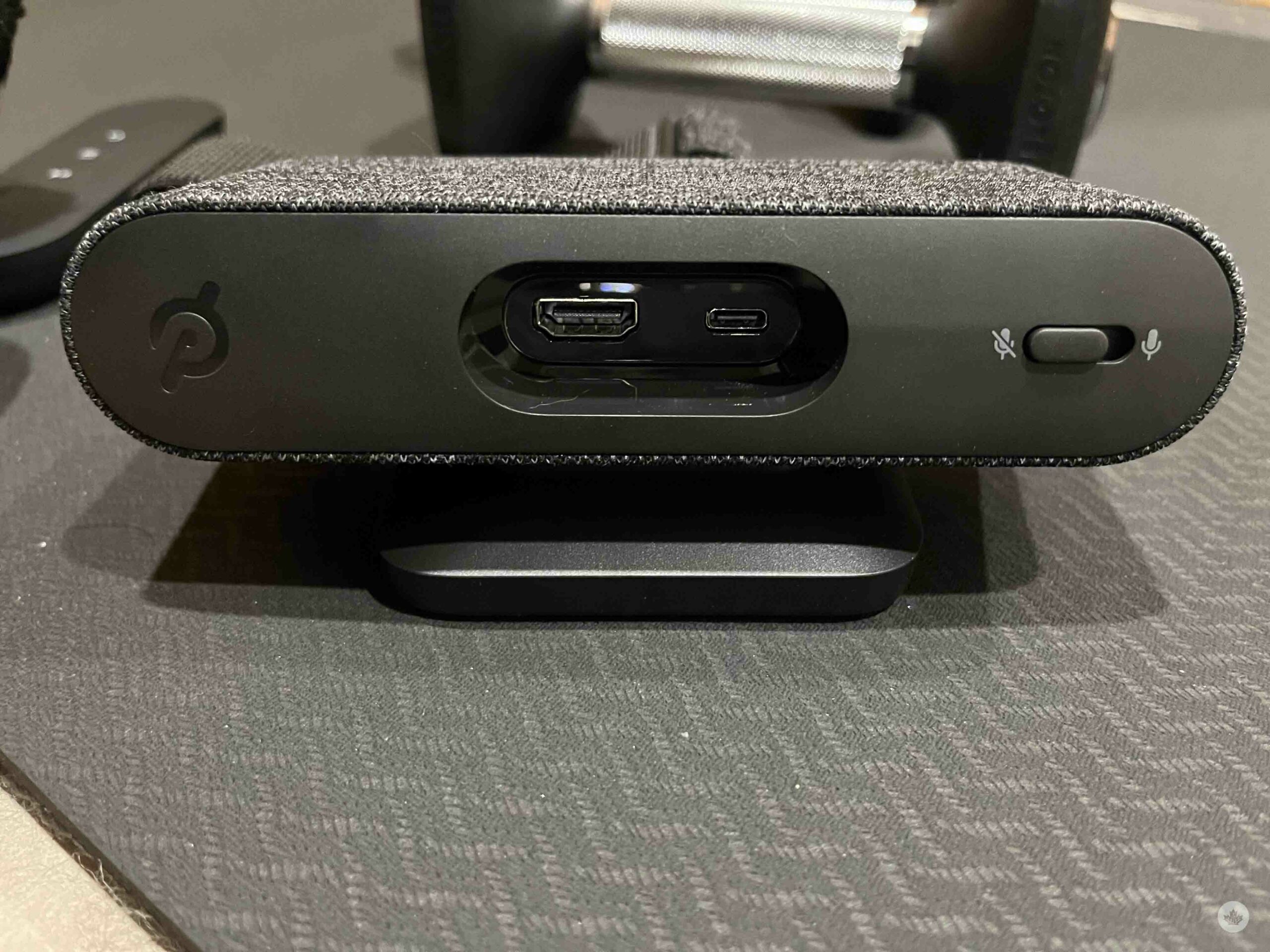
I don’t think I’ve unboxed anything as luxurious looking as the Guide. It comes in a sleek black box with all equipment placed neatly in its compartments. The device is six and a half inches wide, about two inches tall and is covered in a dark grey fabric that carries the luxurious feel of the packaging.
The camera has a 4K resolution, a 30 frame ratio, and a 12MP camera sensor.
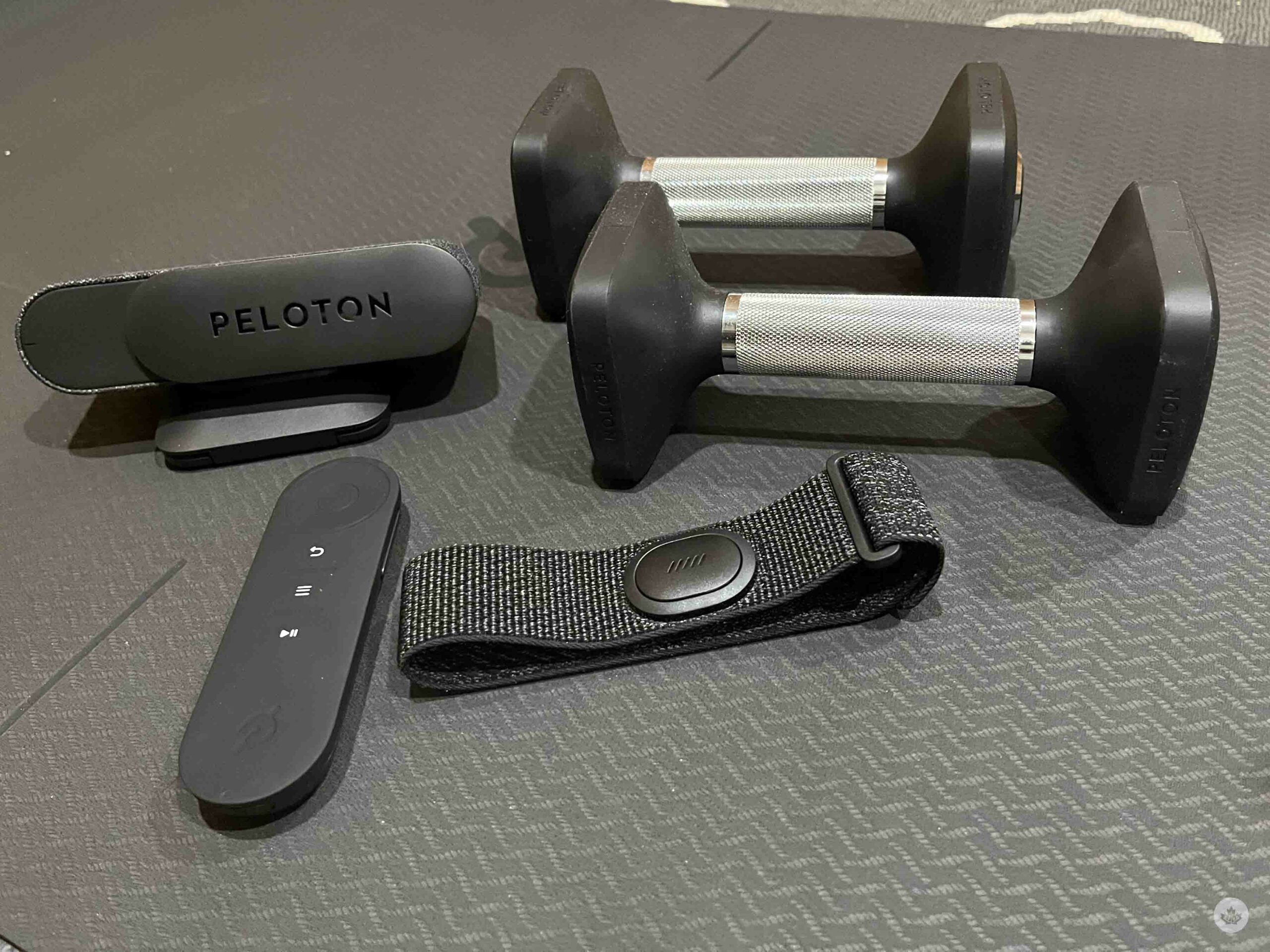
Setting up involves connecting the Guide to its mount (if you want to perch it on top of a TV), connecting the device with the TV through HDMI, plugging the battery in, and adding batteries to the provided remote.
The remote helps you set up the Guide once connected to the TV.
There’s a little on/off switch in the back. The Guide has a built-in microphone and webcam, which tracks your movements as you exercise. There’s a sliding flap that allows you to cover the camera. A rep from Peloton told me the camera and microphone are only on when you’re partaking in a class. The sliding flap is there to ease anyone uncomfortable leaving an uncovered camera in their living room.
There’s no similar piece of mind offered for the microphone. The only thing you can do is turn the Guide off completely. I personally disconnected the Guide when I finished my workout.
After that, I paid for a membership and made a profile. I added my name, location, and other personal details such as height and weight to get an accurate reading on the Guide (more on that below).
Peloton released a heartrate band with the Guide that’s purchased separately.
The workout
Once in, I’m greeted with a screen showing me many options. Towards the top is an avatar called ‘Body Activity.’ It’s essentially a breakdown of what muscle groups I worked out during the week, how many classes I took, and the total calories burned.
You can select a class based on the type of training you want to complete and the instructor you want to teach it. Once you’ve made the selections, it’s time for the Guide to shine.
I appeared alongside the trainer, showing me how I was doing. Users have several options on how they want to appear on the screen, including minimizing the window showing their movements.
As I worked out, a little transparent icon appeared on the screen that filled with a light blue tint as I moved. Called the Sweat Tracker, it tracked how I completed each exercise. The goal is to fill up the icon entirely and earn credit. As I learned, it doesn’t track how accurately I’m doing an exercise but whether I’m doing all the reps. If you don’t earn credit, you can do the exercise again.
I liked the Sweat Tracker because it made me give my all during the workout. The badges on my profile served as a virtual pat on the back for completing the workout.
The Guide also tracked the number of calories I burned based on some of the personal information entered in the profile section.
The Guide is voice-activated, and I can skip to a different section of the workout by saying “Okay Peloton” to wake the Guide up. I found this helpful as I didn’t have to stop my workout when I wanted to restart an exercise.
Alternatively, you can use the remote if you want to change things manually.
The heart rate band was placed on my forearm and tracked my heart rate. Several tiny slivers on the device lit up in accordance with my heart rate. You can also review how your heart did over completed classes.
The negatives
When I’m working out at home, I like to follow training programs on YouTube or apps that are free to download. The Guide does the same thing, but it’ll cost me hundreds of dollars. You also have to buy the heart rate band separately, alongside dumbbells if you don’t already own them, which adds to the total cost.
The only thing that makes the Guide stand out to me is the ability to track how I complete an exercise, which is a great way to hold myself accountable. However, I don’t require tracking to know if I’m giving a workout my all.
By itself, the Guide costs $395. The ‘Guide Strenght Starter’ costs $695 and also comes with three pairs of weights. A third option, the ‘Guide Power’ comes with three additional sets of dumbbells and the heart rate band. You can purchase it on Peloton’s website.
I heard about Oxio for the first time earlier this year while listening to a podcast.
The pitch didn’t quite grab my attention at first — I like to listen to podcasts while gaming, and I likely tuned out for the first few times the ad played. Eventually, I clued in that Oxio was an internet company. Specifically, an internet company in Canada and, after looking it up online, one that offered services in my area.
The first thing you see when landing on Oxio’s website is a bold claim: it’s supposedly “the first internet provider you will actually like.” The company also promises no “telco bullshit,” including contracts, unreadable fine print, and “shifty pricing.”
Interestingly, the website also says those looking for the cheapest internet won’t find it with Oxio. However, the plans on offer in my area were still more affordable than comparable plans from other providers.
Needless to say, I was intrigued. Plus, if I used a referral code from the podcast, I could get my first month free. So, I gave it a try.
Easy switch, smooth sailing
Switching to Oxio was a surprisingly smooth process, although that’s likely because of where I was coming from. I’ve used TekSavvy at my apartment for years, and kudos to them for being excellent and reliable the whole time. Still, getting twice the speed for a few dollars less per month from Oxio was hard to turn down.
I live in Whitby, Ontario, and where my apartment is, both TekSavvy and Oxio run off of the Rogers network, so I already had a line into my home. As an aside, I find this incredibly funny since every time I’ve tried to check Rogers’ website for internet prices at my address, the site tells me Rogers doesn’t serve my building.
It’s worth noting that Oxio serves other provinces too. According to the company’s status page, it runs on the Vidéotron network in Quebec and on Shaw in B.C. Oxio offers services beyond internet too, but only in Quebec.
Anyway, a Rogers tech came to check the line before I could set up my Oxio modem and Wi-Fi router. My one gripe here was that I wish Oxio had mentioned to expect a Rogers tech. In hindsight, it makes sense, but at the time I almost ignored the tech’s call because the caller ID showed Rogers and I wasn’t interested in talking to some salesperson at the time. Regardless, the tech was super nice and was in and out in about 15 minutes.
Plug and play
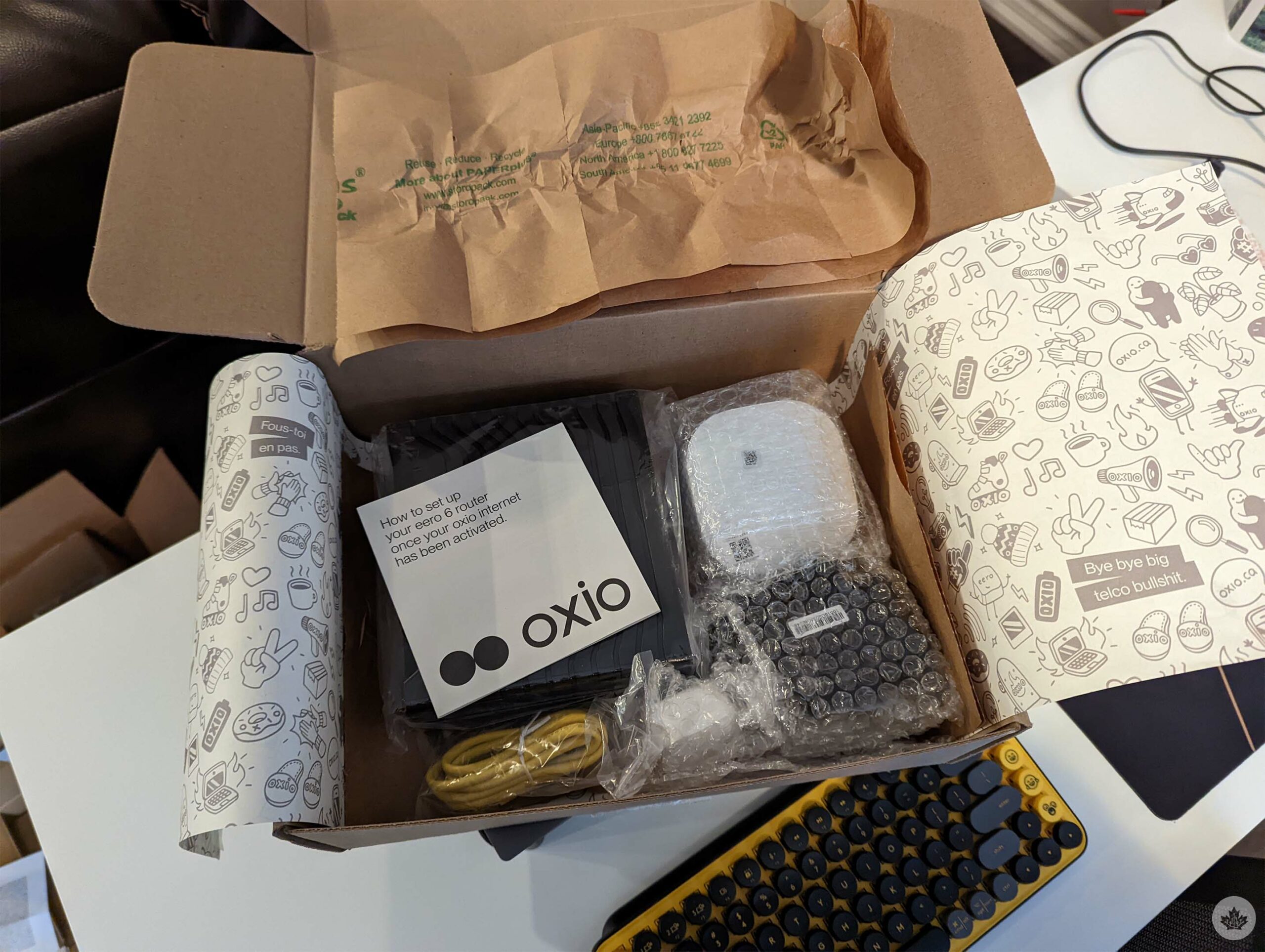
Once the tech was gone, I dug into the package Oxio had sent me with my modem and router. It also had the lovely wrapping paper, some cool stickers, plus a card detailing how Amélie from Quebec-based non-profit Groupe TAQ packed my order. Groupe TAQ helps encourage the socio-professional integration of over 350 people who live with functional limitations.
Oxio includes a free modem and Eero 6 router, and the set-up process was fairly simple. First, I plugged in the modem. Then I plugged the router into the modem. Then, I had faster Wi-Fi.
I ended up sticking with the Asus router I was using before since reviews indicate it has better performance than the Eero 6. While I skipped the router set-up steps, Oxio includes fairly detailed instructions on setting up the Eero 6 and getting started, along with several ways to contact Oxio support if you need help. Ultimately, I think most people will be fine doing the self-install.
It’s been about two weeks since I got my Oxio internet up and running, and I haven’t experienced any issues so far. Granted, I didn’t expect to given that the service runs on the same Rogers line I’ve used without issue for years.
Regardless, going from 150Mbps to 300Mbps was a welcome speed bump, and getting it without paying a higher monthly cost was even better. Naturally, I’ll be paying close attention to the speed and quality of the service going forward, but I have no complaints now.
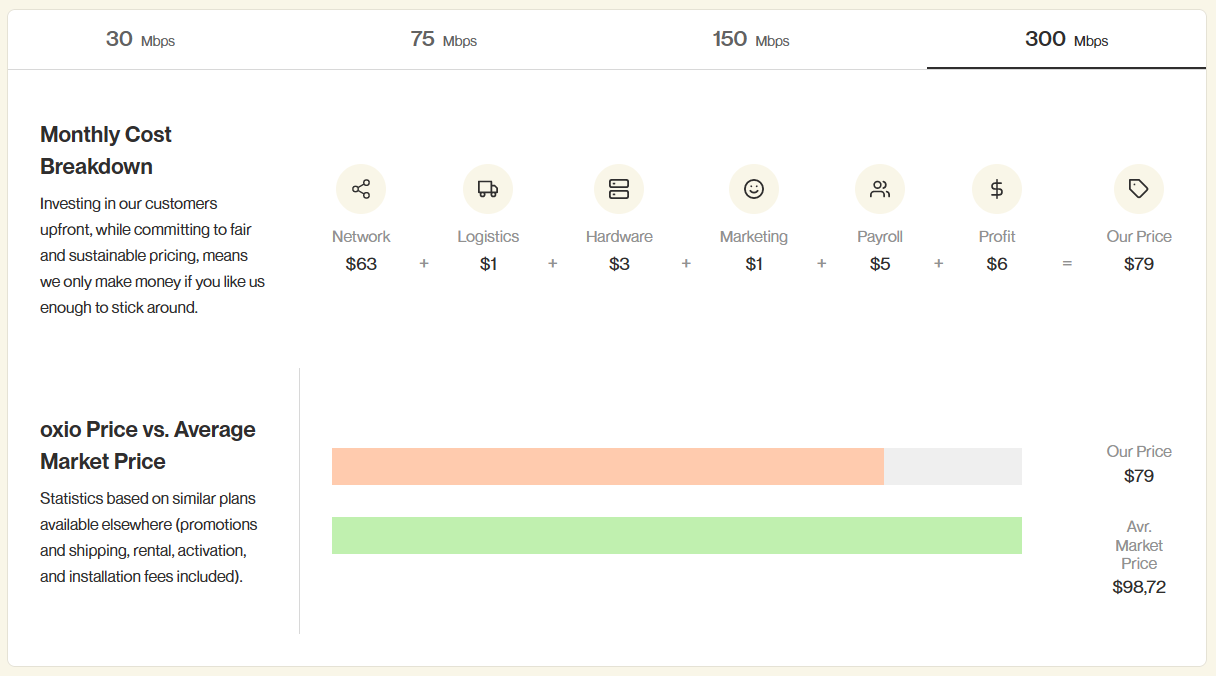
Finally, I thought it was worth highlighting Oxio’s transparency. The company displays a detailed breakdown of pricing on its website, and its blog offers deeper dives on things like employee salaries. It’s an interesting peek behind the curtain and, in my opinion, worth the read if you care about internet service provider transparency.
Every week, MobileSyrup outlines some of the most notable movies and TV shows that recently hit Canadian streaming platforms.
Our ‘Streaming in Canada’ column typically focuses on new content from Amazon Prime Video, Crave and Netflix, but other services like Apple TV+ and Disney+ will be mentioned when relevant. Premium video on demand (PVOD) platforms are also fair game as movies continue to come to digital early amid the COVID-19 pandemic.
Finally, we’ll highlight shows or movies that are made by Canadian companies, involve notable Canadian cast or crew and/or are filmed in Canada.
Amazon Prime Video
All The Old Knives [Amazon Original]
A veteran CIA operative is brought in to root out a mole with his old lover and colleague.
All The Old Lives was directed by Janus Metz Pederson (Borg vs McEnroe) and stars Chris Pine (Star Trek), Thandiwe Newton (Westworld), Laurence Fishburne (The Matrix) and Jonathan Pryce (The Two Popes).
Amazon Prime Video premiere date: April 8th, 2022 Genre: Thriller Runtime: 1 hour, 41 minutes
Based on Arthurian legend, The Green Knight follows Gawain, nephew of King Arthur, as he goes on a journey to confront the fearsome Green Knight.
The Green Knight was written and directed by David Lowery (A Ghost Story) and stars Dev Patel (Slumdog Millionaire), Alicia Vikander (The Danish Girl), Joel Edgerton (Loving) and Sarita Choudhury (Mississippi Masala).
Original theatrical release date: July 30th, 2021
Amazon Prime Video premiere date: April 7th, 2022 Genre: Medieval fantasy Runtime: 2 hours, 10 minutes
Apple TV+ has an exclusive agreement with MLB to stream two exclusive baseball games on Friday nights during the new season.
This begins on April 8th with the New York Mets vs. the Washington Nationals at 7pm ET and the Houston Astros vs. the Los Angeles Angels at 9:30pm ET. On top of live games like these, Apple TV+ will offer 24/7 livestreams with replays, news and analysis, highlights, classic games and more.
The initial schedule can be found here. Note that the only Toronto Blue Jays game there is May 27th at 9:30pm ET against the Angels.
These MLB games will be free through the Apple TV app for a limited time before an Apple TV+ subscription is required, although a specific date for that shift has not yet been confirmed.
Pinecone and Pony [Apple Original]
Based on Toronto writer Kate Beaton’s The Princess and the Pony, Pinecone & Pony follows a young girl named Pinecone who teams up with her friend Pony to learn how to become a warrior.
It’s worth noting that Toronto-based First Generation Films worked on the series alongside Dreamworks Animation.
Apple TV+ Canada premiere date: April 8th, 2022 Genre: Animated Runtime: Eight episodes (23 minutes each)
In the late 1990s, American journalist Jake Adelstein travels to Japan to work at a major newspaper, where he begins to investigate the dangerous world of the yakuza.
Based on Jake Adelstein’s 2009 memoir of the same name, Tokyo Vice was created by J. T. Rogers (Oslo) and stars Ansel Elgort (West Side Story), Ken Watanabe (The Last Samurai) and Rachel Keller (Legion).
Crave premiere date: April 7th, 2022 (first three episodes, two new episodes every Thursday, then finale on April 28th) Genre: Crime drama Runtime: Eight episodes (around one hour each)
Stream Tokyo Vice here.
Tony Hawk: Until the Wheels Fall Off
Director Sam Jones (I Am Trying To Break Your Heart) takes a look at the life and career of skateboarding icon Tony Hawk, featuring new interviews with the man himself.
Crave/HBO Max premiere date: April 5th, 2022 Genre: Sports documentary Runtime: 2 hours, 8 minutes
A standard Crave subscription is priced at $19.99/month, with Starz costing an additional $5.99/month. A mobile-only subscription is also available for $9.99/month.
The full list of movies and shows hitting Crave this month can be found here.
Netflix
Better Call Saul (Season 5)
Jimmy drags Kim into more shady business after regaining his license, while Gus and Mike go to war with Lalo.
Better Call Saul was created by Vince Gilligan and Peter Gould (Breaking Bad) and stars Bob Odenkirk, Giancarlo Esposito and Jonathan Banks reprising their roles from Breaking Bad, as well as Rhea Seehorn (Whitney), Patrick Fabian (Special) and Montreal’s own Michael Mando (the Ubisoft Montreal video game Far Cry 3).
It’s worth noting that the fifth season has been added to Netflix right before Better Call Saul‘s final season, which premieres on April 18th.
Original TV broadcast run: February to April 2020 (AMC)
Netflix Canada premiere date: April 4th, 2022 Genre: Drama Runtime: 10 episodes (45 to 60 minutes each)
After her boyfriend is killed in an accident, a teenager begins to believe that he’s sending her signs from beyond the grave.
The In Between was directed by Arie Posin (The Face of Love) and stars Joey King (The Kissing Booth), Kyle Allan (The Path) and Kim Dickens (Fear The Walking Dead).
Netflix Canada premiere date: April 8th, 2022 Genre: Drama Runtime: 1 hour, 57 minutes
Oscar-winning directors Jimmy Chin and Elizabeth Chai Vasarhelyi (Free Solo) chronicle notorious edgelord and old man Elon Musk and Space X’s efforts to send NASA astronauts back to the International Space Station and revolutionize space travel.
For the few Wordle fiends still out there cranking out their daily puzzles, the New York Times’ latest addition to the popular web-based word puzzle, ‘WordleBot,’ might help you improve your game.
WordleBot is a new tool that evaluates players’ solutions and provides a bunch of interesting stats and visualizations. The tool started as an attempt to prove what the best starting word is using math. It was developed by the NYT’s ‘The Upshot‘ section, which makes data visualizations for news.
Like Wordle, WordleBot works in your browser and runs locally, evaluating completed puzzles stored on that device. In other words, to make the most of WordleBot, you’ll want to run it on the same device you use for Wordle puzzles. Moreover, you’ll need a free NYT account to access the page.
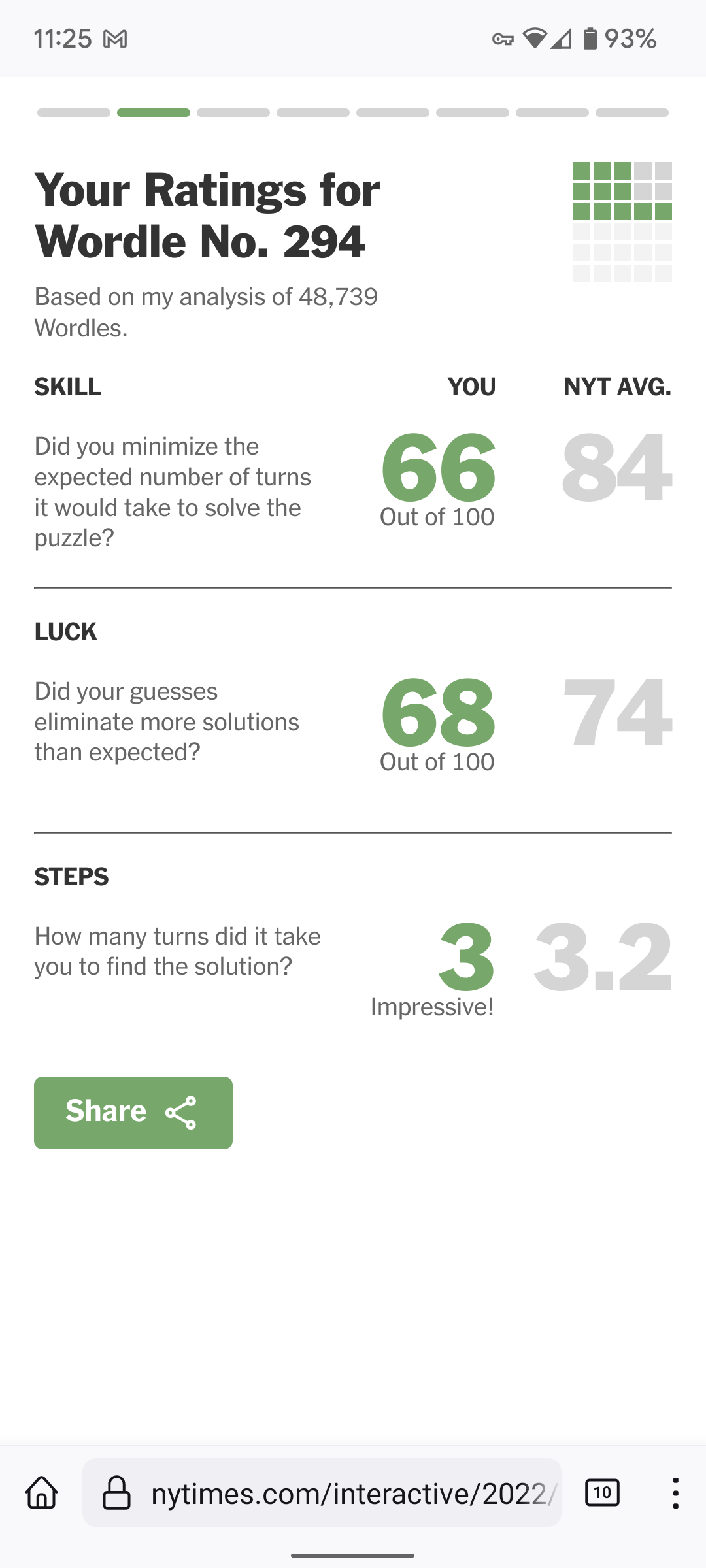
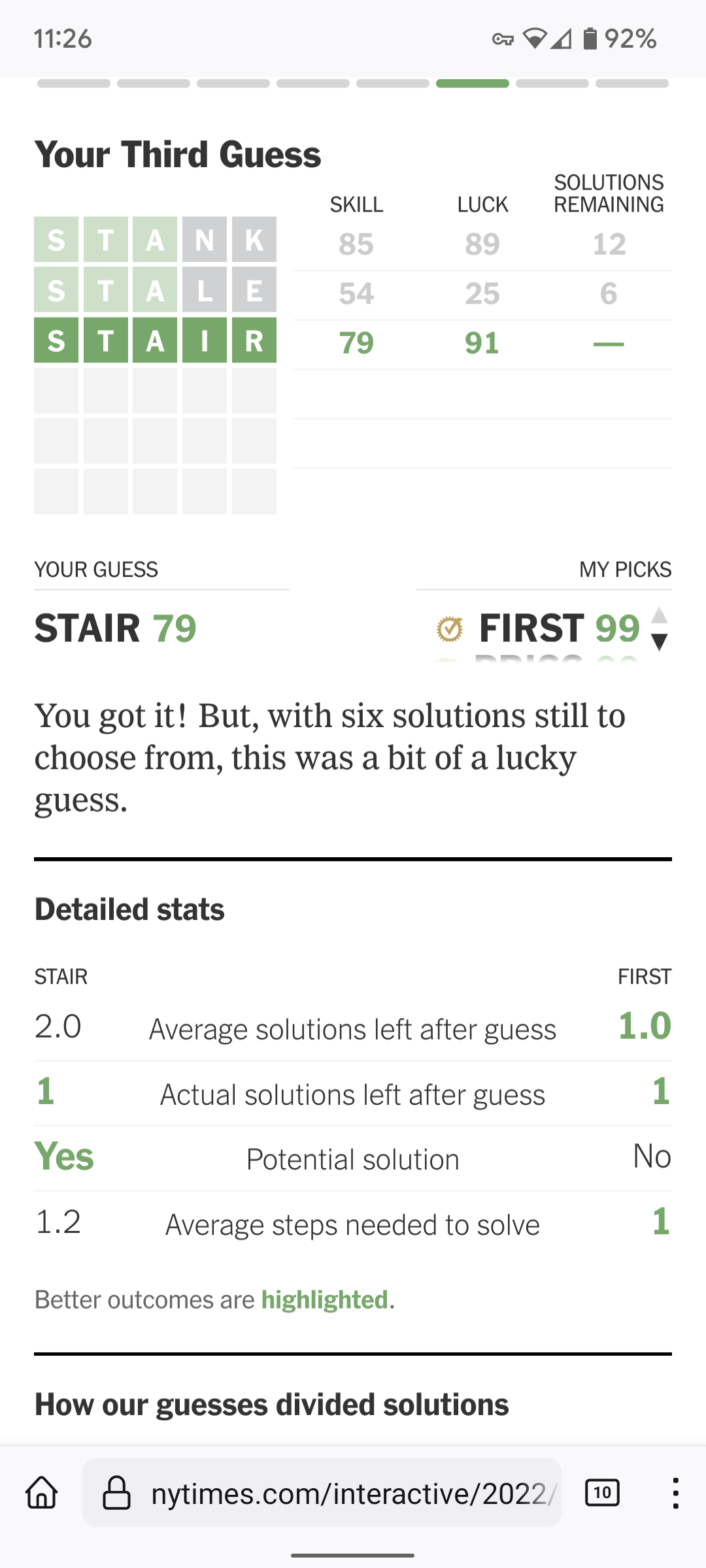
Once you load up the WordleBot, it evaluates your last solution and then you can swipe through stats, including ratings based on skill and luck. You can also see how your solutions stack up to WordleBot recommendations. Check out the screenshots below to see what it looks like (and here’s your warning that the screenshots contain spoilers for the April 9th Wordle, number 294):
Currently, the tool thinks that ‘crane’ is the best starting word for easy mode, while ‘dealt’ is best for hard mode. I’m not so sure I agree with that sentiment — my general strategy has been to use starting words with high-use letters like ‘s,’ ‘t,’ and some vowels like ‘e’ or ‘a.’ For example, ‘stand,’ ‘stare,’ or my personal favourite, ‘stank,’ are great for getting a couple of yellows or even a few greens on the first guess. Plus, if those common letters aren’t in the solution, it rules out a ton of words.
Of course, everyone plays differently — if you’ve got a strategy that works, stick with it. And, if you don’t care about efficiency and just want to have some casual word-puzzle fun, you don’t need to use the tool at all.
Costco members who like ordering from DoorDash will want to take advantage of an e-voucher offer than can net customers $200 in DoorDash gift cards for just $159.98.
Costco’s website notes the offer is only available until April 16th, although according to the posts on RFD, it seems the deal went live yesterday before going out of stock. Moreover, the website notes a limit of two e-vouchers per customer, but some RFD users claim they were able to place multiple orders.
You can place your order on Costco’s website and then should receive the e-vouchers within an hour. Again, RFD users claim the vouchers come as fast as five minutes after placing the order.
While your mileage may vary with this one, you may want to move quickly in case it goes away again.
The Toronto Public Library (TPL) has become the first system in the world to hit 50 million digital checkouts since its launch.
As reported by CTV News, Beth Godlewski, a senior collections specialist at TPL, spoke about the record and how TPL got there.
The library launched its online book-borrowing system in 2007 using OverDrive. It took five years to hit one million borrowed books, but digital book borrowing skyrocketed shortly after. In 2020, TPL said it set a record with eight million borrows.
Godlewski said TPL broke that record the next year, with 9.8 million checkouts. Moreover, she said that TPL was “close to a million ahead of anybody else.”
“We’re leading the world. Have been for nine years straight,” Godlewski said. “What can we say? Toronto, we always say, is a city of readers.”
For those wondering, the 50 millionth digitally-borrowed book was ‘A Town Called Solace,’ by Canadian author Mary Lawson.
Godlewski told CTV News that the pandemic helped spur an increase in borrowing ebooks and audiobooks. Digital checkouts spiked about 30 percent between 2019 and 2020. There’s also been uptake from borrowers who hadn’t used TPL’s physical collections, and Godlewski noted that baking and crafting books became much more popular too.
In total, there are about 230,000 books in the TPL’s online collection.
The library also shared with CTV News what the top borrowed ebooks of all time in Toronto were:
The Goldfinch
The Girl on the Train
Becoming
Educated: A Memoir
Where the Crawdads Sing
The Handmaid’s Tale
Talking to Strangers: What we should know about the people we don’t know
Gone Girl
Little Fires Everywhere
The Life-Changing Magic of Tidying Up: The Japanese Art of Decluttering and Organizing
If you haven’t tried OverDrive for borrowing digital books, check out MobileSyrup’s guide on how to use it here. You can access OverDrive through smartphone apps like Libby or on e-readers.
I know a few people who are really picky with games.
I played around 50 games that were released last year, many of which were really good. Conversely, I have one “hipster” friend who said he barely played anything because nothing really grabbed his attention. To each his own, I guess, but I find that mentality mind-boggling.
Across consoles, PC, mobile and the multitude of distribution methods therein, we’re getting so many new games on a weekly basis. While their respective quality can be argued, the amount of choice we have is indisputable.
The reason I bring this up is that I was reflecting on games of 2022 so far, and man, has it been a particularly good one already. We’re only just a little over a quarter of the way into 2022, and it’s staggering just how many great — and, even better, varied — titles have been released.
While a lot of attention has understandably been given to Elden Ring, Horizon Forbidden West was another outstanding February release. (Image credit: PlayStation)
In January, we got Nobody Saves the World!, a charming action-RPG from Toronto’s own Drinkbox, and Pokémon Legends Arceus, Game Freak’s long-awaited open-world-esque spin on Pokémon.
The following month, we had such heavy hitters as:
Dying Light 2 (Techland) — a zombie-infested open-world, action-RPG featuring rad parkour Sifu (Sloclap) — an action beat ’em up with thrilling martial arts combat
And on the subject of this week, we’ve also gotten Traveler’s Tales’ latest (and perhaps greatest) Lego game,Lego Star Wars: The Skywalker Saga, and Sony San Diego Studio’sMLB The Show 22 (which was released on PlayStation, Xbox and, in a series’ first, Nintendo Switch). Even better: MLB The Show 22, as well as the above Nobody Saves the World!, Tunic and Weird West, all hit Xbox Game Pass on day one. (And outside of specific games, 2022 has already given us a surprisingly good piece of new Valve hardware, the Steam Deck, and another far-better-than-it-has-any-right-to-be Sonic the Hedgehog movie, among other game-related releases.)
In Kirby and the Forgotten Land, our pink hero can eat *an entire car.* Incredible. (Image credit: Nintendo)
Of course, your mileage will vary on some of the titles I’ve mentioned. I, for example, am not at all a sports or racing game guy, so MLB and Gran Turismo don’t appeal to me. On the flip side, some games that weren’t necessarily great, like Team Ninja’s Stranger of Paradise: Final Fantasy Originor Tango Gameworks’ Ghostwire: Tokyo, I still found myself enjoying quite a bit. There’s something here for everyone.
Best of all? This is only the first three months of 2022. Even if you’re somehow like my annoyingly picky friend and only gravitate to specific games (literally just Elden Ring this year), there’s a lot more to look forward to.
Below is a list of just some of the games that are confirmed (barring any delays) to be coming later in 2022:
Once again, that’s only some of what 2022’s got in store. Pick out three random games from above and they’ll likely be from completely different genres. Or, at the very least, they’ll approach the same genre in varying ways, like Horizon Forbidden West‘s more guided open-world to Elden Ring‘s largely direction-free one.
And what’s especially impressive about these lineups is that significant portions of many — if not all — of these games were made during the COVID-19 pandemic. At a time when most industries had to completely shut down for prolonged periods of time, game makers commendably shifted to remote work to continue development.
Anyway, my backlog is so big as is that I’m going to need to finally return to Elden Ring soon. The next couple of months, thankfully, seem to be comparatively slower, which will no doubt help with that.
On that note, which of these games have you been enjoying? Which are you most excited about? Let us know in the comments!