Categories
Mobile Syrup

Native WhatsApp Mac app is now available to download

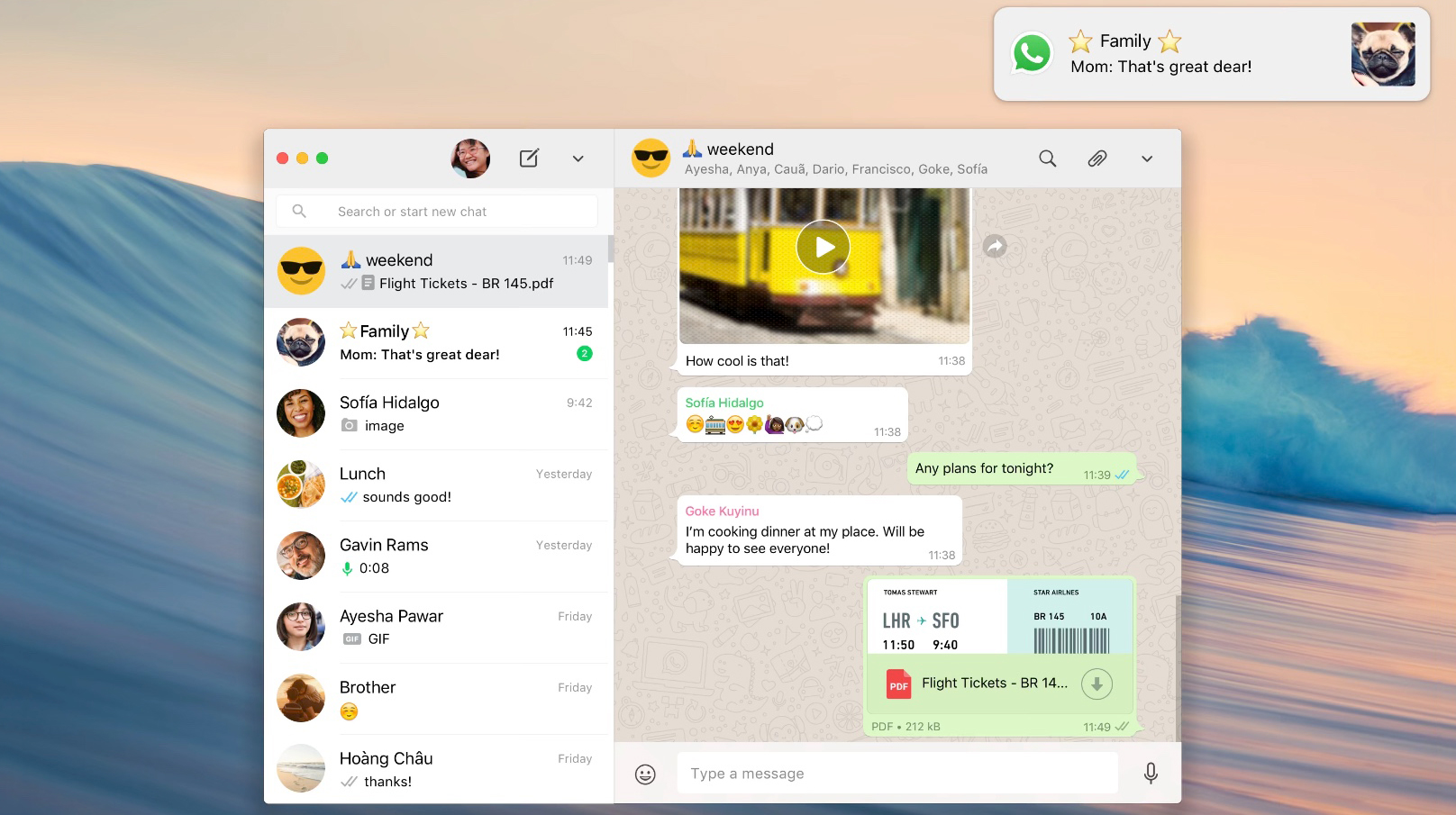
Mac WhatsApp users can now download a native version of the app, making WhatsApp Web completely obsolete.

As shared by WABetaInfo, the native app is optimized for the Mac, and is built with Mac Catalyst, which allows developers to port iOS apps to macOS or create a single version that can run on both platforms, resulting in a WhatsApp app that should technically be faster and more efficient than the web version.

What’s new with the app is that it allows users to make audio and video calls, whereas the web version of WhatsApp lacks the functionality. Further, to make it feel like a Mac app, it allows you to drag and drop files into the app.

Last year, WhatsApp released a native version for Windows 10, which works without needing a smartphone. This version looks similar to the Mac app and offers increased reliability and speed. Windows users can download the desktop app here.

It’s worth noting that native WhatsApp macOS app has been available for several months on TestFlight, but it only offered limited slots for testers. Now that the app is available in a full beta, it can be downloaded directly from WhatsApp’s website or from the App Store.

Image credit: Mac App Store

Source: WABetaInfo

Categories
Mobile Syrup

Elden Ring streamer plays game with just her brain

Twitch streamer Perrikaryal played Elden Ring in a way most would never suspect.

The streamer played the game entirely hands-free thanks to 14 black sensors attached to her scalp through an electroencephalogram (EEG) device.

Perri says she linked brain activity to specific key binds, allowing her to control the ultra-difficult title with only her mind.

She even says words like “heal” and “attack” to perform certain moves. As shared by Jake Lucky, an esports reporter, Perri says different actions to help her think the correct thought, pushing brain activity to the EEG bound to different abilities.

This isn’t something anyone can do, however.

According to Kotaku, which spoke to Ph.D. candidate Cody Cao, EEG technology isn’t 100 percent accurate. Instead, you’re only getting about 60 to 70 percent accuracy compared to the 90 to 100 percent you receive when playing a game with a controller.

“It takes algorithms a lot of training to get to acceptable performance. They likely need to experience a lot of different examples of the same thing (like Perri saying ‘attack’ before attacking) to be able to account for a vast majority of attacks,” Cao said to Kotaku in an interview. “It’s like FaceID on your iPhone — it gets better with the more examples it sees.”

Perri points out that they’re trying to bring EEG usage to the general public’s attention, given it has a variety of applications, including helping those with disabilities.

Source: @JakeSucky, Kotaku

Categories
Mobile Syrup

Man accuses U.S. Customs of destroying valuable copy of Pokémon Yellow

A man has accused U.S. Customs and Border Protection of breaking a rare copy of Pokémon Yellow.

On Twitter, Night Dive Studio CEO Stephen Kick said his friend, who goes by the online handle of The_Master_Of_Unlocking, had an original sealed, near-mint copy of the classic Game Boy title estimated to be worth around $10,000 USD (about $13,300 CAD).

“Friend of mine received this sealed and graded original copy of Pokémon Yellow,” Kick tweeted. “U.S. Customs: Broke the acrylic case, ripped and discarded the seal, [and] sliced the front of the box off. Maybe they weren’t fans of Wata Games?” Wata is a company that grades and certifies games for collectors.

Interestingly, The_Master_Of_Unlocking told Kotaku that he bought the game from a seller in Canada for $3,800 USD (about $5,080 CAD). It was en route to him when the incident is said to have occurred. He added that he wasn’t sure why U.S. Customs agents were so rough with the product, noting there were less damaging ways of opening it up for screening.

Based on the images shared by Kick, it sadly doesn’t look like there’ll be anyway to Full Restore the game.

Image credit: The Pokémon Company

Categories
Mobile Syrup

Google releases January 2023 Play system update for Pixel 7 and 6

The Pixel 7 and 6 are finally getting the latest Play system build update.

The update comes in at 63MB for the Pixel 7 and the Pixel 6 at 59MB. Oddly, after some users on Reddit updated their Play System, the build will continue to say November 1st, 2022.

It’s unclear why this is happening, but the update should still work. However, some users aren’t receiving the update at all, unfortunately.

The Google system updates have the following updates this January.

Critical Fixes

  • [Phone, Wear OS] Bug fixes for Account Management, Security & Privacy, System Management & Diagnostics, and Utilities related services.

Games

  • [Phone, PC] Expanding the range of users and use cases supported by the Play Games profile.

Google Play Store

  • New Features to help you discover the Apps & Games you love.
  • Optimizations allowing faster and more reliable download and installation.
  • Continuous improvements to Play Protect to keep your device safe.
  • Various performance optimizations, bug fixes and improvements to security, stability and accessibility.

Security & Privacy

  • [Phone] Password manager helps you save different passwords to your Google account and lets you use them across various websites and devices. With the new change, you will be able to add notes to your existing and new passwords.

Wallet

  • [Phone] Visual and infrastructure updates to Wallet mobile web experience.

Developer Services

  • [Phone] New developer features for Google and third party app developers to support Device Connectivity, and Machine Learning & AI related developer services in their apps.
  • [Phone] Update the platform QR scanner with the ability to select an existing photo and add support for handling Matter and UPI codes from OEM cameras.

System Management

  • [Phone] Updates to System Management, and Usability services that improve Device Connectivity, Device Performance, Network Usage, Privacy, Security, Stability, and Usability.

Source: Google Support Via: Android Police

Categories
Mobile Syrup

Oreo is launching a Metaverse game in Canada to promote its new cookie

While the Metaverse trend has died down over the course of last year, and only Mark Zuckerberg-led Meta is serious about chasing the dream, a new player has stepped into the game, and it’s one you wouldn’t have guessed.

Originating from Manhattan, New York — Oreo is introducing a new limited-edition cookie called “The Most Oreo,” alongside the “Oreoverse,” an interactive metaverse with all things… Oreo.

The most important thing first — “The Most Oreo” features two chocolate-flavoured cookies packed with the most filling ever in an Oreo, with real Oreo bits and crumbles mixed within the creme.

“A cookie quite literally stuffed with itself is so meta, it twisted open a space in the metaverse for Oreo lovers — the Oreoverse,” writes Oreo.

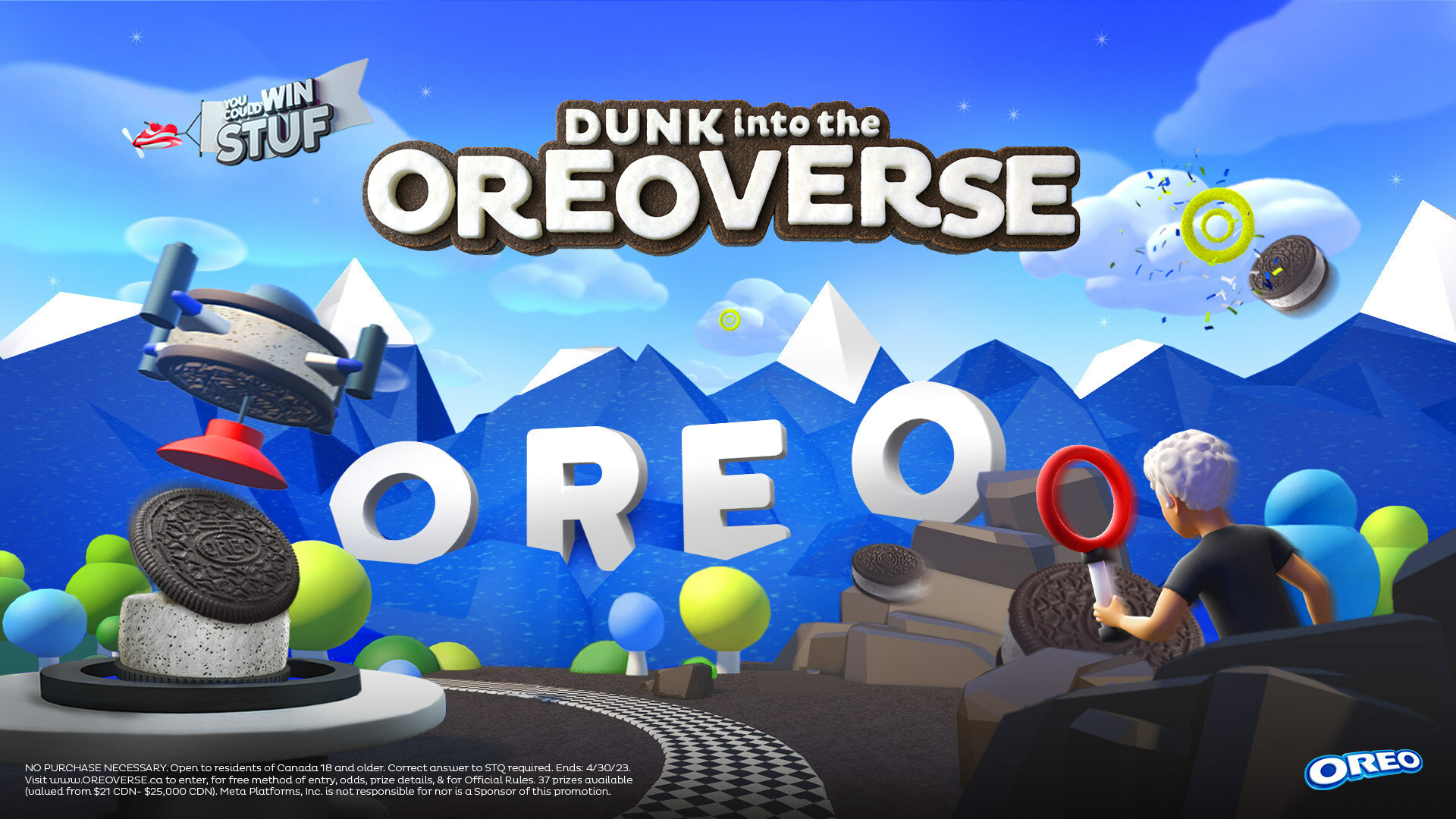
According to the company’s news release, the Oreoverse metaverse features multiple levels of cookie-themed games that earn fans a chance to win an uptown $25,000 prize. One of the games mentioned is called “Stack Stuf,” where players build “The Most Oreo” cookie, while another mini-game called “Rocket Stuf” tasks players with inflating “The Most Oreo” cookie.

“Once all levels are completed, the experience culminates when the player becomes The Most Oreo and gets dunked into a giant glass of milk,” writes the company. The most savage death EVER.

The new cookie will be available at retailers across Canada starting in early February, while the Oreoverse will go live on Monday, January 30th. Fans can access the virtual world in Meta Horizon Worlds using their Meta Quest headsets or via mobile phones or desktop computers by visiting www.oreoverse.ca.

Image credit: Oreo

Source: Oreo

Categories
Mobile Syrup

DeepMind’s Edmonton office to shut down

Alphabet is shutting down the DeepMind Technologies office in Edmonton, Alberta.

According to The Globe and Mail, DeepMind is consolidating its business across the country. Google’s parent company Alphabet owns the artificial intelligence company.

DeepMind’s Toronto and Montreal locations, which are housed in Google’s office, will continue operations. Edmonton had the only stand-alone DeepMind location, the publication reports.

Bloomberg further reports researchers and engineers will be allowed to relocate to another office, but some employees in “organizational infrastructure roles will be laid off.”

The news comes as Google laid off 12,000 employees and moved its focus to AI.

Image credit: Shutterstock 

Source: Globe and Mail, Bloomberg

Categories
Mobile Syrup

Kenyan workers making less than $2/hour helped make ChatGPT safe for public use

OpenAI’s ChatGPT is an impressive tool, but like many impressive technology products, it has a dark side. A recent Time investigation found that OpenAI used outsourced Kenyan labourers earning less than $2 USD (about $2.67 CAD) to help make ChatGPT less toxic.

The Time piece is long but well worth the read — you can find it here. Time reports that ChatGPT’s predecessor, GPT-3, was a tough sell because it was prone to blurting out violent, sexist, and racist remarks. (ChatGPT is based on GPT-3.5.) The main reason GPT-3 was so toxic was that OpenAI trained it using the internet. One the one hand, the internet is a vast repository of human language. On the other, it’s chock-full of awful content — content picked up in the training of tools like GPT-3. To solve the problem, OpenAI pursued building an AI-powered safety mechanism to stop its chatbots from regurgitating the toxic material.

Time reports that OpenAI took a page out of Facebook’s playbook, since the company had already shown it was possible to build AI-powered tools to detect toxic language like hate speech. However, instead of detecting toxic language to remove from a social media platform, OpenAI needed to scrub it from its training data.

To build that AI system, OpenAI needed to label different types of toxic speech to train the AI on. Enter Sama, a San Francisco-based firm that employs workers in Kenya, Uganda, and India to label data for Silicon Valley clients like Google, Facebook’s parent company Meta, and Microsoft. Sams bills itself as an “ethical AI” company.

Starting in November 2021, OpenAI sent tens of thousands of text snippets to Sama that seemed pulled straight from the darkest recesses of the internet. Per Time, some of it described child sexual abuse, bestiality, murder, suicide, torture, self-harm, and incest in graphic detail. Sama paid data labellers a take-home wage of between $1.32 and $2 USD per hour, depending on seniority and performance.

It’s worth noting that OpenAI doesn’t disclose the names of its outsourcing partners, and it’s not clear whether OpenAI used other data labelling firms alongside Sama for the project. OpenAI did confirm in a statement to Time that Sama employees in Kenya contributed to its toxic content detection tool that eventually became part of ChatGPT. Moreover, OpenAI stressed that the work was a “necessary step in minimizing the amount of violent and sexual content included in training data.”

According to documents reviewed by Time, OpenAI signed three contracts with Sama in late 2021. In total, the contracts were worth about $200,000 USD (roughly $267,309 CAD). However, the traumatic nature of the work eventually resulted in Sama cancelling its work for OpenAI in February 2022, eight months earlier than planned.

It’s worth noting that ChatGPT’s popularity has been a massive boon for OpenAI, spurring things like a multibillion-dollar investment from Microsoft. OpenAI is even aiming to launch a roughly $56/mo CAD ‘Professional’ tier of ChatGPT.

Some Sama workers spoke anonymously with Time about the work, with one describing some of the content viewed as torture and mentally scarring. Employees were entitled to attend sessions with “wellness” counsellors, but those that spoke with Time said the sessions didn’t help. Moreover, high productivity demands meant the sessions were rare. Some were only given the opportunity to join group sessions, and one employee said requests for a one-on-one session were repeatedly denied.

The contracts revealed that OpenAI would pay an hourly rate of $12.50 to Sama for the work, significantly more than what the employees actually took home. A Sama spokesperson told Time that the $12.50 rate “covers all costs, like infrastructure expenses, and salary and benefits for the associates and their fully-dedicated quality assurance analysts and team leaders.”

An OpenAI spokesperson told Time that the company didn’t issue productivity targets and said Sama was responsible for managing payments and mental health provisions. The spokesperson also said that OpenAI understood Sama would offer one-to-one counselling and that workers could opt out of any work without penalization.

Despite the collapse of OpenAI’s contract with Sama, a need for human labour in tech, especially AI, remains. Time spoke with AI ethicist Andrew Strait, who warned that ChatGPT and similar systems rely on “massive supply chains of human labour and scraped data, much of which is unattributed and used without consent.” As impressive as ChatGPT is, it’s emblematic of larger, foundational problems in the AI space.

Image credit: Shutterstock

Source: Time

Categories
Mobile Syrup

MLSE partners with AWS to enhance Toronto sports fan experience

Amazon Web Services (AWS) is partnering up with Maple Leaf Sports & Entertainment (MLSE) to bring fans of the Toronto Maple Leaf, Toronto Raptors, Toronto Football Club and Toronto Argonauts extraordinary sports moment and an enhanced fan engagement experience.

According to Amazon’s news release about the partnership, MLSE will use AWS’s “comprehensive portfolio of cloud capabilities, including ML, advanced analytics, compute, database, and storage services to support their teams and lines of business.” By innovating together, MLSE aims to build solutions that will support how teams play on the ice, court, pitch, or field, how players stay healthy on and off season, how fans connect with each other and experience games, and how sports franchises operate internally.

Amazon is deploying its ‘Amazon Rekognition‘ and ‘Amazon Kinesis‘ tools, the former of which is used for automated image and video analysis and the latter for collecting, processing and analyzing video and data streams in real time. The tools would be used to process and analyze video footage from cameras installed at team training facilities and game venues in real time to better prepare for crucial decisions during games. “For example, the critical game data stored and analyzed on AWS can be viewed by coaches on the bench to help them strategize their next play,” wrote Amazon

Additionally, MLSE will develop new technology for sports fans using AWS’s broad portfolio of cloud services to create extended and unrivaled experiences for its teams’ supporters in the arena, and at home. Using AR and VR applications, MLSE plans to power its “Game within the Game” digital experience that would allow fans to track their favourite players, access enhanced game insights in real time, take part in free-to-play gaming, and participate in on-demand sports betting.

Humza Teherany, chief technology & digital officer at MLSE, stated that the partnership with AWS will “help transform Toronto’s sports and entertainment industry” and enhance how the organization engages with fans by giving them exciting, personalized experiences in and out of the venues.

In the future, MLSE and AWS will build an “at-home and in-stadium” mixed-reality experience by combining visual data from cameras around the arena with sensors in players’ jerseys and the puck or ball, depending on the sport, which would build on ‘Digital Arena,’ MLSE’s existing teams’ mobile apps.

Learn more about the partnership here.

Image credit: Amazon Web Services

Source: Amazon Web Services

Categories
Mobile Syrup

Federal Court dismisses Competition Bureau’s appeal against Rogers-Shaw merger

The Federal Court of Appeal has rejected the Competition Bureau’s appeal against Rogers’ takeover of Shaw and Vidéotron’s acquisition of Freedom Mobile.

Justice David Stratas delivered the ruling after a lengthy break where the justices discussed the outcome. The bureau presented its arguments earlier in the morning. Legal representatives from Rogers, Shaw and Vidéotron didn’t present their arguments.

The bureau was arguing the Competition Tribunal errored in its decision by backing the telecom companies. They argued the tribunal should have examined Rogers’ merger with Shaw and not Vidéotron’s takeover of Freedom Mobile. However, the tribunal said it would have reached its decision either way.

Justice Stratas agreed with the tribunal. In his lengthy reasoning, he said he could not be persuaded that the result would be different and it would be pointless to have the Competition Tribunal examine this again.

More to come…

Image credit: Shutterstock 

Categories
Mobile Syrup

Where to stream Ted Lasso creators’ Shrinking in Canada

Ted Lasso‘s long-awaited third season won’t arrive until the spring, but in the meantime, a few of the show’s key creators have a new comedy series to tide you over.

Enter Shrinking, the latest from Ted Lasso co-creator and writer Bill Lawrence, Ted Lasso star and writer Brett Goldstein (yes, Roy Kent himself) and How I Met Your Father‘s Jason Segel (not to be confused with Ted Lasso‘s Jason Sudeikis).

Segel stars as a grieving therapist who breaches ethical barriers by confessing his true feelings to his patients, leading to massive life changes for everyone. Star Wars legend Harrison Ford co-stars in a rare TV appearance.

Like Ted LassoShrinking will stream exclusively on Apple TV+ when it premieres on January 27th.

An Apple TV+ subscription costs $8.99 CAD/month.

Image credit: Apple