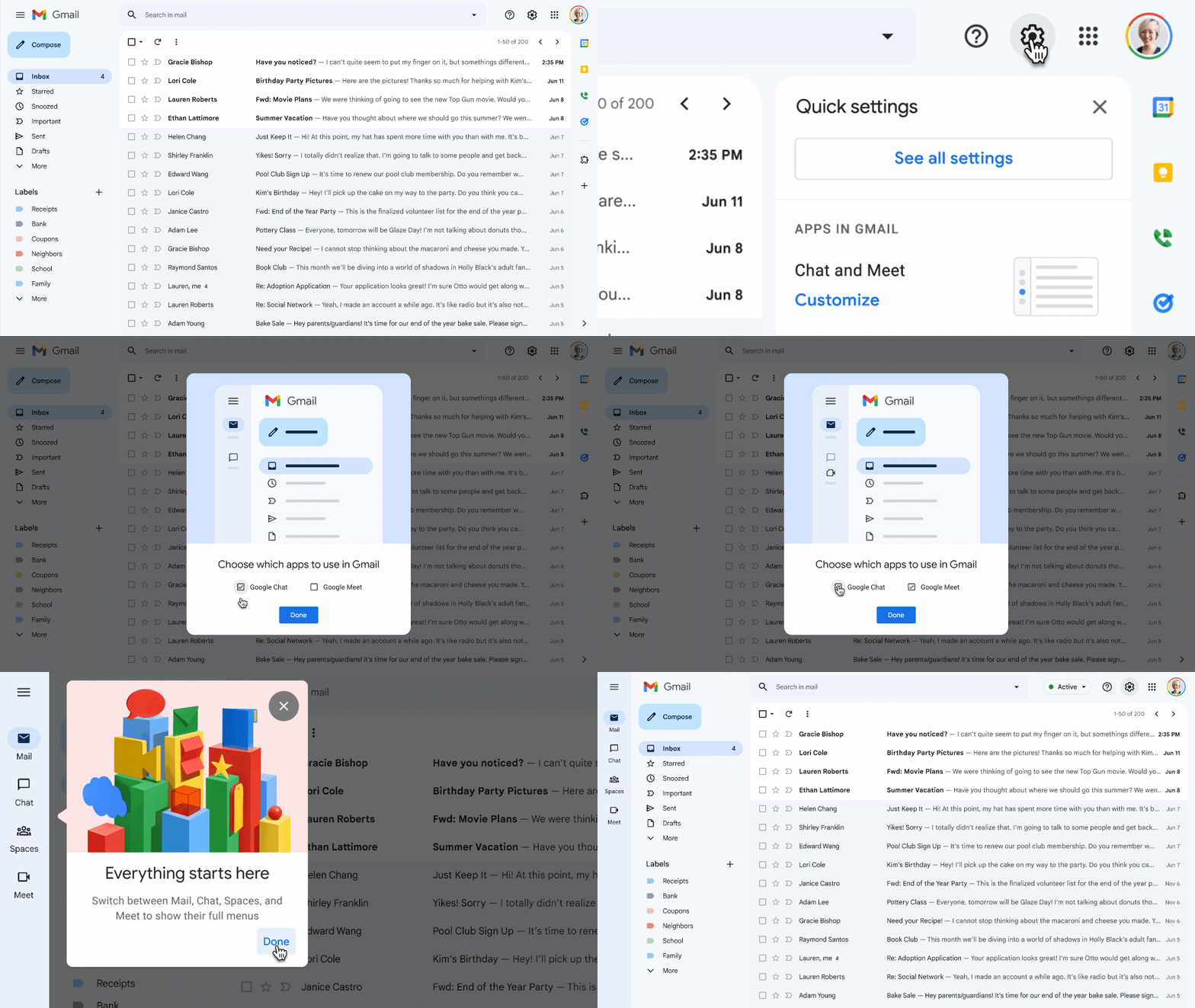
Early in 2022, Google announced a new layout for Gmail that offered Chat, Meet and Spaces integration. This redesign has been rolling out to users in phases and was initially available on an opt-in basis.
Following this, in July, the Gmail integrated view was rolled out to all Chat users. With this in mind, if you turned off Chat on your account, you wouldn’t have this new Gmail. However, now, Google is making the layout standard for all users.
The Gmail design features Material You UI elements and offers an integrated view with Gmail, Chat, Spaces and Meet buttons on the left as the default layout. Personally, I like the change, as it gives me quick access to Spaces, Chat and Meet, tools I use a lot for work.
You can customize it to hide the Chat, Spaces and Meet options if you have no use for them. This will make Gmail look similar to the previous version, but you’ll still have the Material UI.
This update will start rolling out to all domains starting on November 29th.
Did you know that Microsoft Flight Simulator is actually Microsoft’s longest-running product line?
With its introduction in 1982 for the IBM PC, it actually predates Windows by three years, Office by eight and the Xbox gaming brand by a whopping 19. It’s pretty wild to think about, especially considering Microsoft is undoubtedly best known software company.
To celebrate Flight Simulator‘s 40th anniversary, Microsoft is releasing the appropriately titled 40th Anniversary Edition update on November 11th. Naturally, for such a momentous occasion, you want to go big, and that’s exactly what Microsoft has done with the expansion.
“We were sort of constructing this box of chocolate,” says Jorg Neumann, head of Microsoft Flight Simulator, about the approach to the update, which was created with the help of 10 studios around the world. So what, exactly, went into this box of sweets?
Helicopters and gliders and airliners, oh my!
According to Neumann, Microsoft’s tracker for most requested community content additions helped steer them in the right
Jorg Neumann
direction.
At the top of the list were helicopters and gliders, which haven’t been in the series since 2006’s Microsoft Flight Simulator X (FSX). But as Neumann points out, the piloting systems for these vehicles are “totally different” from anything that’s featured in the current Flight Sim. That’s to say nothing of the fact that quite a lot has changed since 2006.
“If you think about FSX back in the day, we always look at the physics system, and the physics system was ‘a plane was a box.’ And it had one control point. And on that control point, you had to do all the physics operations. So it wasn’t exactly the most accurate thing ever,” he says with a smile.
This meant that Flight Sim co-developer Asobo had to write a whole new system and add a variety of features. “The ground effect is different with less water drag when you get close to the ground. We did things like translational lift, which is basically from ‘hover’ to ‘fly forward’ and how that really works, and the vortices that are happening,” says Neumann. He adds that a solution to “dissymmetry of lift” — the unequal amount of lift on opposite sides of the rotor disc — called “flapping” had to be coded from scratch.
The other piece of the puzzle was working with a French company called Helicoptres Guimbal, who provided helicopters and test pilots for reference. With their help, the Flight Sim team would use new recording devices to get the telemetry of the real helicopters and compare them to what they have in the game. In the end, all that work has seemed to pay off.
“I think the best news for us was when we brought it back to the test pilots and they tested it, they actually said, ‘man, you guys got close,” says Neumann. “And they gave us more feedback, and that went on a number of months. And now they’re saying it’s really, really good — to the point that they’d like to use it like for training purposes and such. So that’s always the best validation.”
Another highly requested feature was the addition of a true-to-life airliner: the sophisticated Airbus A-310. To design it, the Flight Sim team partnered with global software company Inibuilds, who Neumann says have “a lot of direct access” to airline pilots. This was essential, he says, because the pilot handbooks for such aircraft are “thousands upon thousands of pages” long.
Given that, he admits he’s not an airliner expert, but from what he’s heard from the true savants is that Inibuilds’ work on the airliner “is really outstanding.” Moreover, he says it helped improve the game as a whole.
“It pushed us, frankly. I think there were things in Flight Sim when we launched that weren’t as deep as far as systems are concerned — like the weather radar was more limited and stuff. And I think a lot of what Inibuilds did was pushing the platform to get really great, which is a a net benefit to all the other third parties that make airliners.”
Honouring the past — including Canada’s
One of the other notable elements of the update is the set of seven famous historical aircraft: the 1903 Wright Flyer, the 1915 Curtiss JN-4 Jenny, the 1927 Ryan NYP Spirit of St. Louis, the 1935 Douglas DC-3, the beautiful 1937 Grumman G-21 Goose, the 1947 Havilland DHC-2 Beaver and the 1947 Hughes H-4 Hercules.
The Spruce Goose.
That last plane, also known as the ‘Spruce Goose,’ is perhaps the most notable of the bunch — the largest seaplane and largest wooden plane ever made. Its creator? A lesser-known business magnate, pilot and engineer by the name of Howard Hughes, who also happened to be the only person to ever fly it. This begs the question: how do you simulate a plane that was only ever flown once?
“Howard Hughes was an interesting guy, right? So he kept actually building on that plane. He flew that one time back in 1947. But that’s just one configuration — he kept changing the thing to make it better,’” explains Neumann. “And we saw all the pictures over the ages and we needed to figure out like, ‘what is this lever do here in the central console?’ And then they [the Evergreen Museum who houses the Spruce Goose] went in and actually gave us the engineering specs and where the electrical lines actually go. And we discovered some stuff that I think nobody really knows about like it’s two APUs, power units, and they’re in the cockpit. This thing must have been crazy loud, when it flew, sitting in the cockpit!”
And if the recent Canada-themed update wasn’t enough, Canucks will also have something unique to enjoy in 40th Anniversary Edition: the 1947 Havilland DHC-2 Beaver. Shortly after World War II, Canadian aviation company De Havilland shifted focus to civilian operators — in this case, a single-engined high-wing propeller-driven short takeoff and landing (STOL) aircraft. On top of that, Canadian 3D model and animation company Blackbird Simulations (formerly Milviz) actually handled the Beaver. “Because they’re from Canada, they were like ‘the Beaver — we need to do the Beaver!” Neumann says with a laugh, noting that some of the team flew for Canadian Air Patrol. “It’s a great group of people.”
In general, he says it’s “most important that people really love the plane that they work on,” and that’s especially been apparent with Blackbird. “The lead engineer on [Blackbird], his name is Jim. And he sends me builds, ‘hey, check it out!’ And you see all the needles through this little jitter. I’m like, ‘what is happening?’ And he’s like, ‘Oh, it’s this power unit up here!’ And it does this vibration thing. And it’s a super authentic version of what the Beaver really feels like. And I think Flight Simmers really enjoy that. It’s not just the shape — it floats and it can go into lakes. It really feels the part, and it sounds the part. They’re so proud of the sound recordings because it’s all custom recordings done for specific planes up in Canada. It was cool.”
Reaching new audiences for years to come
When I last spoke to Neumann, it was to preview the launch of the Xbox Series X/S versions of Flight Sim — the first time the series had ever come to consoles. Of course, that brought in a whole new wave of players who had never experienced the series, and the team took great care into creating tutorials and other guiding missions to ease them in.
Fast forward over a year and Neumann says he’s happy to see how this new audience has received the game. “It was great. The audience is huge — we doubled the audience.” And that was just with the native Series X and S versions. This past March, Microsoft added Xbox Cloud Gaming support to the game, letting players stream it to the last-gen Xbox One and, even, mobile devices.
“It’s a fascinating thing — I actually test a bunch on iPhone 12 because it’s so fast to fire up the SIM,” he admits with a laugh. But his biggest takeaway is just how much these two expansions reached people.
“It added people all around the world — more so than what I expected. Because there’s a traditional PC audience and a traditional Xbox audience, and this one literally liberates it from any country on Earth now. For example, just a tidbit: Turkey, somehow, is now the number six most popular place where people fly Flight Simulator. I would have never thought that because the country doesn’t have a deep history of aviation. But clearly people like it — it’s a big country, it has [85] million people. So I think we’re reaching new people and innocent people.”
To that point, he mentions how he sees the Flight Sim add-on developer community has a lot of new teams with people who are 20-years-old or younger. His conversations with aircraft manufacturers have also indicated that interest in aviation is going up.
“I’m not saying it’s all because of us or anything, but I do think we’re contributing to sort of a resurgence, where people say, ‘planes are cool, let’s get into this.’ And the emails that always make me the happiest are from like eight to ten year olds writing me saying, ‘hey, I’m flying Flight Sim every day,’ and then they ask me something about their hometown or whatnot and it feels awesome. That’s when it feels that you’re doing something meaningful.”
The other side of the equation, he says, is that Flight Sim can play a role in the preservation of aircrafts.
“I go to a bunch of museums and I talk to those people. And they are kindred spirits, just of a different ilk. They are spending their life — all their passion goes into preserving these amazing machines. And they look at me like sort of almost like a savior, because they know that machines, at some point or another, physical things erode over time. For example, the Spirit of St. Louis — the cloth is going away and they can’t do anything about it. Like nobody can touch the plane — nobody has been on the ceiling for decades. It’s just the tools of time. And they look at what we can do in the digital space, which is not the same, but but it has a certain element of the preservation, so they pour their hearts into helping us.”
Taking that one step further, he says he’s had conversations with museums to preserve them, too, in a digital space. “It’s not perfect or anything, but it keeps getting better, and people want to be part of that. And we’re doing some prototypes right now that could lead us to some fascinating places.”
Ultimately, he says these sorts of efforts can appeal even to those who aren’t interested in aviation.
“I was thinking about the photogrammetry cities that we have — some of them are from 2013, and we’re getting new ones now. And I was projecting forward, 40 years of Flight Sim… what’s the world going to look like 40 years from now? That’s the kind of the mental game I play. You know, we will have cities from 50 years ago. And people can look back in time and say, ‘Hey, this is what the city looked like.’ And we are really making this ‘history of Earth thing,’ a little bit. Not just planes, but the world itself, and I think that that has lots of fascinating things going for it.”
This interview has been edited for language and clarity.
Microsoft Flight Simulator 40th Anniversary Edition will be available as a free update to all Flight Sim players, including those on Xbox Game Pass.
This is where Dean Daley’s and Brad Shankar’s new SyrupArcade episodes of the SyrupCast come in. These special SyrupArcade Cast episodes are still the SyrupCast you know and love, but with an emphasis on all things gaming. All episodes will be available in the standard SyrupCast podcast feed on nearly every podcast platform out there.
On this episode of the SyrupArcade Cast, Dean and Brad have a nearly spoiler-free discussion about Ragnarök‘s characters, settings, Norse mythology and more.
As always, you can listen to the SyrupCast below or find the pod on your favourite streaming platform.
This isn’t an official device, so don’t get your hopes up, but the Aesthetics of Science and Technology (AST) has created a Frankenstein-like foldable iPhone.
The device is designed after the Motorola Razr and uses some of its parts alongside 3D printed pieces and an iPhone X’s display that’s been kitted out by replacing the glass and touch layers. Further, an iOS jailbreak lets it work like an iPhone, but since this obviously isn’t an official device, the software doesn’t work perfectly with the hardware. So, while it folds, the user interface isn’t optimized for the form factor.
There are also a few hardware issues, including a huge gap when folded, a small battery, one external speaker and no wireless charging, but it’s sort of a foldable iPhone, so that counts for something, right?
Several rumours have pointed to Apple possibly launching an actual foldable handset in 2023.
It’s not an entirely outlandish claim. I’d even argue that most people really enjoy Nintendo’s latest console, which is on track to becoming its best-selling hardware ever. However, something doesn’t add up when you see the data in a graph.
As you can see in the tweet below, there’s a pretty significant data spike in the number of 22-year-olds compared to 21 and 23-year-olds. Sure, maybe there could be a few more people born in 2000 that just so happen to own a switch, but this also suggests misleading data.
A data spike like this tells you your data is broken. I’m willing to bet they ask people their date of birth and a large proportion pick the year 2000 as a shortcut. There aren’t really 2x as many 22-year-olds as 23-year-olds playing switch. https://t.co/egWmKjdluP
Twitter user Colm Larkin points out that it’s likely the year 2000 is enough to make users age-appropriate for an adult account. Plus, who doesn’t like round numbers? It also seems strange that there are more 22-year-olds than 15 and 16-year-olds, which you would think would be the prime age for Switch gaming. However, this is also old enough to start to figure out that if you set your age to be an adult, you then deal with fewer restrictions.
On the other hand, maybe there really are a crazy amount of 22-year-olds playing games on the Switch. We’ll likely never know.
While Apple champions itself as a privacy-conscious company, new research reveals several Apple apps collect detailed information about users, even when they turn off tracking.
The news should, unfortunately, not come as a surprise given previous research about Apple’s not-so-private privacy features. For example, Apple’s App Tracking Transparency, which supposedly lets iPhone users tell apps not to track them, doesn’t actually do that much. Now, research shows that the iPhone Analytics setting, which promises to “disable the sharing of Device Analytics altogether,” doesn’t do anything for Apple apps.
According to research shared with Gizmodofrom app developers and security researchers Tommy Mysk and Talal Haj Bakry, several iPhone apps, including the App Store, Apple Music, Apple TV, Books, and Stocks, all ignore the iPhone Analytics settings and other privacy settings. Germany-based Mysk and Toronto-based Bakry work for the Mysk software company and frequently share research on the Mysk Twitter account and blog. Regardless of whether users turned these settings on or off, these iPhone apps would send the same amount of data to Apple.
For example, the App Store appears to harvest data for just about everything users do. That includes which apps they tap on, search queries, ads users see, and more. It also sent data about the device users have, including ID numbers, screen resolution, keyboard languages, and more. These data points are all commonly used for fingerprinting, a tracking tactic that gathers a bunch of data to create a digital fingerprint that can be used to track activity across apps and services. Other apps shared data about what users did in those apps, such as which stocks they viewed in the Stocks app.
Notably, the researchers tested other apps for Gizmodo and found that the Health and Wallet apps didn’t transmit any analytics data regardless of the settings.
Mysk and Bakry tested two iPhones, a jail-broken iPhone running iOS 14.6 and a regular iPhone running iOS 16. With the jail-broken iPhone, the duo was able to decrypt the traffic being sent from the phone and examine what was being sent. Part of why they chose iOS 14.6 was because Apple introduced the App Tracking Transparency feature in iOS 14.5, which included the prompt asking users if they wanted to allow an app to track them.
While they couldn’t decrypt the traffic sent from the iPhone running iOS 16 to see what data was being sent, Mysk and Bakry noted that the same apps sent similar packets of data to the same Apple web addresses as what they found on the jail-broken iPhone. Moreover, data was transmitted at the same times and under the same circumstances, and adjusting the various privacy settings made no difference. The similarities suggest that the regular iPhone was transmitting similar data to what the researchers could see on the jail-broken iPhone.
It’s possible Apple doesn’t use the information it receives if the privacy settings are turned on, but then why collect it in the first place? Moreover, Gizmodo notes that Apple’s privacy policy suggests the iPhone Analytics setting doesn’t work that way anyway. Moreover, Mysk and Bakry said third-party apps they test don’t send data when the analytics settings are turned off.
What makes Apple’s data collection particularly egregious is that the company has long promoted itself as the private option. Remember the massive billboards Apple put up around Toronto advertising how it stays out of your business? Anyway, Apple doesn’t think its tracking behaviour is actually tracking. As Gizmodo pointed out, Apple says its “advertising platform does not track you, meaning that it does not link user or device data collected from our apps with user or device data collected from third parties for targeted advertising or advertising measurement purposes, and does not share user or device data with data brokers.” Put another way, Apple’s tracking isn’t tracking because only Apple collects that data, which seems like a very Apple-friendly view of tracking.
Even though Black Friday is still a few weeks away, The Source has already started its annual sale. While these are the retailer’s Black Friday deals, the sale seems to last until December 31st, serving as both Black Friday and Boxing Day offers.
You can check out all of The Source’s Black Friday deals, here.
MobileSyrup utilizes affiliate partnerships. These partnerships do not influence our editorial content, though we may earn a commission on purchases made via these links that helps fund the journalism provided free on our website.
Back in September when Google announced that it is shutting down Stadia, it came as a surprise that it will also refund users that purchased Stadia hardware through the Google Store, alongside all games and add-on content purchases made through the Stadia store.
During the time, Google said that it ‘expects to have the majority of refunds completed by mid-January, 2023,” and it looks like Google has now started the process of refunding users.
According to an announcement made today, Stadia will “attempt to” automatically process refunds for all Stadia Store purchases of games, add-on content, and subscription payments. “We ask for your patience as we work through each transaction and ask that you refrain from contacting Customer Support as they will not be able to expedite your refund during this time. We still expect the majority of refunds to be processed by January 18th, 2023,” said Google.
Google says refunds would be processed directly to the source of the payment. If that isn’t possible for any reason, Google will email you on the Google account used to make the purchase with more information.
Customers who have made 20 or fewer purchases on the Stadia store will receive one email for each transaction made, whereas customers who have made 21 or more purchases on the Stadia store will receive one email summarizing all the refund attempts.
Users who’ve made pre-orders will have the orders cancelled, and their cards won’t be charged. Additionally, the charges for the Stadia Pro subscription and Power Support CLAW would not be refunded.
Apple has confirmed that its long-under-construction Pacific Centre store located in Vancouver will open on Friday, November 18th.
The tech giant recently acknowledged that the two-storey building inside the CF Pacific Centre is indeed a new Apple Store, despite it being common knowledge that a location was being built on the site.
Apple commissioned a massive 30-foot mural to celebrate the store opening, led by prominent Canadian designer Mooren (Mo) Bofill with contribution by acclaimed xʷməθkʷəy̓əm (Musqueam) weaver and artist Debra Sparrow, giving the location a unique look when compared to the company’s other stores. The mural also features several nods to recognizable Apple products, including the Apple Pencil, AirPods, Face ID and more.
At roughly 14,000 square feet, this is the largest Apple Store in the core Vancouver area.
Apple says that the location’s grand opening will feature live performances by Vancouver-based rapper and musician Boslen and a Q&A moderated by Apple Music radio host George Stroumboulopoulos, alongside free programming tied to art, music and photography.
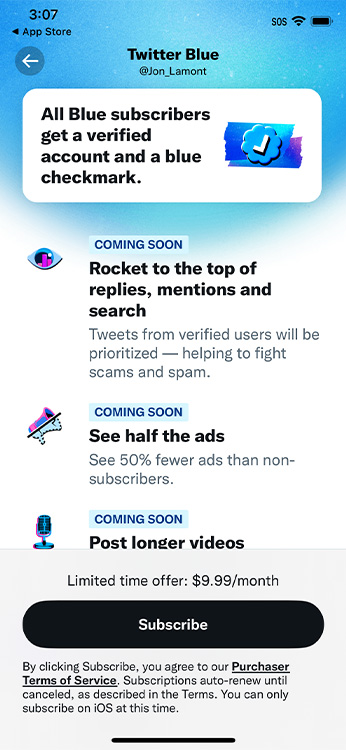
Now that the U.S. midterm elections are over, as promised, Elon Musk and Twitter are rolling out the new Twitter Blue subscription that costs $9.99 per month in Canada and gives you access to a blue verified checkmark. Interestingly, the $9.99 price is listed as a “limited time offer.”
However, there’s one caveat. Twitter Blue is currently only available on iOS and iPadOS, and only in the U.S., Canada, Australia, New Zealand and the U.K.
Up until now, Twitter used the blue checkmark to denote accounts that were noteworthy, active, and genuine and that were of interest to the general audience. Now, however, the Blue checkmark can mean two different things — either that the account was verified under the previous verification criteria or that the account is paying $9.99 per month for a Twitter Blue.
Unlike the previous version of verification, users who get their checkmark through Twitter Blue wouldn’t need to go through an active review that gauges if the user is ‘active, notable and authentic.’ Twitter Blue users will have their checkmark until their subscription ends.
Additionally, Twitter has stopped accepting verification requests under the previous criteria. The only way to get the blue checkmark moving forward will be to subscribe to Twitter Blue. Further, according to Twitter, legacy verified users get to keep their checkmark, though it can be taken away “at any time for any reason at all by Twitter, including as the result of certain types of violations of the Twitter Rules, including but not limited to our rules around spam, ban evasion, and impersonation.”
Twitter Blue users are also set to receive additional perks as part of the subscription, including priority in replies, mentions, and search, the ability to post longer videos, and see fewer ads. These perks haven’t rolled out yet, however.
Twitter Blue used to cost $6.49/month in Canada, but will now cost $9.99/month. If you’re looking to subscribe to the new Twitter Blue, make sure you cancel your old subscription to avoid getting charged twice.
You can find all of our Musk x Twitter coverage here.