The Entertainment Software Association of Canada (ESAC) has released its latest biennial ‘Essential Facts’ survey, which reveals a variety of statistics related to Canadian gamers.
Conducted by NPD Group on behalf of the ESAC, Canada’s video game industry lobbying group, Essential Facts 2022 emphasized how player habits have shifted over the course of COVID-19 pandemic, but still demonstrate strong engagement.
The most immediate finding from the data is that fewer Canadians are playing games. To be sure, it’s still a significant amount — 53 percent of Canadians, averaging 7.9 hours of play each week. But it’s down from the 61 percent of Canadians who reported playing in November 2020.
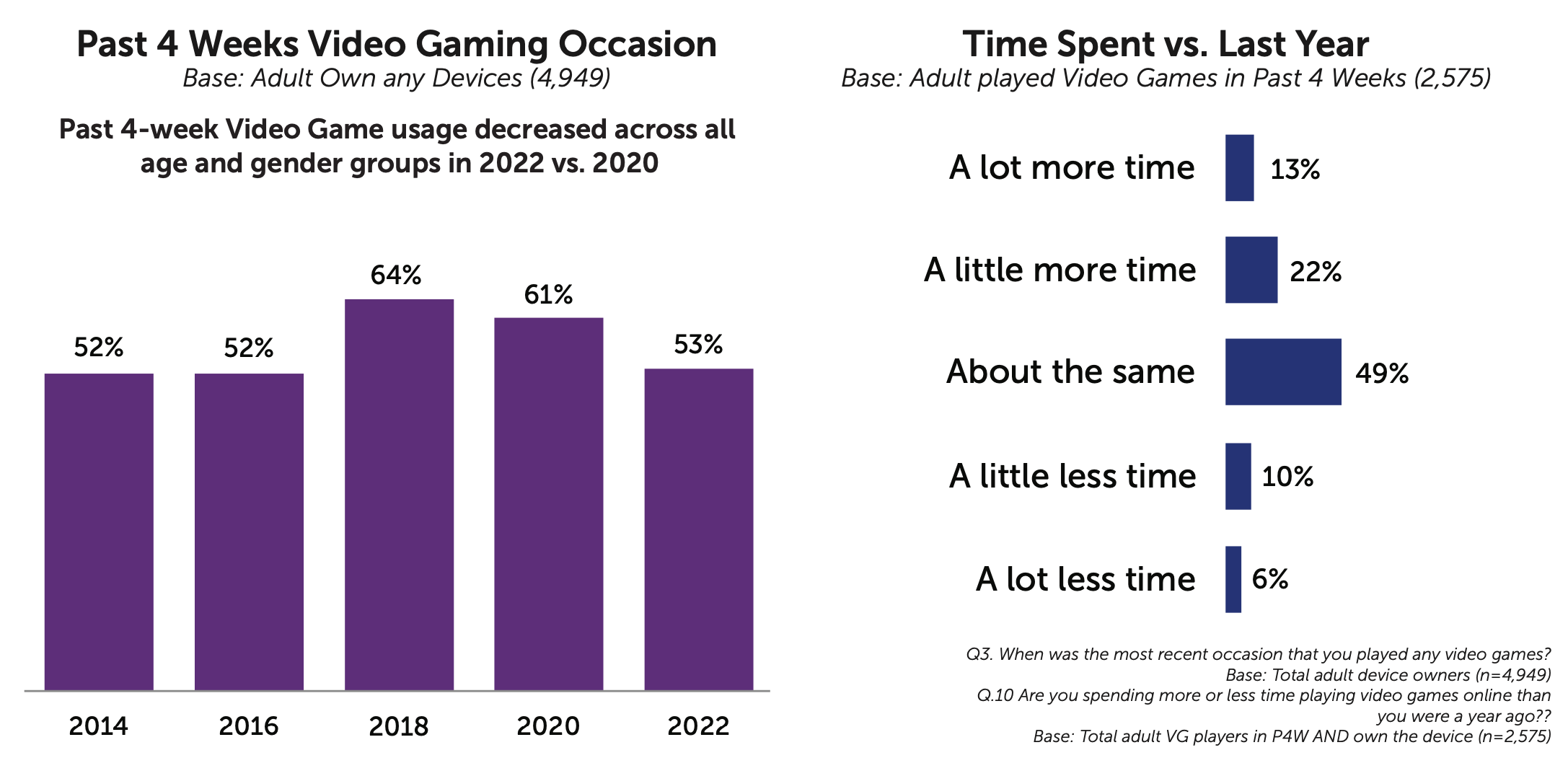
Canadians have been playing a bit less now that COVID restrictions are down.
For Jayson Hilchie, ESAC president and CEO, this isn’t exactly a surprise, given how many more COVID-19 restrictions there were two years ago.
“People have just wanted to get outside, and people want to do things they couldn’t do during COVID. I don’t think it was a huge surprise for us that we were going to see a drop,” he says. “I think what we’re seeing people temporarily deciding that they want to do things they couldn’t do, and gaming filled such an important part of their lives during the pandemic that for many people, they wanted to go and do something else. And that’s okay. I totally expect that these people are going to continue to game, but it’s okay to take a break, and it’s okay to do something else.”
That said, the interest in games remains consistently strong across Canada. While there are some standouts, like Manitobans playing the most at nine hours per week (above the overall 7.9-hour average) or B.C. having the highest gamer population at 59 percent, the number of gamers per province is uniformly above 50 percent, which Hilchie says he’s happy to see.
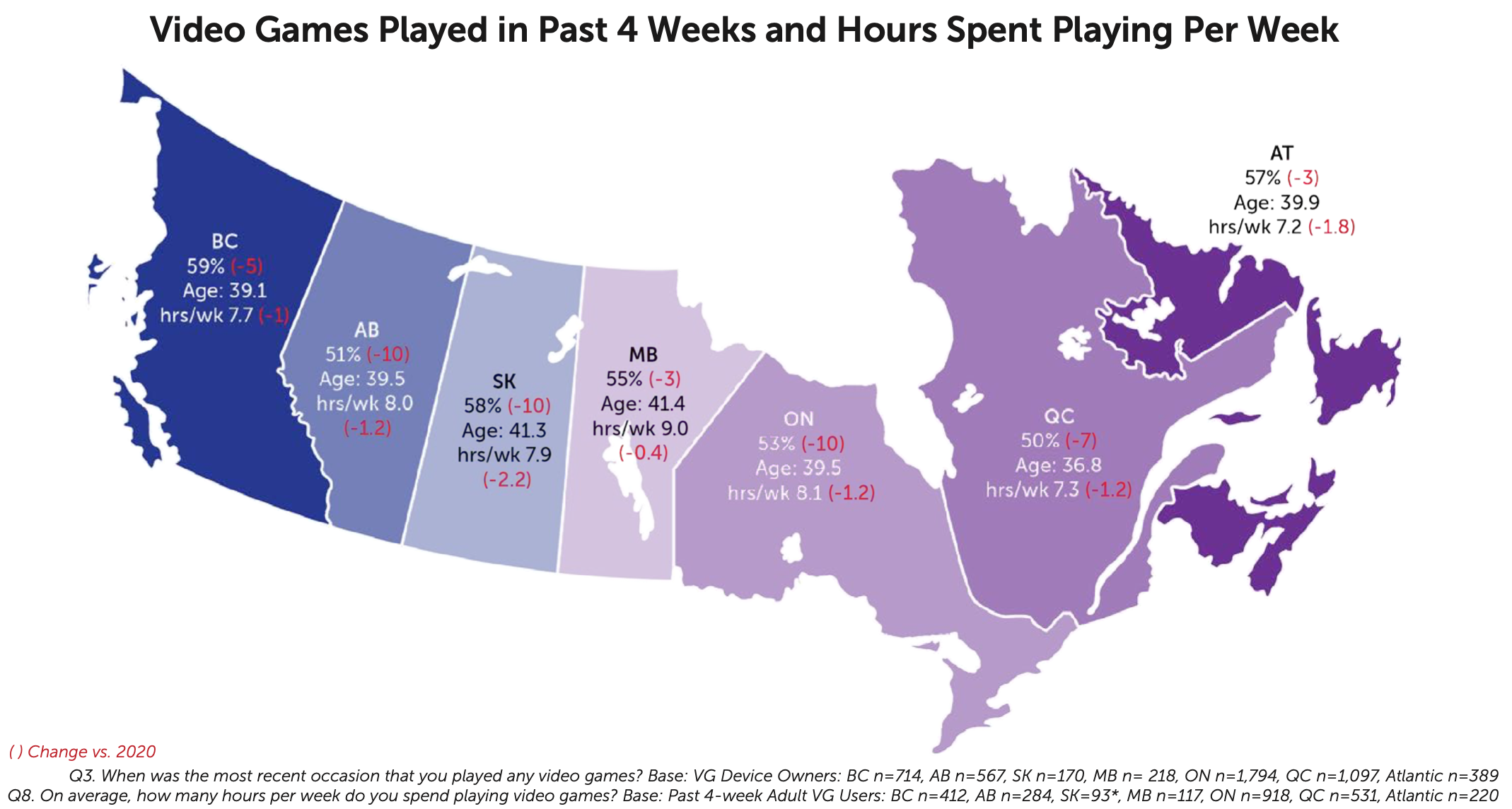
All provinces were gaming less overall, but some have been playing more than others.
“We have a balanced population of people who play video games. It doesn’t matter if you live in Newfoundland, or if you live in Manitoba or British Columbia. I think that’s what’s important,” he says. “If there was one province that was off, compared to some of the others, I would be asking [why], but for the most part, what I see is a balanced country of a very similar demographic playing video games from coast to coast.”
Games as a form of connection
Across the board, the ESAC also wants to highlight games’ unique ability to bring people together. Indeed, the top two reasons respondents provided for playing games were the ability to socially interact with others (35 percent) and play/compete against others (34 percent). Tied for third place with 25 percent, meanwhile, were cooperating with others through games and collecting trophies and achievements.
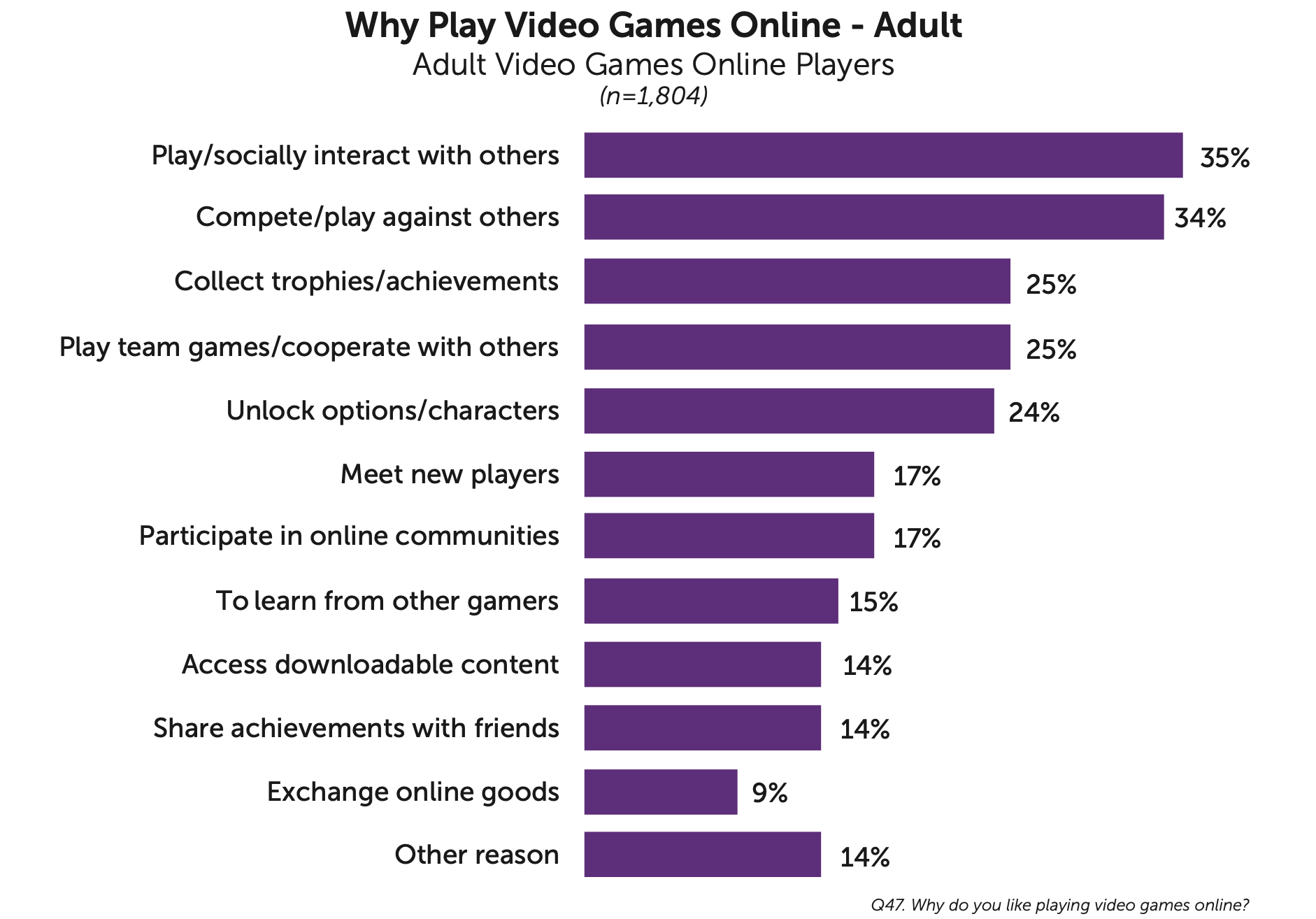
Canadians have many reasons for gaming, but some of the top ones are to connect with others.
“Video games are playing such an important part of people’s lives. It’s really moving a lot more to online gaming, people seeing games, both as a form of entertainment, but also as a place to hang out with their friends to meet new people,” says Hilchie. “One of the cool statistics is 38 percent of people have either met a really good friend or a spouse through video gaming. 38 percent of people — that’s a lot. That’s more than one-third of people doing something I would consider to be really significant.”
Companies are clearly looking at this, too, with big multiplayer games like Fortnite and Call of Duty bringing in millions of players per month. A number of popular social-focused games are even made in Canada, including Rainbow Six Siege (Ubisoft Montreal), Warframe (London, Ontario’s Digital Extremes) and FIFA 23 (EA Vancouver), all of which help contribute to the national games sector’s $5.5 billion annual contribution to Canada’s GDP.
Perhaps the biggest testament to this broader push for online games can be found at PlayStation, a company best known for blockbuster single-player experiences like Marvel’s Spider-Man, Horizon Forbidden West and God of War Ragnarök. The gaming giant plans to launch more than 10 live service games by 2026, and as part of those efforts, it recently acquired its first-ever Canadian studio, Montreal’s Haven, to develop an ambitious cloud-based title.
Hilchie, who was at the launch of Haven, says he has “a lot of respect” for studio founder Jade Raymond, a veteran of the industry who co-created Assassin’s Creed and helped found Ubisoft Toronto (Far Cry 6) and Montreal’s EA Motive (Star Wars: Squadrons).
“Just the name of the studio, Haven — it’s a haven for game developers that wants to do something different,” he says. “But at the end of the day, the majority of video game players are playing online, because they want to connect with others, they want to immerse themselves in worlds, they want to see themselves represented. And anything that video game companies can do to cater to those needs, I think is going to be reasonably successful […] I’m optimistic about what they’re going to do — not just Haven, but just across the entire industry, of being more representative of the players.”
Reaching older people
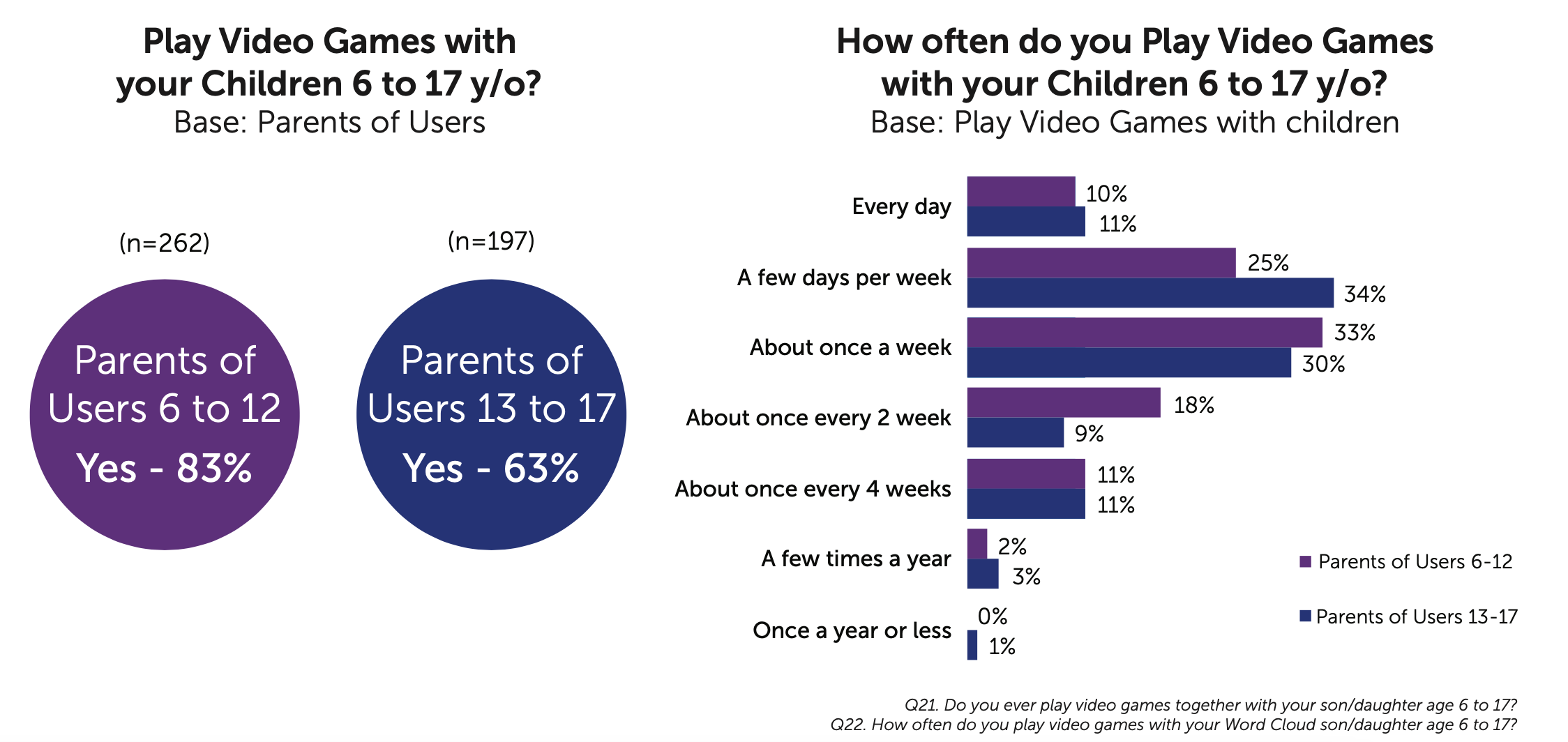
Parents are playing more with their kids.
The 2022 survey also found that games continue to reach older audiences. In particular, 74 percent of parents who play games say they do so with their children, an increase of nine percent over the past two years. Hilchie says part of this is just due to the number of kids who continue to become interested in games, but another factor is that modern parents themselves have grown up with games.
“I grew up with video games. I’m 43-years-old, I have a 10-year-old and a seven-year-old, and I like to play video games with them. My parents couldn’t have cared less about playing video games with me when I was 10 or 7. They didn’t understand what it was — they only knew that I wanted a Nintendo or Sega, and that was it,” says Hilchie. “Now it’s just so different — I understand what the kids are doing, but I also understand that it’s where they want to be. It’s where their friends are. It’s where they’re having fun.”
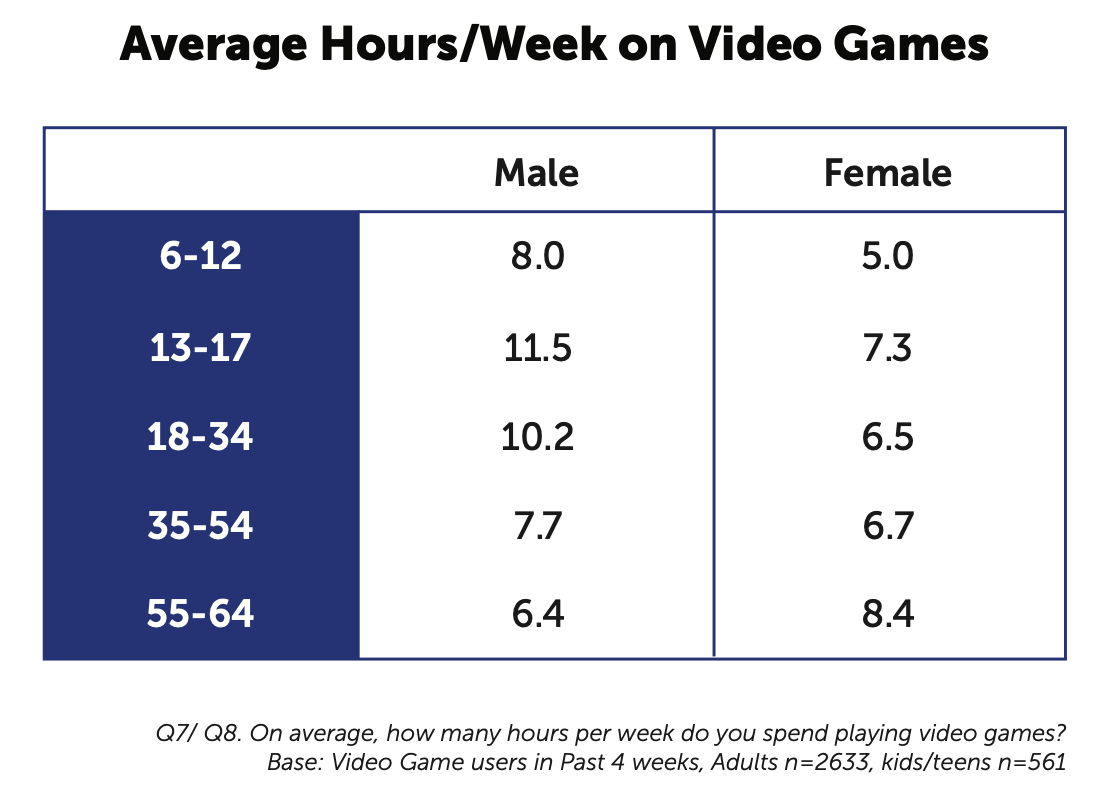
Older women are taking to games more than men in the same age groups.
What we also see in the survey is that more women in older demographics are turning to games. While the overall split of gamers once again is about 50-50, and more males in the 6-12, 13-17 and 18-34 age groups spend significantly more time playing games, this disparity, on average, shifts significantly in the older demographics. Among those aged 35-54, males spent an average of 7.7 hours per week versus 6.7 per week for women, a much smaller gap than in the other age groups. What’s more, women aged 55-64 actually played more than men — 8.4 hours versus 6.4 hours per week, respectively.
While Hilchie notes that it isn’t easy to pull a larger narrative from this, he says he thinks it points to how popular mobile games have become, and how their accessible nature appeals to older demographics.
“All I can do is surmise that because women are playing more mobile games and social games, it’s just much more accessible for them to play when they’re on the move, or when they’re on the go, whereas older men are playing more PC games. And it’s not as easy for them if they’re on the train, or if they’re traveling, to sit down and log on to the PC game that they’re playing […] I hate to generalize because not all women are playing mobile games — there are lots of women playing console games, and not all men are playing PC games or console games either […] But it does seem to me that the accessibility of mobile, and the predominant nature of that, on the women’s side of things, probably results in more women playing.”
The next level
Looking ahead, there are two areas that Hilchie says the ESAC is focusing on.
The first is the recently launched Global Video Game Coalition (GVGC), a collaboration between the ESAC and its counterparts in the likes of the U.S., Europe and Asia to raise awareness about the benefits of gaming. That includes working with the likes of the United Nations and World Health Organization (WHO), the latter of which controversially added “gaming disorder” to its list of illnesses a few years ago.
“[We want to] ensure that they understand the positive impacts that video games are making in people’s lives, specifically because of the challenges that we’ve had with the WHO — that’s why it’s based in Geneva. And we want to ensure that they understand that video games are a force for good,” says Hilchie.
Part of that is the latest Essential Facts survey, which he says raises a lot of points the GVGC brought up to the WHO. “We’re pushing a narrative right now of video games being a social, community-building, relationship-making place for people to go that is positive in people’s lives. It’s improving people’s well-being, their mental health — people are happier, they have more joy, when they play video games.”
While he notes that the gaming disorder isn’t going to change, there does seem to be an “openness and a willingness from the WHO” to explore the positive impacts of games.
“Because they’re not mutually exclusive. One can be true along with the other at the same time. And I think that’s really where the industry is trying to go, which is, ‘Okay, gaming disorder is over there, we realize that a small number of people may excess in video game play and they need to get the treatment they need to get. But over here, video games are improving so many more people’s lives by helping well-being, helping them connect, and so on.’”
The other area that Hilchie singles out, as he’s mentioned before, is continuing to work to get more women interested in games.
“There is evidence out there that girls who play video games are three times more likely to get into STEM curriculum programs and get into making them. And so the more girls, especially younger girls at early stages of their lives, get interested in video games and interested in technology and computer programming and animation, hopefully, the more we will have entering the programs that allow them to then get into the industry […] We do need to be able to get more and visible minorities into the industry and be more representative of the players who play our game, but also being more representative within the people who are making them, because obviously that’s going to make the games better for everybody.”
The Essential Facts 2022 study was conducted by NPD Group among 3,091 people between May 20th to 31st, 2022. The full study can be found here.
Image credit: Shutterstock (header), ESAC (in-line photos)










 Next up is its easy-to-use UI. It’s definitely not stock Android, but it’s still pretty simple to use. It’s also quite clean and doesn’t come with a lot of ad-like apps like Samsung’s Galaxy A53. However, the TCL 30 definitely can’t beat Google’s Pixel 6a in the user interface race.
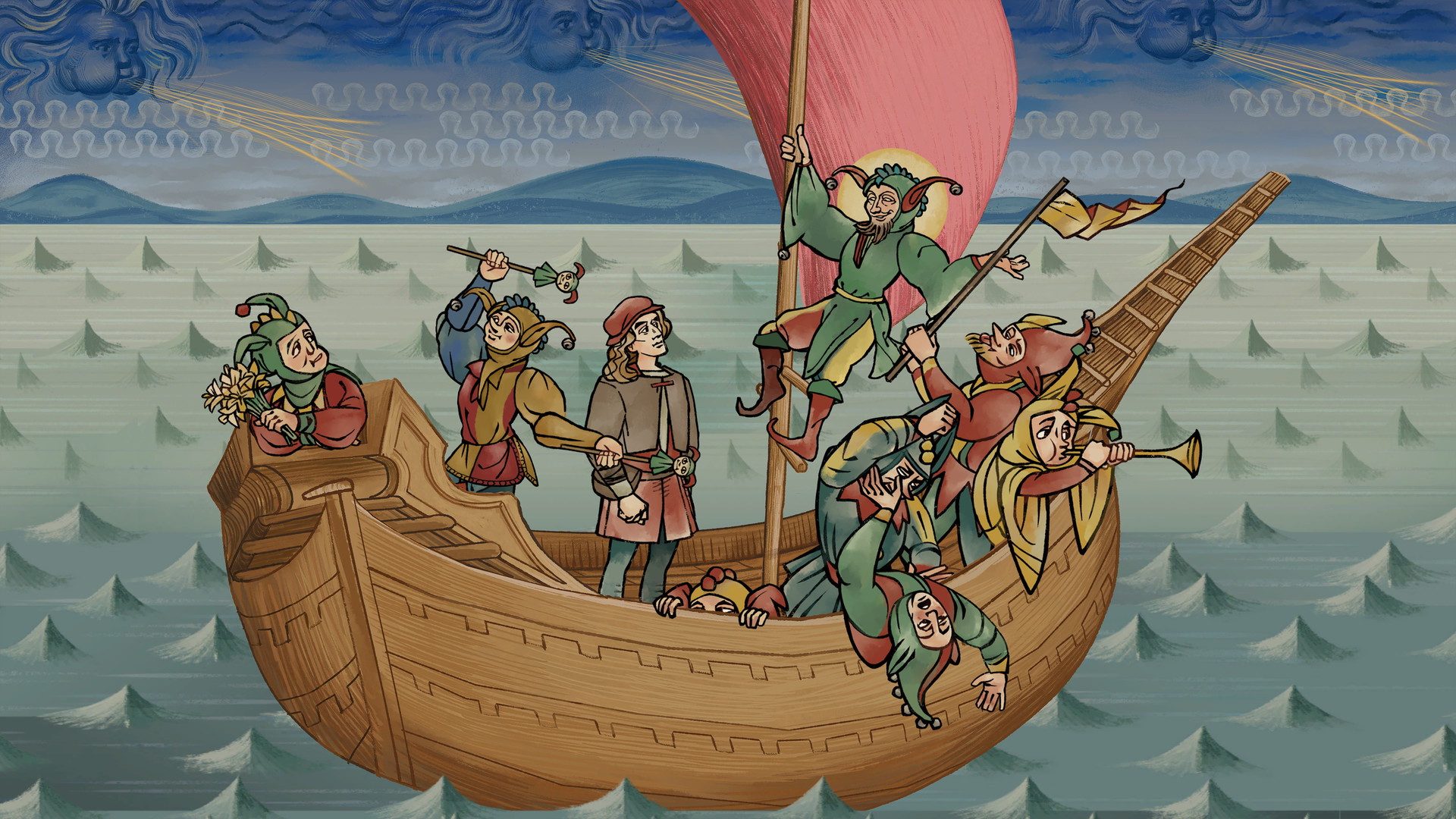 Frey: First of all, Josh wanted to go there, because it’s something that he he has a lot of history in studying and he knows a lot about. And he thought it was a kind of an interesting setting for a lot of different reasons. First of all, the printing press had just been invented and was starting to gain popularity. And what that did was it caused more people to have access to books and texts and reading, and a lot more people were learning how to read. At the same time, there was a lot of change happening in the church. So [German priest] Martin Luther was starting to fan the flames of the Reformation and having people kind of ask questions about what religion meant and what the church should be doing with what power they have. And that information was able to be spread due to the advent of the printing press. So that combination of things caused a lot of social and political upheaval and change, and telling a story in that environment sounded really cool and really appealing to us. So that’s a big part of why the setting is where it is and when it is.
 Within the team, we wanted to all really delve deep into the setting and understand it really well. So we very commonly would spend, for a pretty long amount of time regularly on Thursday evenings, the team would get together. We were all remote, so we’d get together on a call. And we would watch something or play something together that we thought would help us understand the setting more — quite often that was a show or a documentary. And we would dig really deep into that sort of stuff. So we got inspiration from all sorts of sources. And we made sure to look into things like documentaries that could educate the whole team. And it was really cool. It had this really cool effect where over the course of the project, you saw all of the team — which, yeah, the core group is like 14 people, it’s not very big — kind of learn this part of history and become semi-experts at it and all get a lot more knowledge on this time period. And that was really cool to kind of be able to correct ourselves and the old stuff we worked on as we went to and be like, ‘Oh, this isn’t accurate, wow.’ And we got to talk about that a lot, so that was really cool.
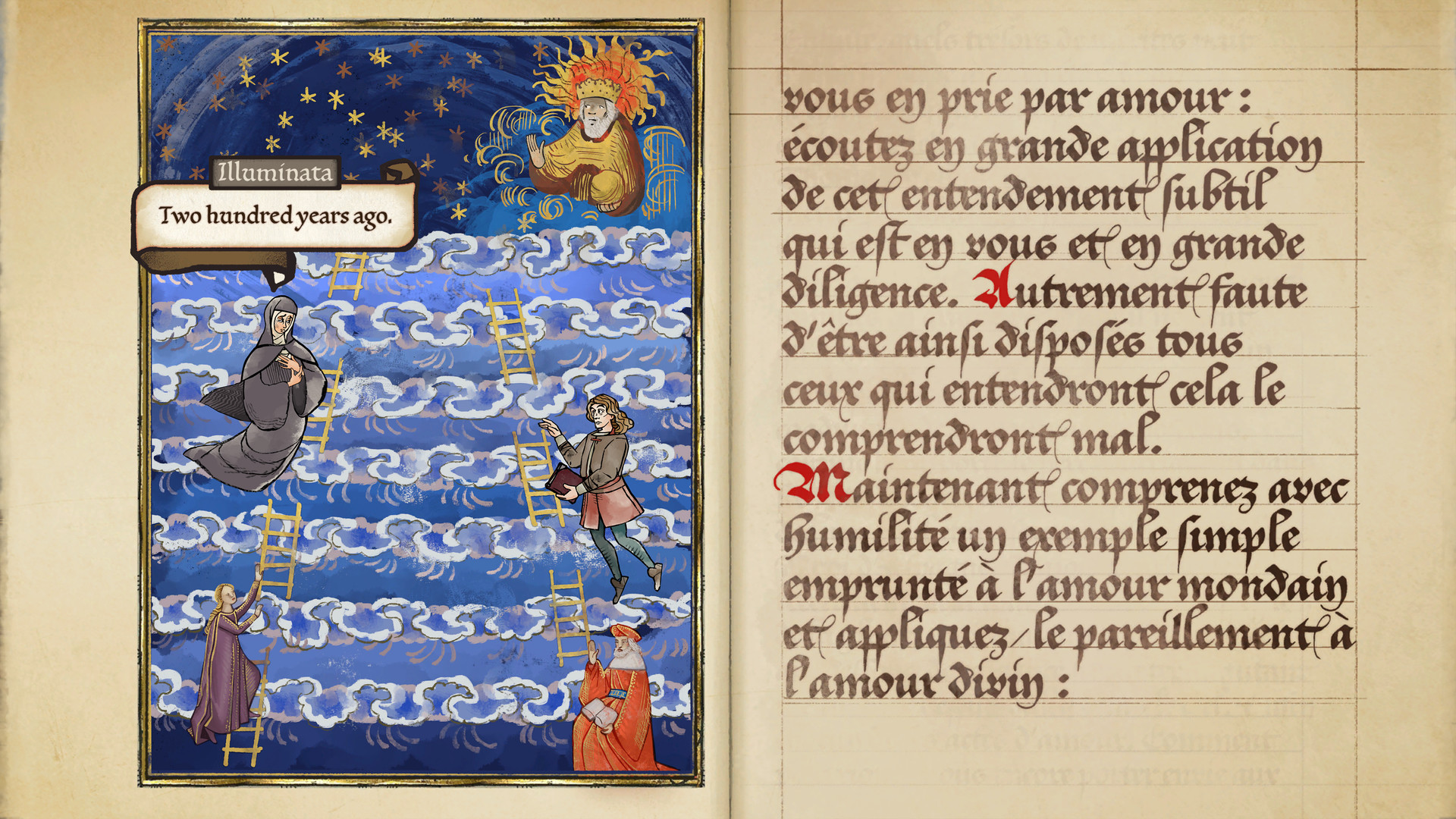
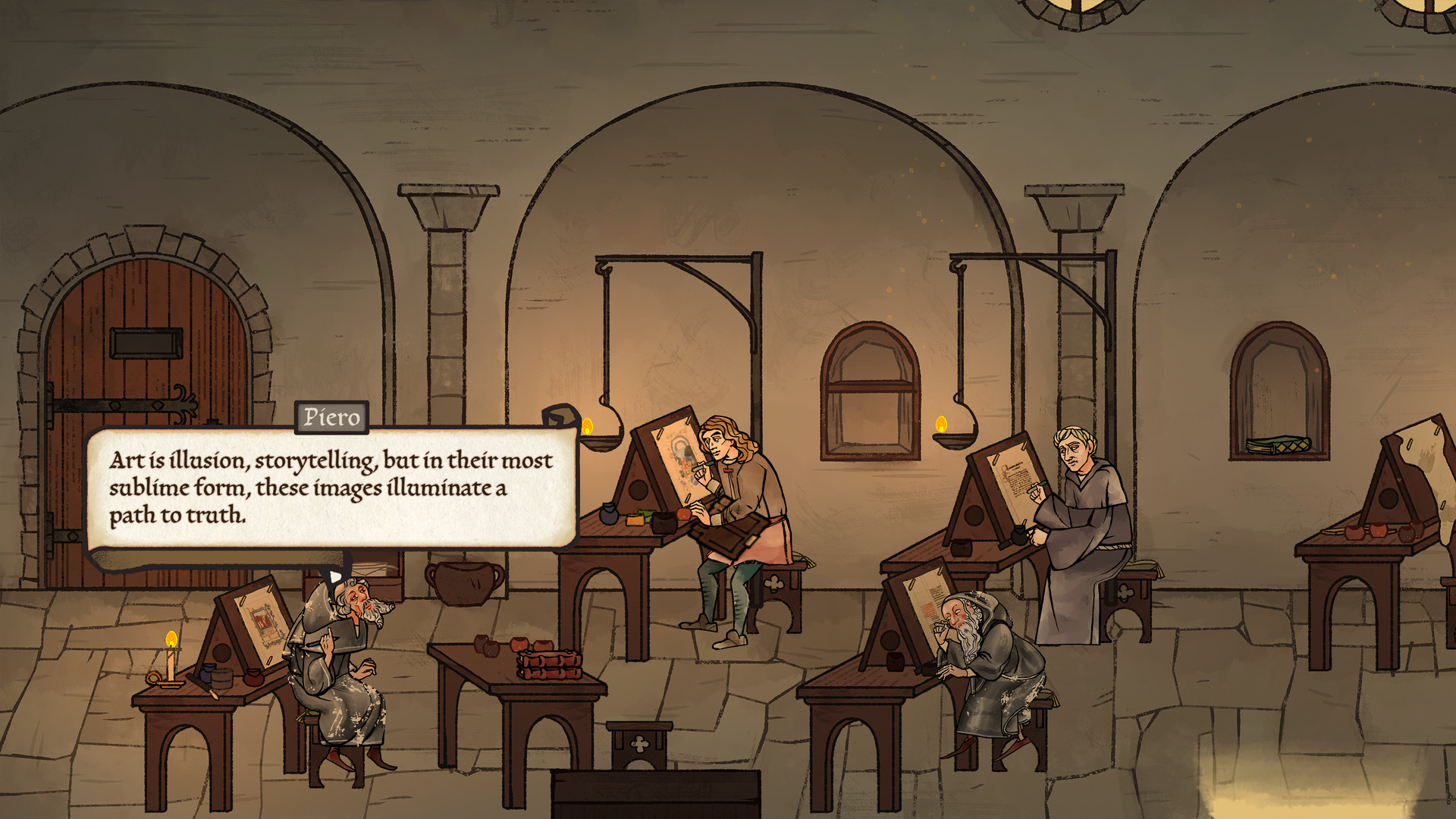 Frey: For iterations, Josh wanted to do like a 2D game, inspired by things like Night in the Woods and Oxenfree and other other adventure games that are kind of in that same field. And we thought, ‘okay, we’re doing 16th-century Bavaria — at the time, the scriptorium and illuminated manuscripts were kind of nearing the end of their life, and the woodblock printing was becoming a bigger thing.’” And so very early on, it was a decision that was made that we were going to kind of try and mesh those two. And that actually comes out in the game — you’ll notice the older characters in the game are more of an illuminated painterly style, and the younger kids look like they’re woodblock printed. And so it actually creates this really cool, like, ‘older characters have a different vibe.’ And as characters age throughout the game, you notice that. So I think that that’s a really cool aspect to how we landed on the style — the iteration on that. Even the very early stuff looks very similar to what the final version is. Some characters got cleaned up and changed; as we went, we discovered some techniques and stuff that we really liked, and we went back and changed and cleaned up some of the older characters. But even the really early stuff has that really illuminated manuscript vibe.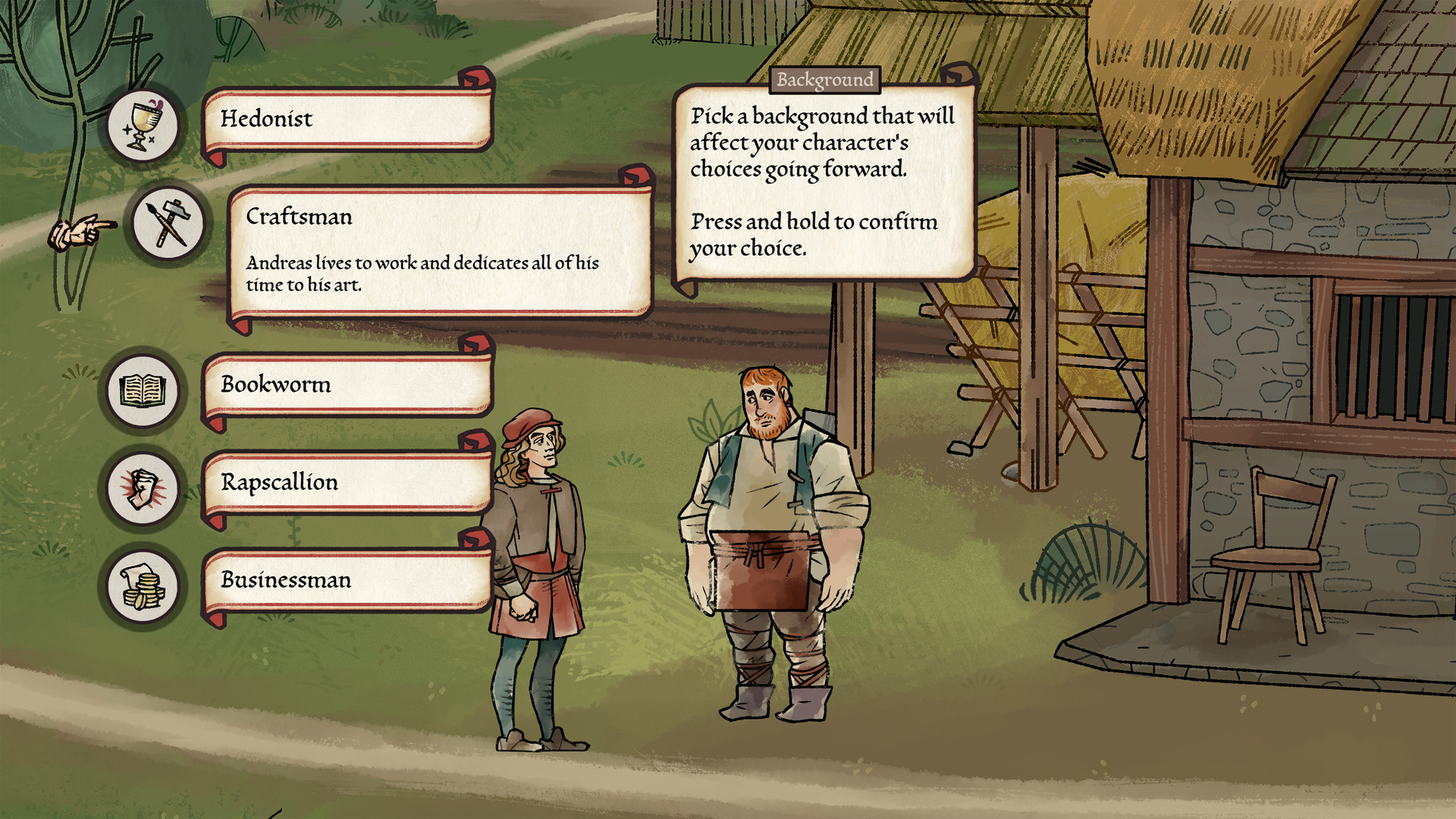
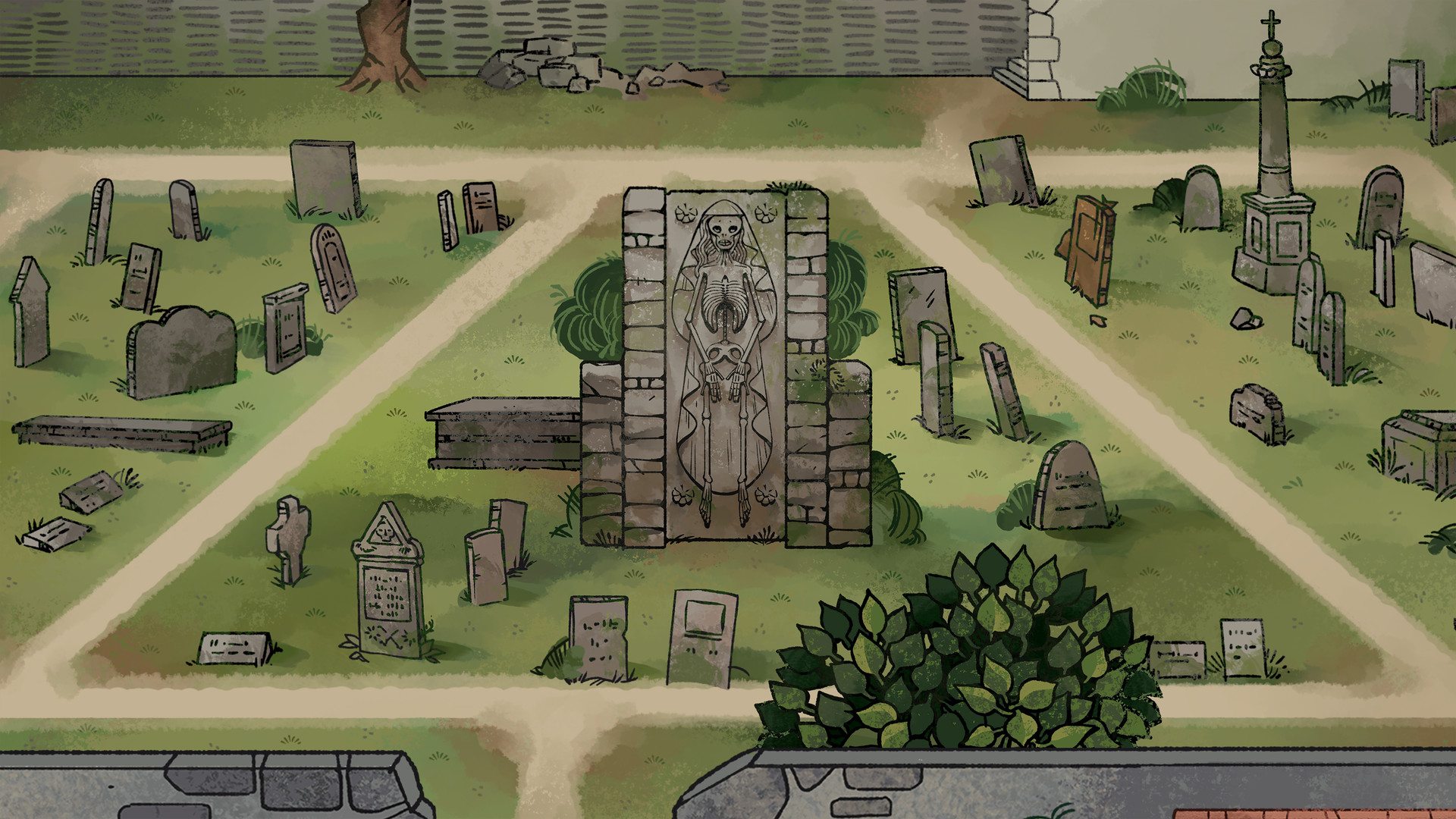 Frey: I think the biggest thing is this is a story that we tell, and first and foremost, because of that, we want to make it narrative first. Also, we’re very good at narrative and we want to bring that forward. We want to take that Obsidian way, the things we thrive at, and we really want to bring them into the story. That said, there are elements to the game that pull you out of that narrative a little bit and let you do other things. We have mini-games, we have exploration, we have other stuff in the game that we want you to interact with. But that first and foremost narrative element is really important to us, and we want to make sure that you understand that you’re reading people talking in a time of the illuminated manuscript. They talk in these special fonts. We have really cool effects when talking to them. The different characters speak differently and faster and slower and make mistakes in their writing. And we wanted to really put our energy into the manuscript in the game, and that’s kind of where it all kind of comes together and makes this narrative-focused adventure. But we also have mini-games and all that stuff, and we placed those in to make sure that they break up reading, but also, some of the things that we want to show to you is there because we want to have you experience it and not just read it. And so sometimes just giving you a mini-game gives you a better understanding of what you’re doing and what you’re playing.
