Categories
Mobile Syrup

Weird West puts the wild back in the west

I’d never seen a dead horse used as a weapon before. Now I’ll laugh every time I hear the word horseplay. And neigh, I don’t think that makes me crazy. At least not in the world of Weird West.

Weird West is the kind of game where you try to steal a bottle of whisky, but end up killing half the town by setting the bar on fire instead. You can play the game carefully and get through the story unseen and unscathed. Or you can get weird — it’s all up to you.

Developed by Wolfeye Studios, Weird West takes the immersive sim genre to new heights. It’s a fascinating blend between western and gothic horror that gives you a wide array of tools and sets you free into its world. More than any game I’ve played in recent memory, it offers a true sandbox.

The game starts with you waking to the sounds of your husband being kidnapped and your son being murdered. After a few quick tutorials to introduce the combat mechanics, travel system and character upgrades, you’re let loose. It’s up to you whether you want to go after the culprits, take on bounties, or set off in a random direction on the map. No matter what you choose, you’re sure to encounter scenarios that will test your creativity, skill and luck.

The most immersive of sims

For those unfamiliar with the genre, immersive sims are built on the idea that players should be able to approach a situation in any way they see fit. Popular games in the genre include Deus Ex, Deathloop, Dishonored, and Prey. The last three of those were made by Arkane Studios, a studio co-founded by Wolfeye Studio’s Creative Director, Raphael Colantonio. Their current team might be a bit smaller, but that also means they have more creative freedom. And immersive sims are all about freedom. Whether you want to go in guns blazing or take the stealthy route, the genre is defined by giving player’s as much freedom as possible when it comes to gameplay. Weird West encourages outside-the-box — even if that means performing heinous crimes.

Early in the game, a text box pops up telling you that you can kill anyone you meet — even important story characters. And they weren’t kidding. If you want to walk into a random town, murder everyone in sight, loot their bodies, and sell their belongings back to their families, you can. It’s not just about violence, though. You can often find solutions to problems by exploring the environment, making friends, or just being patient. The game is built on a set of rules. It’s up to you to manipulate those rules to your advantage.

If you really want, you can play the entire game without killing anyone. Or so the developers say. I’m having way too much fun being the monster of the west to try it out.
Thanks to some smart decisions by the developers, Weird West‘s systems truly feel like they’re reacting to your decisions. This isn’t a high budget first-person game that needs detailed textures to achieve a sense of immersion. By cutting out unnecessary features and expensive elements, they were able to create a focused adventure that has a much grander scope than its AAA counterparts.

Despite foregoing voice acting for the most part, the game manages to create an intoxicating atmosphere that’s hard to pull yourself away from. The writer’s have done an excellent job keeping the dialogue to a minimum while still offering plenty of lore, world building, and character to the proceedings. The lower production quality is well worth the tradeoff in terms of scope and player consequence.

What was that about a flying horse corpse?

At its most basic, Weird West is a real-time twin-stick shooter with special abilities, branching dialogue, and a lot of explosions. More broadly, it’s a world where your demons are set loose. And it feels so good.

But be careful. You’re not the only one with a dark side. Walking over to the sheriff’s office, you’ll find a board with bounties on it. Take those on and you’ll reap the rewards. Fail to put your target in the ground in the allotted time though and the hunter will become the hunted.

Go to the local gun shop and you’ll find your wallet instantly lighter as you stock up on the finest barrels and bullets. But at any moment, you might find yourself at the end of another’s shiny barrel.
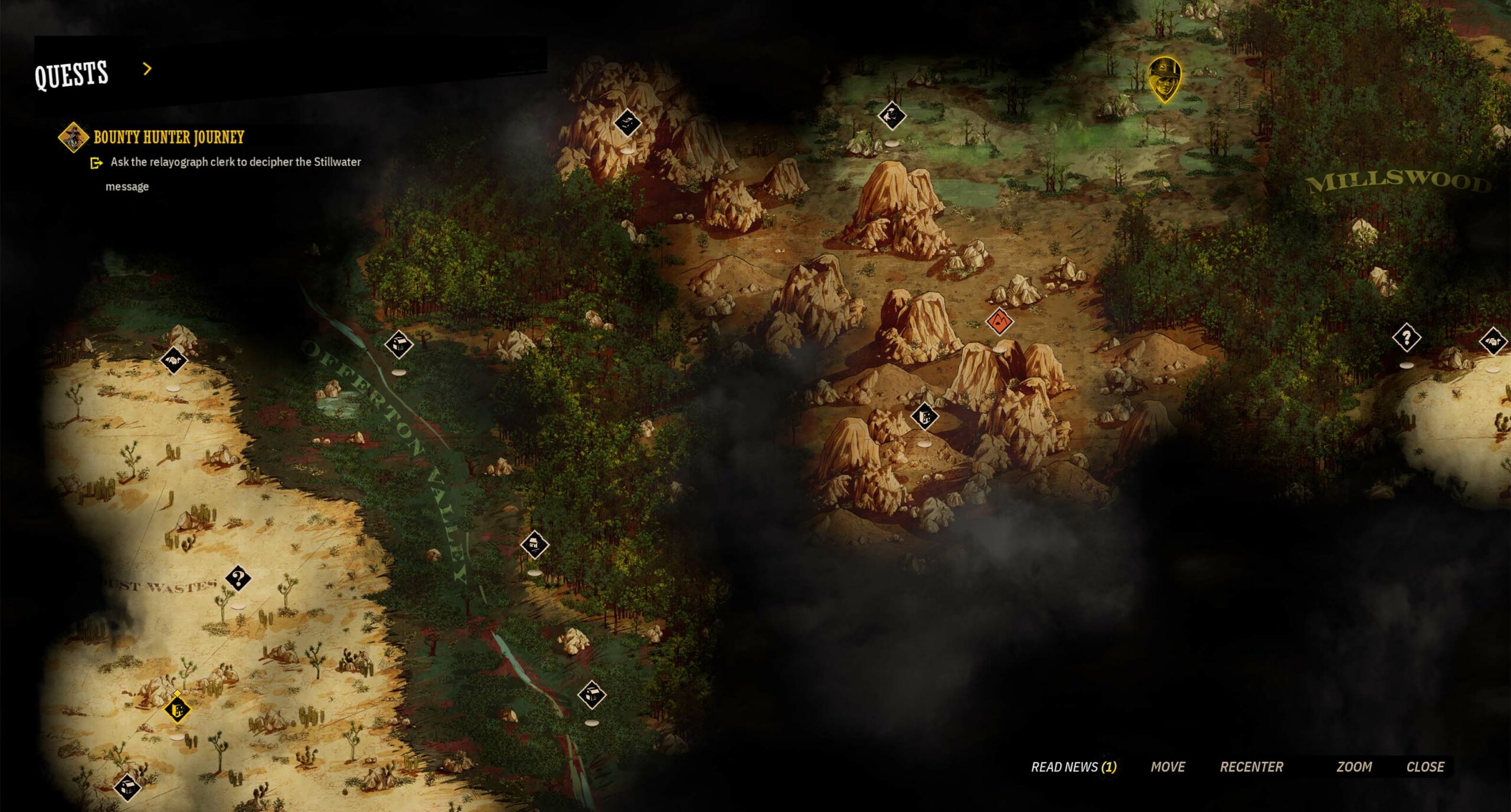
When you decide to brave the wilderness and travel to your first destination, you’ll be faced with a new reality — one filled with all sorts of creatures and con artists. Travelling not only takes time, but puts you at the risk of random encounters. If you stumble across a band of robbers, you’ll need to either pay them off or settle for the smell of gunpowder.

Not all encounters are bad though. There are teasures to be had, and mysteries to unravel. Some of the best mysteries in the game come from these random encounters, and they may take hours to pay off. They’re never more than a minor deviation from your path, but they always carry the risk of using up your supplies before you reach your destination.

Once you do, it’s time to get to work.

All in a night’s work

Weird West is all about making decisions.

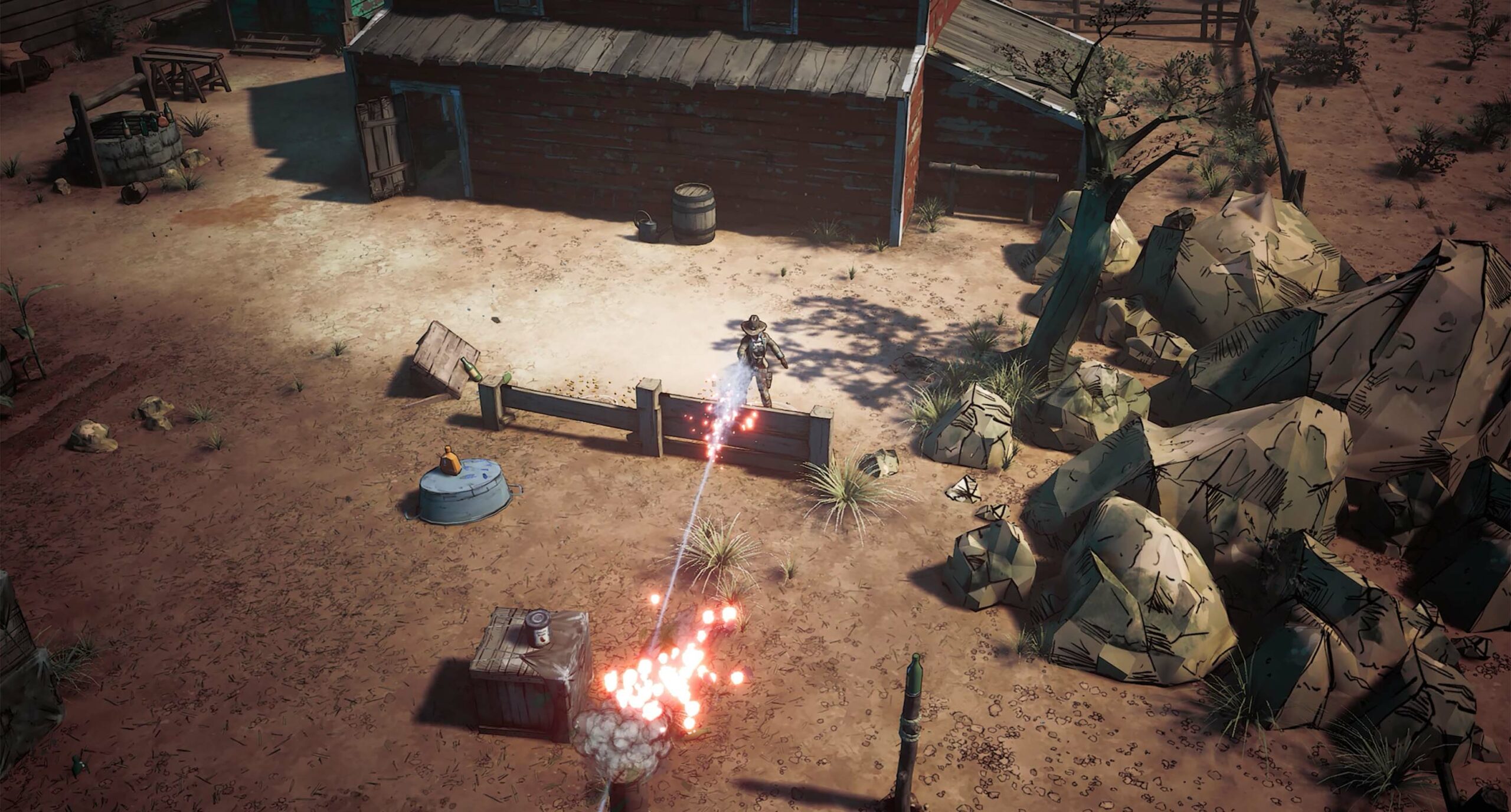
Let’s say you’re tasked with rescuing a prisoner from a gang out in the badlands. You can wander in, light some dynamite, and pick off your foes as the gang members descend on you in droves. This is a totally viable strategy if you’re well equipped and use your abilities effectively.

Alternatively, you can sneak into the compound, lower a rope down the well, lockpick the door to the holding cell, and distract everyone by blowing up their distillery while you escape.

Or if you don’t want to risk either of those, you could seek out a nearby saloon, get one of the gang members drunk, steal their possessions, and use map and key you find to enter the hidden entrance to the holding cells without anyone being the wiser.

Not every scenario offers this many options, but even if there aren’t planned variations by the developers, your choices are still nearly endless. Every environment in the game is a combat zone if you try hard enough.
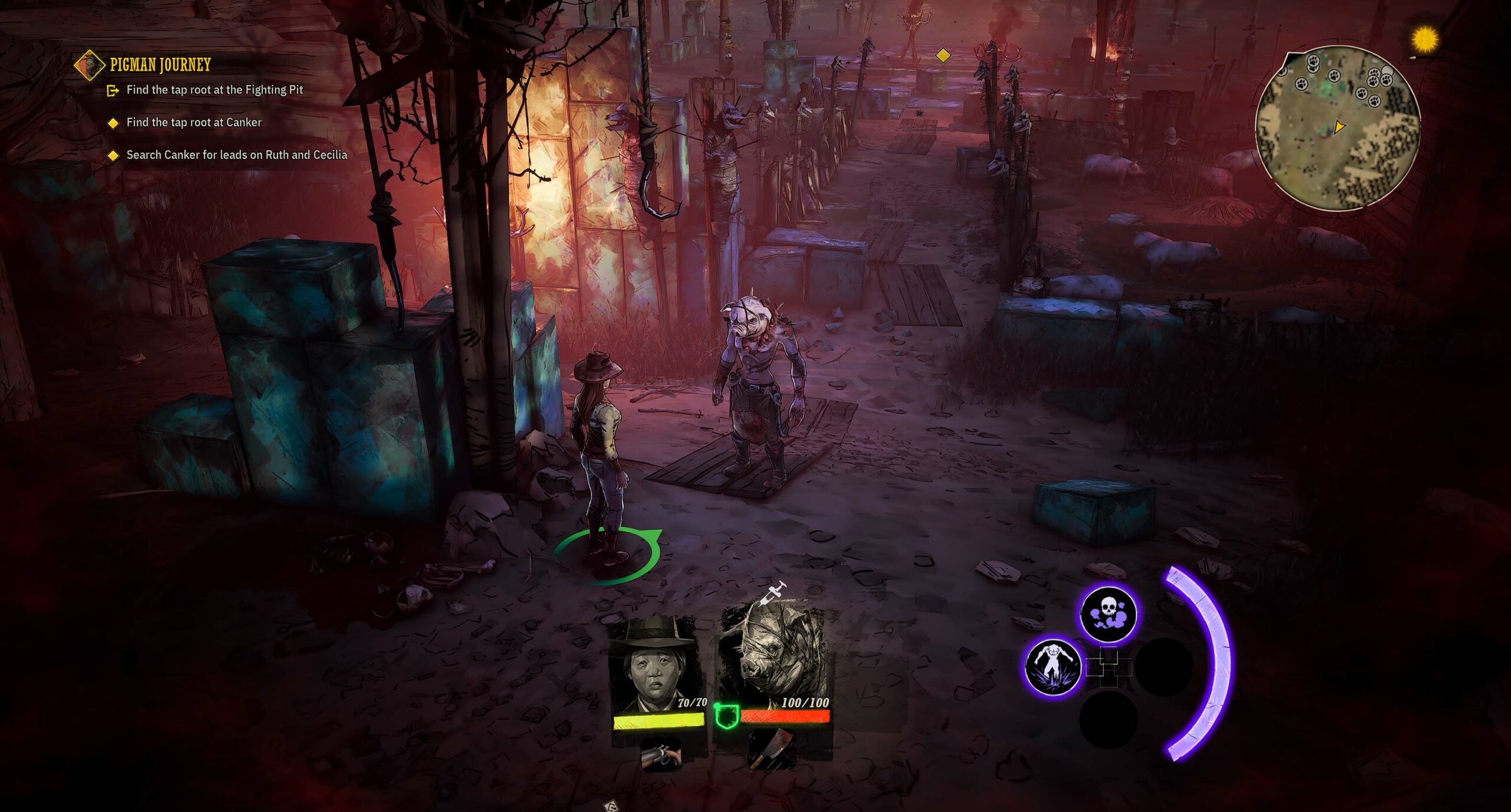
This is one of the first immersive sims where I chose violence as often as I sought out a peaceful solution. The gunplay is satisfying, the abilities make you feel powerful, and dynamite makes things go boom.

However, while controllers can be used, playing with one on PC is far more finicky than using a mouse and keyboard — something you don’t often hear for twin-stick shooters. The aiming doesn’t feel tight in the way that something like The Ascent did with a gamepad. And not being able to remap the controls is something I’d really like to see added in a patch down the road. With a mouse and keyboard though, the combat manages to balance careful decision making and frantic real-time combat.

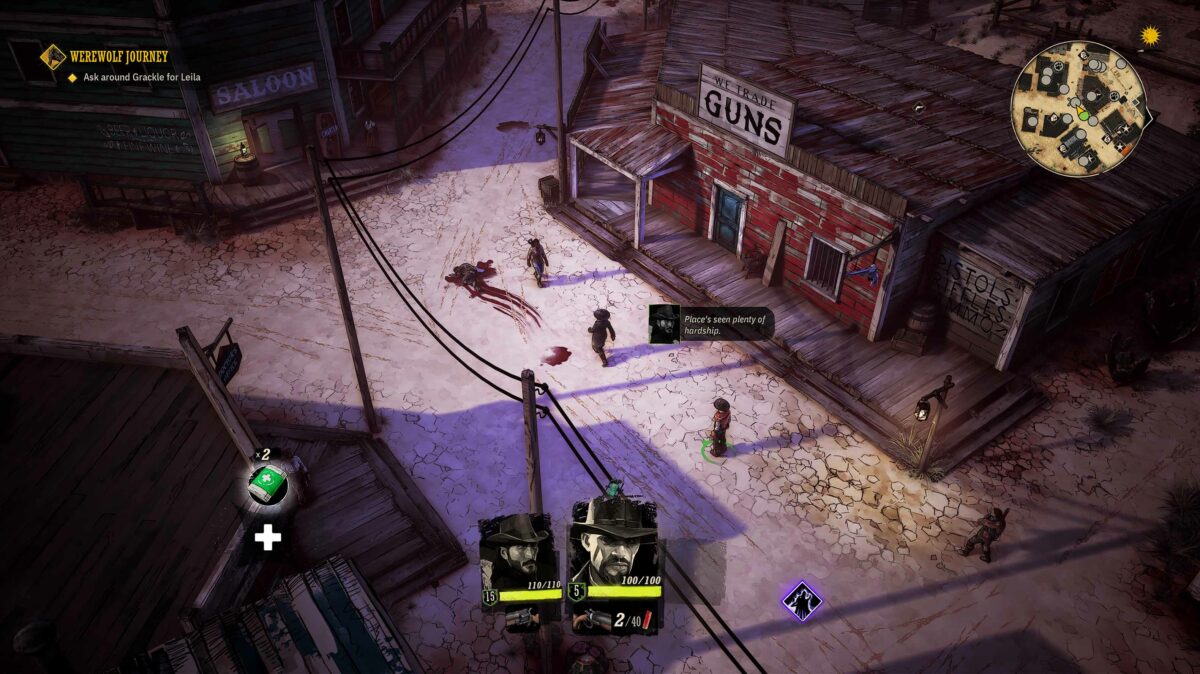
Or more often, those careful decisions are what lead to combat. I really needed some money to buy bullets for my rifle at one point, so I decided to steal from the local saloon. I went behind the bar and attempted to grab a bottle of whisky without anyone noticing. Well, next thing I knew guns were drawn, and I was shooting my way out of the bar.

And that’s when I accidentally shot the oil lamp.

The entire bar went up in a blaze. I ran outside, chased by the surviving patrons. Luckily for me, they were dead drunk, so a lot of their shots missed. While they were missing me though, they were hitting everything else, including my horse. One of the drunkards lobbed a full stick of dynamite in my direction. It sailed right over my head, landing at the hooves of my now dead horse. The explosion sent him careening through the air, taking out the very person who threw the dynamite. Incredible.

Give loot the boot

Not all encounters are this lively though, especially in the early game. You’ll spend a lot of time slowly sneaking up behind people and knocking them out before they can react to save on ammunition. There’s not much to the stealth here. It’s a lot of hiding in bushes, waiting for the moment to strike, and dragging bodies out of sight.

But that’s not the real issue. The problem is the pacing outside of combat and conversations. And it comes down to one thing: loot.

Like many games in the genre, Weird West requires you to loot every nook and cranny in its world to find the best gear—and to maintain your supplies. If it had a better inventory system this might not have been too much of a pain, but by the twenty-hour mark, I was sick of looting bodies in the hopes of a shiny upgrade. I never want to see another deck of cards.
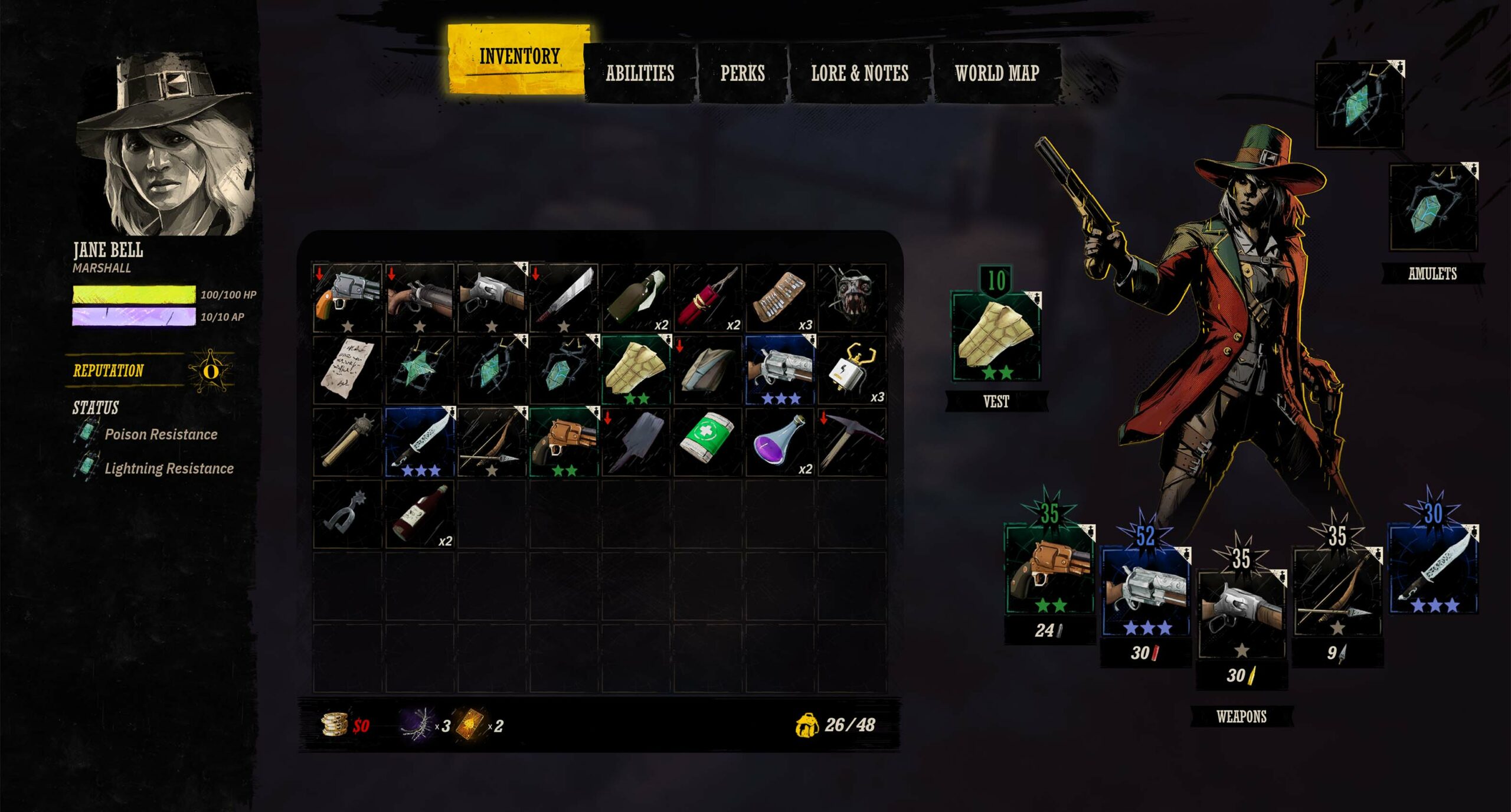
When you’re not looting though, the game manages to find ways to make most moments engaging. At any moment hell can break loose. And it’s in those moments that Weird West is at its best. They may not be constant, or even consistent, but they add up to create an unforgettable experience.

That’s also in part thanks to the music. The moment the music kicked in for the first time, I could tell that I was in for something special. It was simultaneously foreboding and inviting. An odd mix of western and electronic that I hadn’t heard before. So far, this is the soundtrack of the year for me. Paired with some great writing, it’s a world that’s hard to shake.

I touched upon it earlier, but the writing manages to set an ominous tone without overstaying its welcome. Most conversations only last a minute or two, though the characters will linger in your mind much longer. It isn’t the kind of story that had me emotionally invested in every story beat, yet I found myself eagerly anticipating the next major moment. There are plenty of surprising revelations that shine a new light on the world of Weird West. It might not be at the forefront of the narrative conversation this year, but the writing here shouldn’t be overlooked.

The weird wild west

This is a world where it isn’t unusual to run into cannibals, werewolves, witches, and cults. Heathens, hounds, and hallowed souls are bound to threaten your life. And you’re connected to many of these supernatural elements.

Throughout Weird West, you won’t just play as one character, but five. While you start as a bounty hunter with an unnatural aptitude for firearms, you’ll inhabit several other beings as well. Each presents a new view of the world and the battlefield. Don’t expect the same strategies to work for every character. And don’t be afraid to experiment.

That’s why I haven’t completed the main story of Weird West just yet. I have countless saves, replaying the same scenarios over and over again to see what the game would let me get away with. And it turns out, it’ll let you get away with almost anything. After all, it’s the wild west.

It’s the kind of game that will have you delivering secret love letters between gang members. The kind of game that will have you wondering what would happen if you stacked all of those boxes in the corner and toppled them on top of that guy who insulted you. And the the kind of game that lets you murder the father of a family, watch the family bury him the next day, dig up his corpse to steal his valuables at night, and come back the next day to find the family burying him again.

Even though I’m in the last couple hours of the main story, I’m far from finished with the experience. It’s the rare game where I don’t feel the need to be the good guy. Because you are held accountable for your actions, punished for your sins, and praised for killing those who dare attempt to dole that punishment out.

Weird West is now available on Playstation, Xbox, PC and Game Pass.

Image credit: WolfeEye Studios

Categories
Mobile Syrup

Tunic is a nostalgia-fueled romp but never shies away from its challenges

Tunic reminds me of my own journey and the adoption of video games into my life.

I reminisced about when cartridges and accompanying manuals were the norm. Canadian indie developer Andrew Shouldice has a lot of love for that golden age of video games and Tunic wears its fondness for era on its sleeve.

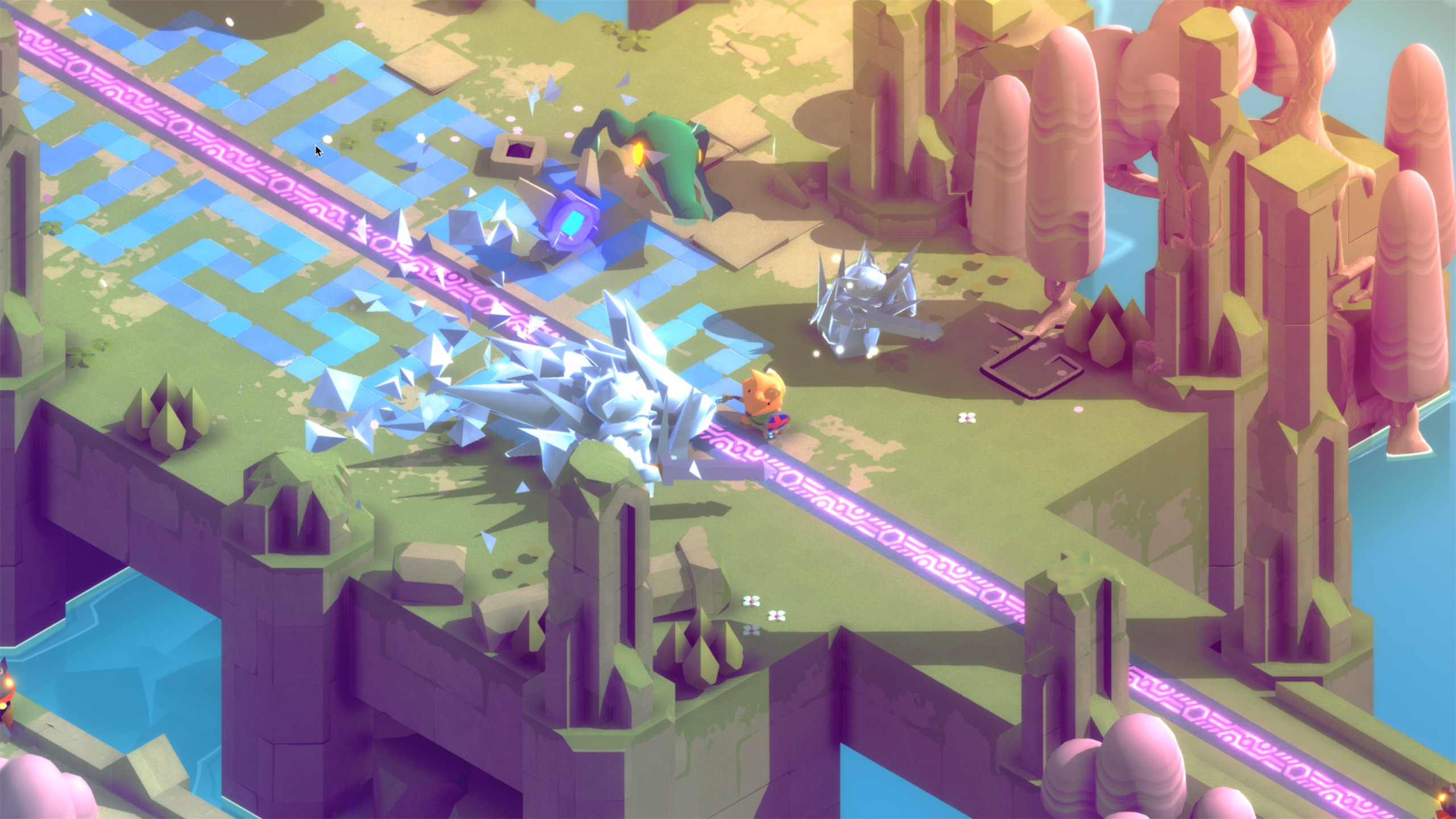
The game is an adorable and colourful love letter to top-down 2D dungeon crawlers. More specifically, Tunic is inspired by The Legend of Zelda series. This is evident not only by the Tunic name, a nod to the Hyruelian’s garb, but also its central items being a blue-and-red-emblazoned shield and sword. Being a product of the early ’90s, Tunic speaks to me on a deep level. Bringing Tunic into a more contemporary light, the game incorporates a lot of Dark Souls elements into its gameplay.

Tunic takes a minimalist approach to its storytelling. Much like many games of the NES era, a lot of the story is interpreted by the player. We see the central anthropomorphic fox character — who, for simplicity’s sake, I’ll call “Tunic” — wake up on the shores of an island. Here, the journey of piecing together the mysteries on this isle begins in this isometric game.

Due to Tunic taking a hands-off approach to storytelling, the game mainly pulls you through the paces by way of collecting manual pages. Just like how I poured hours over the Super Mario World manual back in the day, everything you need to know about Tunic can be found by collecting these pages in the Overworld. The first few pages you find walk you through the controls and tutorial phase of the game. I eventually navigated my way to find a sword and shield, thus establishing myself as a fighting force on the island.

“Tunic isn’t afraid to put the responsibility in the hands of the player. Once you understand the toybox, it’s easier to progress and solve the many brilliant puzzles.”

Tunic’s objectives hinge around a central temple located in the middle of the island. First, you must open the doors by ringing two belltowers on the island. Next, players must locate three keys being guarded by bosses deep within the game’s dungeons. I explored a range of diverse areas including a forest temple, beach-side ruins, and snowy hilltops. The game never actively directs the player via exposition or dialogue. It’s all discovered by parsing through the recovered pages of the manual. Tunic isn’t afraid to put the responsibility in the hands of the player. Once you understand the toybox, it’s easier to progress and solve the many brilliant puzzles.

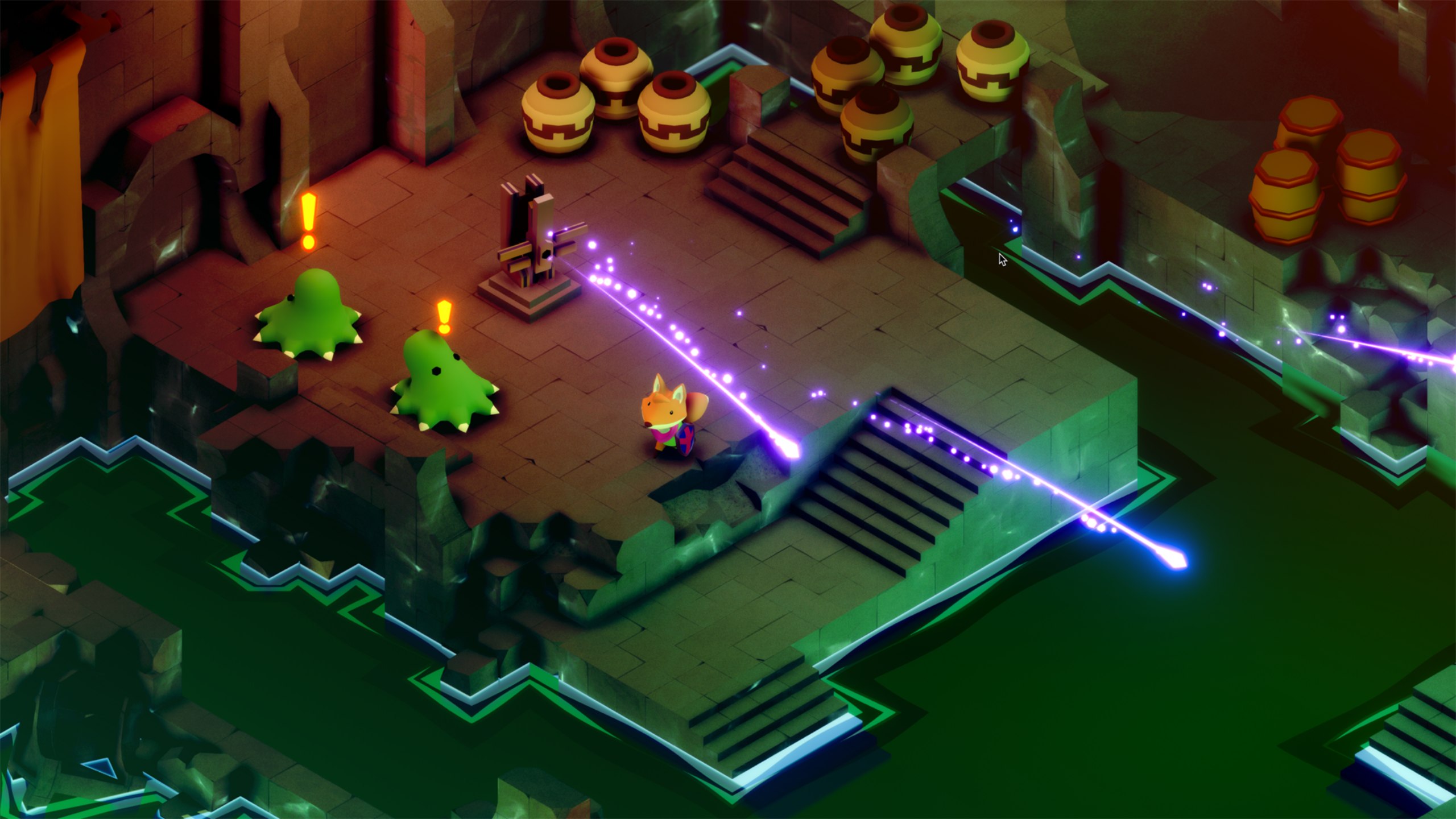
Tunic features several puzzles to piece together as you make your way across each of the various hubs featured in its Overworld. There are two common puzzles throughout the game. The first is the obelisk puzzle, which connects these vibrant power rails to one another. Praying at these obelisks will activate them and oftentimes open up a fast travel portal or a door to progress. The other is line puzzles. Throughout the world, I came across patterns that I traced using the D-Pad on Xbox Series X. Sometimes these would spawn a collectible treasure, a faerie, or open up secret passages.

One of the most novel aspects of Tunic is its fictional undecipherable language that is commonly used throughout the world and in the manuals. This leads to some required critical thinking from the player. Some pages have scribbles and notes made, akin to my own as a kid. This led to me playing connect the dots across the pages. In many ways, this genius puzzle design was my favourite aspect of playing Tunic. In fact, I was so invested in this 10-hour tale, I fully completed the game and all its achievements.

“Exploration is key in Tunic and the game rewards the curious. Even after completion, I’m certain that there are still little routes I’ve yet to take…”

With this hands-off approach in mind, some of the navigation and objectives of Tunic can be a bit obtuse. There’s no waypoint or traditional compass on-screen, so finding your way to the various dungeons and back again can become a bit frustrating. A lot hinges on memorizing the map and learning about the game’s shortcuts. Often, hitting a wall would open up invisible paths. Paths even snake their way behind waterfalls. Exploration is key in Tunic and the game rewards the curious. Even after completion, I’m certain that there are still little routes I’ve yet to take as I may not have organically come across them throughout my journey. The lack of direction can lead to some irritating moments. There were a couple of moments when I felt stonewalled by the game when the solution was staring me in the face.

Where Tunic’s diversions from the NES-era are the most apparent is its gameplay. While maintaining a somewhat simplistic approach to defeating skeletons, and other mobs, the game takes a lot of inspiration from the ‘Soulsborne’ genre. Enemies hit hard and Tunic only has a set amount of health and potions. Tunic can dodge out of the way of enemy attacks or use his shield to protect himself. Similar to Elden Ring’s health regenerating Sacred Flasks, once depleted I had to scurry back to one of the many prayer statues. This regenerates health, mana, and potions but also the mobs. While certainly challenging at times, Tunic is more accessible by virtue. Plus the game offers a ‘No-Fail’ mode and the option to get rid of stamina restrictions.

It’s been an interesting period for me as I distracted myself from Elden Ring with Tunic and found myself enamoured by how similar the two games are. Both games offer little instructions and rely on astute problem-solving and fortitude. Tunic puts difficulty in the back seat but still offers its own unique challenges. This is apparent in some of the later boss battles. Though, thanks to some of the additional weaponry like the Magic Staff, Magic Orb, and bombs, victory is feasible.

Tunic features a wonderfully crafted world and art style. While maintaining the familiar look of a game I’d play on an old CRT, Tunic is more refined in its appearance. The Quarry, a later area in the game, does feature some on-screen effects that aren’t that pleasant to look at. Thankfully, there is an in-game item to negate those effects.

The soundtrack in Tunic is also whimsical and soothing. I don’t have a standout track in mind, though the music reinforces the lighthearted and curious nature of our central fox character. It ramps up when needed but otherwise provides a calming audible treat in the backdrop during exploration and puzzle-solving.

As a ’90s kid, Tunic hits on so many levels. The game celebrates the pre-internet days of gaming. Where manuals were the Bible and sole resource to reach the credits. It creates a meta-level of gaming that pays off in many ways. Though, the hands-off approach does come at a cost at times when you lose direction in the overworld. While providing a solid challenge throughout, Tunic is an accessible and caring game for players young and old. Those weary of the Soulsborne comparisons can rest assured that the climax is obtainable. With this in mind, Tunic is a game that you shouldn’t miss.

Tunic is available on PC, Xbox One and Xbox Series X/S for $34.99. The game can also be played via Xbox Game Pass.

Image credit: Finji 

Categories
Mobile Syrup

How the new PlayStation Plus compares to Xbox Game Pass, Nintendo Switch Online in Canada

On March 29th, Sony finally unveiled its long-rumoured expansion to PlayStation Plus.

Keeping the same branding, the service merges PlayStation Plus and PlayStation Now in addition to offering various other perks, all spread out across three tiers. This all-new PS Plus is set to launch sometime in June.

Naturally, one of the first questions people may have is “how does it compare to Xbox Game Pass?” After all, it’s a service that many have praised for its value, and one that has been reported to be PlayStation’s answer to Microsoft’s offering.

With that in mind, we’re breaking down how the all-new PlayStation Plus stacks up to Xbox Game Pass, as well as Nintendo’s Switch Online service. It should be noted that there are many differences between all three, so these are by no means 1:1 comparisons.


PlayStation Plus

For context, the current PS Plus offers access to online multiplayer, a few free games a month, cloud saves and exclusive deals on the PlayStation Store. PlayStation 5 owners, specifically, can get nearly two dozen games for free, including God of WarUncharted 4Bloodborne and Monster Hunter World.

There’s currently only one PS Plus tier, with three payment options:

  • One month — $11.99
  • Three months — $29.99
  • 12 months — $69.99

Meanwhile, the current PS Now service offers more than 800 PS2, PS3 and PS4 titles via streaming, and it costs $12.99/month.

With that out of the way, this is a breakdown of the new PS Plus. Note that we’re using rough conversions from USD to CAD because PlayStation hasn’t yet responded regarding Canadian pricing.

PlayStation Plus Essential — same perks as current PS Plus (same price)

PlayStation Plus Extra — All Essential perks, plus “up to 400” PS4 and PS5 downloadable games from first- and third-party studios ($14.99 USD/about $18.75 CAD monthly, $39.99 USD/about $50 CAD quarterly or $99.99 USD/about $125 CAD yearly)

PlayStation Plus Premium — All Essential and Extra perks, as well as:

  • “up to 340” more games, including PS3 games (streaming only), a “catalogue of beloved classic games” from the PS1, PS2 and PSP eras (can be streamed and downloaded)
  • time-limited game trials for “select” titles
  • costs $17.99 USD/about $22.50 CAD monthly, $49.99 USD/about $62.53 CAD quarterly or $119.99 USD/about $150 CAD yearly

Key takeaway: PlayStation has been almost completely mum about what any of these games are. In the company’s blog post announcing the PS Plus expansion, the only launch titles mentioned are Death Stranding, God of War, Marvel’s Spider-Man, Marvel’s Spider-Man: Miles Morales, Mortal Kombat 11 and Returnal. The biggest question mark, then, relates to what those older PS1/PS2/PSP games will end up being. As such, the value of the service can’t properly be judged at present.

It’s also important to note that the new PS Plus will not offer first-party games like God of War: Ragnarok on day one. This is the biggest way in which PS Plus is different from Xbox Game Pass. That said, PlayStation boss Jim Ryan noted that the industry is always changing and that this stance could change in the future.


Xbox Game Pass

First, it should be noted that Microsoft’s direct equivalent to the current PlayStation Plus offering is Xbox Live Gold. At a cost of $11.99/month or $29.99/year, Xbox Live Gold offers access to online multiplayer plus a few free games every month and exclusive deals on the Microsoft Store — just like PS Plus.

That said, with PS Plus and PS Now merging to offer expanded, all-in-one functionality, it will be more apt to compare Sony’s service to Xbox Game Pass.

For context, there are a few Game Pass memberships.

The base Game Pass membership, which is available on Xbox and PC with some catalogue variations, costs $11.99/month and offers:

  • Hundreds of Xbox Series X/S, Xbox One, Xbox 360 and original Xbox games, including day one Xbox Game Studios titles like Halo Infinite, Forza Horizon 5 and the upcoming Starfield (new games added monthly)
  • EA Play (PC only) — catalogue of EA games, discounts and free trials
  • Member-exclusive 20 percent discounts to purchase any game in the catalogue

But the best value for Game Pass is the second tier, Game Pass Ultimate. For $16.99/month, you get:

  • Access to Game Pass on console and PC, including all of their respective catalogues
  • Xbox Cloud Gaming — streaming on a selection of these titles to console, PC and mobile devices
  • Xbox Live Gold (console)
  • EA Play (console)

Key takeaway: It should be noted that while Game Pass does include older games like Crimson Skies (OG Xbox) and Fallout: New Vegas (Xbox 360), the Xbox Series X/S and Xbox One’s innate backwards compatibility means that you can also purchase older titles individually or even use your discs if you still have them. This is in stark contrast to PlayStation Plus, which is locking titles from the PS1, PS2 and PSP generations behind its more premium tiers — no à la carte buying option available.

It’s also worth mentioning that a Game Pass “family plan” is also reportedly coming later this year, although it hasn’t yet been confirmed by Xbox.


Nintendo Switch Online

We’re largely just including this here to round out the “Big Three,” because otherwise, Switch Online really doesn’t have much in common with the other services.

Like PlayStation Plus and Xbox Live Gold, Switch Online is required for online play. It also offers a catalogue of more than 100 NES and SNES games, including Super Mario Bros.Metroid and The Legend of Zelda: A Link to the Past, with new freebies added every month. Finally, cloud saves are supported.

This base tier is priced as follows:

  • One month (single account) — $4.99
  • Three months (single account) — $9.99
  • Twelve months (single account) — $24.99
  • Twelve months family membership (supports eight Nintendo accounts) — $44.99

That said, there’s an “Expansion Pack” option with includes everything from the standard tier, plus Nintendo 64 and Sega Genesis titles. These include The Legend of Zelda: Ocarina of TimeSuper Mario 64 and Banjo-Kazooie from the N64 and Sonic the Hedgehog 2Castlevania Bloodlines and Streets of Rage 2 from the Genesis.

Expansion Pack also includes Animal Crossing: New Horizons and Mario Kart 8 Deluxe‘s respective DLC passes at no additional cost.

Expansion Pack is priced at:

  • 12 months (single account) — $63.99
  • 12 months (eight accounts) — $99.99

Key takeaway: The games catalogues offered with either Switch Online tier are exclusively retro titles. That’s a marked difference from PS Plus and Game Pass, which have older titles but mostly focus on more modern fare.


In the end, these services are really only “competitors” in that they’re all offered by rival console makers. Otherwise, they all have their own strengths and weaknesses. The unfortunate fact with all three is that the least expensive tiers are essential if you want to play games online which, let’s be honest, many people do. Beyond that, it’s really a matter of whether you care for their respective on-demand catalogues of games.

Which of these services do you subscribe to? Do you plan to sign up for the new PS Plus, and if so, which tier? Let us know in the comments.

Image credit: PlayStation

Categories
Mobile Syrup

Apple, Meta and Discord deceived by hackers posing as law enforcement to share customer information

Apple and Meta have reportedly handed over customer data to hackers who masqueraded as law enforcement officials, according to a Bloombergreport.

The incident happened in mid-2021 and resulted in the two tech giants giving away customer IP addresses, phone numbers as well as home addresses to the incognito hackers.

Bloomberg says that three people familiar with the situation have reported that the hackers raised an “emergency data request,” which usually happens during a criminal investigation when law enforcement wants information about a specific account. ‘

Requesting said information needs a search warrant signed by a judge, although “emergency data requests” don’t, and are usually raised in life-threatening situations.

According to the report, Snap also received a similar data request from the hackers hiding behind the facade, though it is still unclear whether Snap gave in or not.

“We review every data request for legal sufficiency and use advanced systems and processes to validate law enforcement requests and detect abuse,” a Meta spokesperson told Bloomberg. “We block known compromised accounts from making requests and work with law enforcement to respond to incidents involving suspected fraudulent requests, as we have done in this case.”

“As we have done in this case,” says the spokesperson after the company he works for handed over crucial customer information to the hackers. Nice.

Investigation into the matter has revealed that some entities behind the data breach are minors from the U.K. and the U.S. and had links with a cybercrime group known as “Recursion Team.”

Intelligence found that Recursion is no longer in operation though several of its members are now believed to be in direct affiliation with hacker group Lapsus$, who recently hacked its way into Nvidia, Microsoft, Samsung, Globant and more.

The stolen information was then used by the hackers to carry out harassment campaigns and financial fraud.

In a later update, Discord added that it also received fraudulent “emergency data requests,” and abided.

Source: Bloomberg

Categories
Mobile Syrup

Apple launches iOS 15.4.1, hopes to solve iPhone and iPhone battery drainage issues

Apple has released iOS 15.4.1, a minor improvement to its previously released iOS 15.4 software update. While also bringing an aassortment of changes to tvOS, macOS and watchOS, all eyes are on Apple’s latest software update and how it aims to fix known battery issues with the iPhone and the iPad.

Following the launch of iOS 15.4 a few weeks ago, iPhone and iPad users reported experiencing battery drainage issues with their devices. Apple’s latest software update aims to fix this problem.

The release notes for iOS 15.4.1 are as follows:

      • “Battery may drain more quickly than expected after updating to iOS/iPadOS 15.4
      • Braille devices may become unresponsive while navigating text or displaying an alert
      • Made for iPhone/iPad hearing devices may lose connection within some third-party apps”

Alongside iOS 15.4.1 for iPhone and iPad, Apple has launched tvOS 15.4.1, watchOS 8.5.1 and macOS 12.3.1 across all regions. These updates bring the usual bug fixes, security updates commonly found across Apple’s several software updates.

iOS 15.4 was a significant drop for Apple products. It arrived on March 14th and brought the long-awaited ability to unlock an iPhone while wearing a mask using Face ID. Apple also launched Universal Control support and a new voice for Siri.

Categories
Mobile Syrup

Google Maps now features ‘eco-friendly routing’ on mobile

Google has launched a new Maps mobile app feature in Canada that aims to help drivers make more sustainable choices.

Called “eco-friendly driving,” the feature uses AI to analyze carbon emissions of your planned route and suggests alternative directions that would consume less fuel. The app takes into account traffic, road steepness and other variables.

As Google notes, nearly 20 percent of global CO2 emissions come from ground transportation, which was a key reason why this feature has been introduced.

Google Maps can be downloaded for free on Android and iOS.

Categories
Mobile Syrup

Windows 11’s Phone Link app gets redesigned interface and spotlight for notifications

Microsoft has taken the Your Phone app and given it a refresh in the form of a UI overhaul and new features. Moving forward, the app is now called Phone Link and puts notifications out front for added exposure.

The tech giant announced the next step in the evolution of the Your Phone app. Phone Link will now be taking the mantle. It will still be a crucial tool to access photos, texts, and other important features on your computer.

This tool was first introduced three years ago and the overhaul comes at a time when the Phone Link app needed to reflect Windows 11. The design changes mean that the app features Windows 11’s colour pallet. The app now features the rounded corners of Windows 11, updated iconography, and overall aesthetic.

Microsoft has also added the ability to filter notifications on your Windows PC and receive phone calls when your device is charging elsewhere or out of reach. Android mobile apps are accessible on PC now too.

The most significant addition to the Phone Link app is how notifications are upfront for the user’s benefit. Thanks to this change, it should be much easier to see alerts and notifications pop up throughout the day. Tabbed notifications are also in the update. This ensures users have access to manage calls, apps, messages and photos.

In addition, the next Windows 11 update brings the ability to set up Phone Link during the initial set-up of a PC. This feature utilizes a QR code that users can scan with their device and streamline that process.

Windows 11 has been progressively bridging the gap between PC and Android. The improvements made and subsequent changes to the Phone Link app only strengthen that notion. The improvements Microsoft is bringing to the table should only enhance multitasking and update the ways users can share media between devices.

The release of the Phone Link app comes hand-in-hand with the Link to Windows app on Android. This was formerly known as the Your Phone Companion and is an important facet between a PC and a smartphone.

Via: Engadget

Categories
Mobile Syrup

Telus’ mobile network offers consistent quality, according to Tutela report

Telus’ mobile network “dominated” in quality tests, scoring highest in Tutela’s latest ‘Canada State of Mobile Experience‘ report.

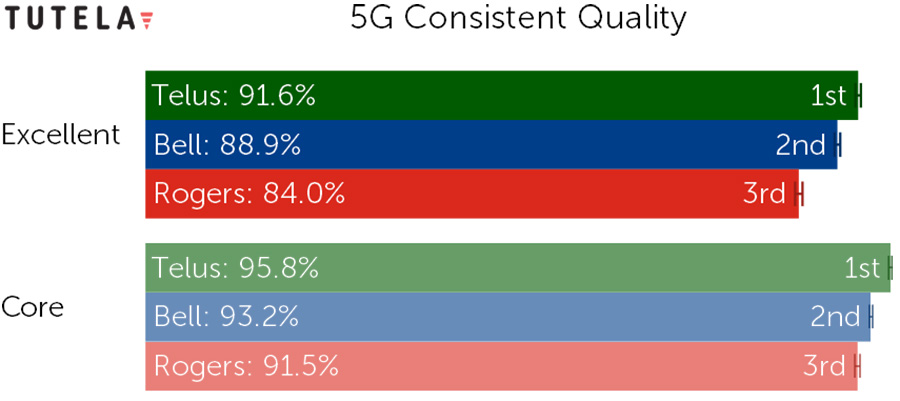
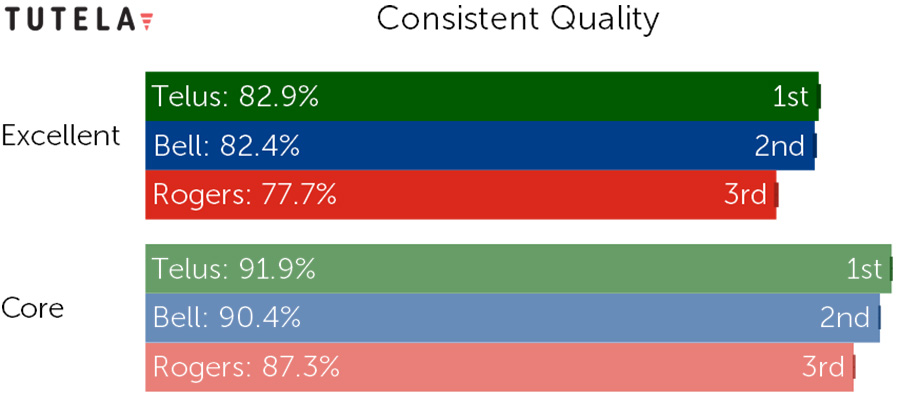
In an email to MobileSyrup, Tutela highlighted points from the report, noting that Telus had the highest ‘Excellent Consistent Quality on a 5G Network’ at 91.6 percent. Telus also scored the best for ‘Excellent Consistent Quality’ of its overall network at 82.9 percent, followed closely by Bell at 82.4 percent and Rogers at 77.7 percent.

Tutela details in its report that its annual benchmark evaluated 879,152 speed and latency tests “conducted on the smartphones of real-world users of national mobile operators within Common Coverage Areas, between September 2021 and February 2022.

5G Consistent Quality | Image credit: Tutela

The report also breaks down what, exactly, an 82.9 percent consistent quality score means. In short, Tutela says that 82.9 percent of Telus’ mobile connections were good enough to handle demanding tasks and apps like 1080p video streaming, high definition group video calling, and real-time mobile gaming.

Overall Consistent Quality | image credit: Tutela

Tutela also shared “Core Consistent Quality” scores measured the percentage of connections that “users’ average experience met the minimum recommended performance thresholds for lower performance applications.” That included standard definition (SD) quality video, voice calls, and web browsing.

Again, Telus scored best here at 91.9 percent, followed by Bell at 90.4 percent, with Rogers taking third at 87.3 percent.

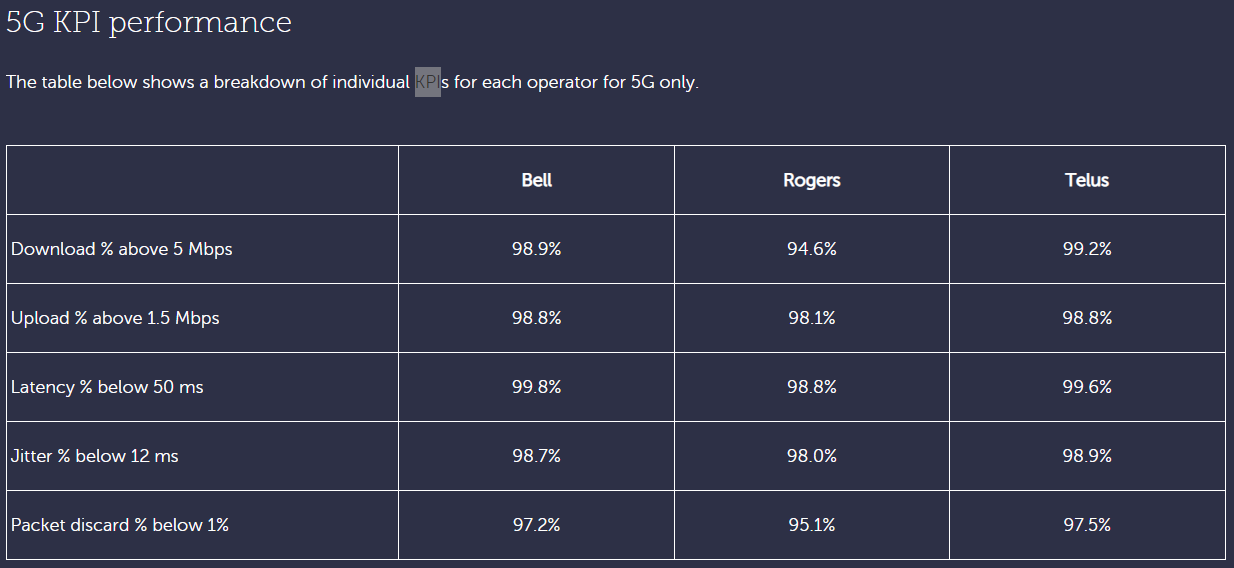
Finally, Tutela shared a breakdown of key performance indicators (KPIs) for each network overall and for 5G specifically.

Tutela describes itself as an “independent crowdsourced data company” that gathers information on mobile infrastructure and tests wireless experiences.

You can view the full report here.

Categories
Mobile Syrup

‘Nothing’ might have plans to finally show off its smartphone on April 1

After last week’s disastrous ‘Nothing’ presentation, the company is back at it again, hyping up another announcement. The event is set for April 1st, April Fools Day, too… so there’s that.

The teaser image shows off the bottom of a smartphone, hinting that perhaps we’ll finally catch a glimpse of the long-overdue Nothing smartphone. But at this point, I wouldn’t be surprised if Carl Pei just came out and showed us tangible proof that he actually was the first person to buy an iPod, or something.

I don’t expect this to be a full-blown event like the keynote on March 23rd. It could end up being something as anticlimactic as simple as a blog post hyping a Nothing phone spec like fast charging or a brief glimpse at its design.

Since the Nothing Launcher is scheduled to drop in April, my bet is we’ll get more information about it and possibly even a release date.

The company has retooled its Twitter and Instagram presences to be called ‘Another,’ and you can see the phone’s teaser image on both accounts. The bottom of the device features curved sides that look suspiciously like the OnePlus 10 Pro, but with more symmetrical speaker grills.

Source: Nothing

Categories
Mobile Syrup

E3 2022 reportedly cancelled, virtual expo to no longer be held this year

It appears as though the ESA has cancelled any form of E3 this year. According to recent reports, E3 2022, both digitally and in-person, is officially cancelled.

Earlier this year, it was reported that the ESA cancelled its week-long E3 event. Previously, E3 has been held annually at the Los Angeles Convention Center in June. At the time, rumours swirled about whether the digital version would be held. It appears as though the ESA will not be moving forward with any version of E3 this year.

Will Powers, a notable PR lead at Razer, tweeted that he received official confirmation from the ESA directly regarding the cancellation of E3 2022. “It’s official, E3 digital is official cancelled for 2022,” Powers writes. In a response to an inquiry about whether it was only the in-person event, Powers states E3 is “officially cancelled cancelled.”

IGN independently confirms the news. Its report states that rather than focus on a digital show, the ESA is regrouping “for a larger comeback in 2023.”

Last year, the ESA held a virtual substitute for E3. The end result saw mixed reactions, largely from media and those who held virtual passes. Aside from the strange avatar creations and focus on outdated chatrooms for networking, organization and publisher involvement was lacking.

Geoff Keighley and his Summer Game Fest programming have been slowly picking up the torch dropped by the ESA over the past few years. The Summer Game Fest has been an all-digital annual outing for the industry and has gained a lot of support.

Following Powers’ tweet, Keighley tweeted a single, yet cheeky winking emoji.

News of this comes at a time when many believe publishers have the ability to reach their target audience on their own by hosting virtual conferences. Last year, we saw the likes of Microsoft, Ubisoft, PlayStation, and others host their own “Direct” style shows via Twitch and YouTube.

Without the ESA and E3 this year, it will be interesting to see how publishers align their announcements and reveal next to each other throughout the June and summer months.

Source: Will Powers (Twitter)

Image credit: ESA