Categories
Mobile Syrup

Elon Musk says Starlink won’t block Russian media ‘unless at gunpoint’

Elon Musk said SpaceX’s Starlink satellite broadband service won’t block Russian news sources “unless at gunpoint” and apologized for being a “free speech absolutist.”

In a tweet (it’s always a tweet), Musk claimed some governments asked Starlink to block Russian news sources. Musk didn’t say which governments but noted the request didn’t come from Ukraine.

It’s an interesting stance to take considering Russian President Vladimir Putin’s recent crackdown on media outlets that share information contrary to the Russian government’s narrative about the invasion. Those who do could face prison sentences of up to 15 years.

Musk’s claim to be a “free speech absolutist” is especially interesting given his track record of harassing people who disagree with him, not to mention his repeated efforts to bust unions at Tesla.

Oh, and who could forget when Musk compared Canadian Prime Minister Justin Trudeau to Adolf Hitler. Yea, definitely the person I want championing free speech.

Musk’s stance puts SpaceX at odds with the growing list of tech companies taking action against Russia following its illegal invasion of Ukraine. It also comes after Musk tweeted excessively about efforts to deploy Starlink in Ukraine to help keep the country connected amid the invasion.

On that note, Musk also tweeted that SpaceX would reprioritize “to cyber defense & overcoming signal jamming,” which would cause “slight delays in Starship & Starlink V2.”

Source: Elon Musk Via: Engadget

Categories
Mobile Syrup

Mouse and keyboard support is coming to Xbox cloud games

I might finally start using Xbox Cloud Gaming (oft called xCloud) thanks to an upcoming, much-needed addition: mouse and keyboard support.

Currently, Microsoft’s game streaming service only supports gamepads and touch (on limited titles). While there’s nothing wrong with those options, I’ve found that restriction to be one of the main reasons I don’t use xCloud. The few times I’ve wanted to try xCloud games, I couldn’t because I didn’t have a controller handy. What did I have? Yup, a keyboard and a mouse.

Windows Central spotted the news in a developer Q&A video. A comment from Jorg Neumann, the head of Microsoft Flight Simulator, at 8:40 confirmed that xCloud keyboard and mouse support was on the way.

“The next step for us is mouse [and] keyboard,” Neumann said. “This is platform-level support, so it has nothing to do with us. Obviously, mouse and keyboard works for our sim. So the platform team is working on this. I know I can’t give a date because it’s the platform team. I don’t know their dates, but it’s coming.”

Neumann also said Flight Simulator would get touch control support in the future, and expressed interest in adding gyroscope support for mobile devices. Both would make Flight Simulator much more accessible on mobile devices, which can access the title now thanks to its recent arrival on xCloud.

Despite the lack of a timeline, it’s great to know that mouse and keyboard support is on the way. xCloud, to me, has always stood out as a great way to game on the go or for testing games before committing to a download. For the former, I often have a laptop with me when I’m away from home — mouse and keyboard support would make it much easier to use that for xCloud. For game testing, mouse and keyboard support would make it much easier to try PC titles like Age of Empires IV.

Source: Developer Q&A Via: Windows Central

Categories
Mobile Syrup

Samsung says an update is coming to address throttling issue

Samsung officially addressed reports that its ‘Game Optimizing Service’ (GOS) software was throttling performance in thousands of apps. The company says an update with an option to disable GOS is on the way.

In a statement to The Verge, Samsung spokesperson Kelly Yeo said:

“We value the feedback we receive about our products and after careful consideration, we plan to roll out a software update soon so users can control the performance while running game apps. Our priority is to deliver the best mobile experience for consumers. The Game Optimizing Service (GOS) has been designed to help game apps achieve a [sic] great performance while managing device temperature effectively. GOS does not manage the performance of non-gaming apps.”

The response comes after reports claimed several Samsung phones throttled the performance of some 10,000 apps, which included social media services like Instagram and TikTok, games such as Genshin Impact, and more.

GeekBench delisted Galaxy S devices impacted by GOS throttling

The throttling did not apply to benchmarking apps, which meant results from those apps didn’t reflect real-world performance. That led GeekBench, one of the more popular benchmarking services, to delist Galaxy S devices ranging back to the S10 series for “benchmark manipulation.” It’s worth noting that Galaxy Note and Galaxy A series phones are not included in this and don’t seem to have the same GOS throttling.

Moreover, Android Police analyzed the GOS code and noted that the throttling is quite sophisticated. GOS appears to balance various parameters, including temperature, expected battery level, CPU speed, and predicted FPS benefits when determining what resources a game gets. In other words, the tuning happening with GOS likely varies between different games and apps, as well as devices.

Along with the statement offered to The Verge, Samsung confirmed the authenticity of a statement shared to the Samsung Members app that was translated to English and shared widely on Twitter.

As for when users can expect an update, Samsung hasn’t yet shared a timeline.

Several publications have drawn parallels to OnePlus, which was caught in a similar situation last year. OnePlus tried to explain away the throttling as a battery life optimization feature before ultimately adding an option to let users turn it off.

Perhaps the most frustrating part of this is the lack of transparency. In both cases, I think if OnePlus and Samsung had been upfront with users, said the phones included a throttling mechanic to extend battery life, and provided an option to enable it or not, there wouldn’t have been a big debacle. The secrecy, however, soured people on the feature.

Source: The Verge

Categories
Mobile Syrup

Koodo launches Spring Sale with discounts on phones and pre-owned devices

Telus’ flanker brand Koodo launched a ‘Spring Sale’ with several deals on phones and plans.

Well, mostly phones. The provider still has the same $55/10GB and $60/15GB plans added in February, but now with fancy ‘Promotion’ stickers tacked on. Still, if you’re in the market for a new phone and don’t mind Koodo’s new data speed caps, there are some offers to consider:

Koodo also has some offers on ‘Certified Pre-owned’ devices:

  • iPhone XS – $0 down, $15/mo Tab + get a $200 Visa gift card
  • iPhone XS Max – $0 down, $17/mo Tab + get a $200 Visa gift card
  • iPhone XR – $0 down, $12/mo Tab + get a $150 Visa gift card

Finally, it’s worth noting that Koodo is offering $100 in savings if you shop online during the Spring Sale. However, what that actually means is new customers who get an eligible 4G speed data plan that costs $45/mo or more can get a $50 bill credit and Koodo will waive the $50 connection fee.

You can check out all the Koodo Spring Sale offers here.

Categories
Mobile Syrup

Freedom Mobile drops $80/mo 40GB plan from roster

Shaw-owned regional carrier Freedom Mobile has removed its $80/mo 40GB plan.

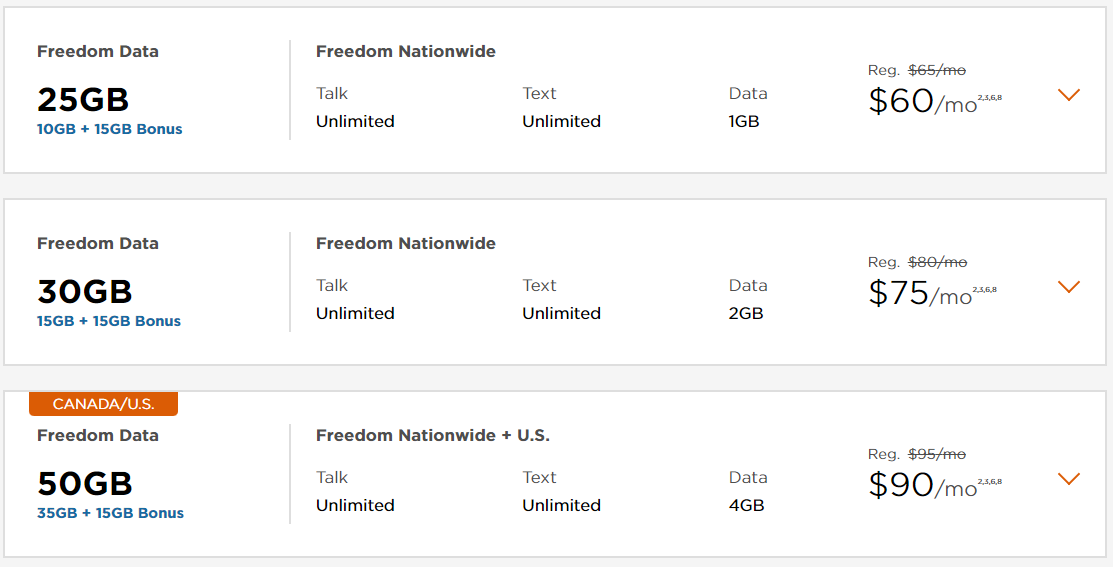
Freedom changed up its plans slightly just a few days ago, adding a new $55/mo 18GB plan and bumping its Canada/U.S. plan from $85/mo with 30GB to $90/mo with 50GB of data. However, at the time, the carrier still offered that $80/40GB plan.

It’s definitely a bummer to see the plan go considering that not everyone needs (or wants) Canada/U.S. calling. The $80 plan fit nicely at the top of Freedom’s plan stack and offered a great option with lots of data but for slightly less than the Canada/U.S. plan.

It’s unclear if Freedom will bring back the plan, or offer a similar new plan, sometime in the future.

As a refresher, Freedom’s plans offer two buckets of data — Freedom data customers can use when on Freedom’s network and ‘nationwide’ data when they’re off of Freedom’s network. The data amounts mentioned above are for Freedom data — the $80/40GB plan also had 2GB of nationwide data.

If you’re looking to get that amount of nationwide data, you’ll need to pick either Freedom’s $75/30GB plan (also has 2GB of nationwide data) or the $90/mo Canada/U.S. plan (has 4GB nationwide data). Freedom’s other plans have 1GB of nationwide data.

You can check out Freedom’s plans here.

Categories
Mobile Syrup

iFixit tears down Galaxy S22 and S22 Ultra in latest video

Samsung’s flagship Galaxy S22 series recently released, and right on cue, iFixit has torn-down the Galaxy S22 and S22 Ultra.

For the S22 Ultra, the deconstruction gives us a look at how Samsung implemented the smartphone’s S Pen stylus and shows off the device’s new cooling vapour chamber.

There’s also a vibration motor inside the S22 series’ bottom speaker rather than the top like in past devices. According to The Verge, the vibration motor is an attempt to catch up to the iPhone’s excellent ‘Taptic Engine.’

Unsurprisingly, iFixit’s video also indicates that the Samsung smartphones are difficult to repair. The phone is held together with Philips-head screws, but additional adhesive makes the device hard to pull apart. Further, the batteries in the handsets are challenging to remove and replace.

Both S22 and S22 Ultra received a three out of 10 for reparability, which is the same number the S21 Ultra hit last year.

While these devices are difficult to fix, they’re also incredibly durable. For example, a YouTuber drove over the S22 Ultra and it only suffered from a few scratches.

If you want to know more about the Galaxy S22/S22+ and S22 Ultra check out our reviews of the devices.

Image Credit: iFixit 

Categories
Mobile Syrup

Here are the big tech companies taking action against Russia

The recent illegal invasion of Ukraine by Russia has left the general population on both sides appalled. And while the West can’t do much when it comes to taking action on foreign soil, several big tech and social media companies have joined forces and decided to limit, or completely cut off Russia from their services.

Note: This story doesn’t mention any financial sanctions against Russia, and instead focuses solely on social media and big tech restrictions/limitations. This story will be updated with more information as it becomes available.

Apple

Apple announced on Tuesday, March 1st that it has halted all product sales through its web store in Russia.

Heading to the Russian Apple website shows that all items, including iPhones, iPads, Macs, Apple Watch, AirPods and accessories are marked with “в настоящее время недоступно,” which translates to “currently unavailable.”

Further, Apple has disabled live traffic and live incident data from Apple Maps in Ukraine in a bid to safeguard the local population’s locations, in addition to removing Russian state-led news outlets RT News and Sputnik News from its App Store globally, except for those accessing the store in Russia.

Russians are also currently unable to use Apple Pay as the bank that facilitates the transactions in the nation — VTB has been hit with strict economic sanctions.

Reddit

Reddit initially decided to “quarantine” (shadowban) its r/Russia and r/RussiaPolitics subreddits on Tuesday, March 1st in an effort to curb misinformation originating from threads posted by bad actors. Visiting the quarantined subreddit shows a message, stating “This community contains a high volume of information not supported by credible sources.”

Said subreddits were host to posts defending the invasion, and cherry-picking reasons to justify it, including discussions about Ukrainian soldiers being Nazis, the Ukrainian population spreading misinformation and using past war/training drill photos as current and other types of false propaganda.

Since then, Reddit has doubled down on its approach and decided to outright ban any and all links that direct to Russian state-supported media outlets, including RT and Sputnik and said that it will not allow any advertisements that “target Russia or originate from any Russia-based entity, government or private” on its platform.

Netflix

Netflix announced on Wednesday, March 2nd that it has decided to put all future projects it had undertaken in Russia on hold.

The Los Gatos, California-based streaming service had four Russian originals planned, including a Dasha Zhuk-directed crime thriller series that was in the works but has since been put on hold.

Further, Netflix was recently added to Russia’s list of ‘audiovisual services,’ and was due to oblige to new obligations starting March 1st. One of the new obligations was for Netflix to stream 20 Russian federal television stations. Since then, Netflix has responded and said that it won’t comply with the new rules.

Microsoft

In a blog post published on Friday, March 4th, Microsoft president Brad Smith announced that the company will “suspend all new sales” in Russia.

“We are coordinating closely and working in lockstep with the governments of the United States, the European Union and the United Kingdom, and we are stopping many aspects of our business in Russia in compliance with governmental sanctions decisions,” Smith wrote.

Microsoft specifies that its decision will only affect “new sales.” It’s currently unclear what that could mean for current Windows, Office, Microsoft 365, Azure, and Xbox users in Russia.

EA

EA, undoubtedly one of the biggest game developers and publishers out there announced that it is removing all Russian club and international teams from its FIFA and NHL titles.

The company announced its decision in simultaneous Tweets posted its FIFA and NHL accounts:

The move from EA further’s the International Ice Hockey Federation (IIHF), Fédération Internationale de Football Association (FIFA) and Union of European Football Associations’s (UEFA) decision to kick out Russian international and club teams from real-world sports.

In addition, EA is ceasing all operations in Russia and will stop selling its games and content, including virtual currency bundles, in Russia and its ally Belarus. “our games and content will no longer be available for purchase in our Russian region storefront on Origin or the EA app, including through in-game stores. We are also working with our platform partners to remove our titles from their stores and stop the sale of new in-game content in the region,” reads EA’s statement.

Google and YouTube

Google condemns the unjust violence in Ukraine, and as a result, the Mountain View, California-based company has disabled the Live traffic layer, in addition to information on how busy restaurants and stores are from its for Google Maps. The move should deter Russian forces from spotting concentrations of the Ukrainian population, and the ones trying to leave the country but are stuck in long roadblocks on the location and navigation service.

Additionally, on Friday, March 4th Google suspended all of its ad sales in Russia. “In light of the extraordinary circumstances, we’re pausing Google ads in Russia,” the company said in a statement given to Reuters. “The situation is evolving quickly, and we will continue to share updates when appropriate.”

This applies to all of Google’s offerings, including Google Display Advertising, Google Search, Google News and YouTube.

YouTube previously blocked Russian state-backed media outlets like RT and Sputnik from earning ad revenue, but the new rule suspends said channels from running ads completely.

Meta-owned Facebook and Instagram

In response to the ongoing conflict, Meta has blocked state-run media accounts like Russia Today on both Facebook and Instagram in the EU, UK and Ukraine. While the ban only applies to those three regions, the media outlets have been shadowbanned globally. What this means is that the state-run accounts are still live and posting, their content will be severely demoted and not recommended to anyone.

Additionally, state-run media outlets can no longer run earn-through ads on all Meta-owned platforms globally.

As a form of retaliation, the Russian government banned Facebook on Friday, March 4th, stating that the social media company had infringed the country’s rules by limiting, and in some cases, outright abolishing access to state-backed media.

Twitter

Along with Meta and its subsidiaries, Twitter has also taken down Russian state-run media accounts in EU and Ukraine, and paused ads in both Ukraine and Russia “to ensure critical public safety information is elevated and ads don’t detract from it.”

Snapchat

While Snapchat’s private format helps it avoid the spread of misinformation, and its Discover and Spotlight sections are pre-moderated, the Santa Monica, California-based company said that it will be swift to remove instances of misinformation regarding Ukraine or Russia on the platform if and when it finds any.

The company has stopped all advertising in Russia, Belarus and Ukraine and says it will stop advertising sales to all Russian and Belarusian entities. “We do not accept revenue from Russian state-owned entities,” reads its release.

Russia Today, or similar Russian state-backed media outlets were never allowed to distribute content through Snapchat.

Snapchat is still available to users in Russia.

TikTok

TikTok announced on Monday, February 28th that it has geographically blocked access to Russian-state-run media outlets like Sputnik on its platform in the EU. The channels remain available and visible on TikTok for users outside the EU.

Nintendo

On Friday, March 4th, Nintendo announced that it has suspended payments via the Russian Nintendo eShop, which means users in Russia would no longer be able to purchase video games, DLC, or download free demos.

Visiting the website currently shows a message in Russian, which roughly translates to “Due to the fact that the payment service used in Nintendo eShop has suspended the processing of payments in rubles, Nintendo eShop in Russia is temporarily placed into maintenance mode.”

CDProjekt Red

Warsaw, Poland-based CD Projekt Red announced in a Tweet on Thursday, March 3rd that it has decided to pause selling its games in Russia and Belarus. The developer states that it is working with its partners to suspend all digital sales and cease physical stock deliveries, along with halting its game sales through GOG.

“We know that players in Russia and Belarus, individuals who have nothing to do with the invasion of Ukraine, will be impacted by this decision,” reads CDProjekt Red’s statement. “With this action we wish to further galvanize the global community to speak bout what is going on in the heart of Europe.”

Poland, home of CDProjekt Red shares its border with Ukraine and Belarus.

Disney

Disney announced on Tuesday, March 1st that it will stop releasing its theatrical films in Russia.

“Given the unprovoked invasion of Ukraine and the tragic humanitarian crisis, we are pausing the release of theatrical films in Russia, including the upcoming ‘Turning Red’ from Pixar,” a Disney spokesperson said in statement given to CNN. “We will make future business decisions based on the evolving situation.”

Canadian service providers

Several Canadian TV service providers, including Bell, Rogers, Telus, Shaw, Access Communication and VMedia have pulled the state-backed RT channel from their respective lineups.

Image credit: Shutterstock

Categories
Mobile Syrup

Russian state agency blocks Twitter

Russia’s communication and mass media state regulator Roskomnadzor has blocked social media giant Twitter.

This news comes from military & intelligence correspondent at Reuters, Phil Stewart.

This past week Russia started restricting Twitter access for certain users, according to the social media company. A Reuters reporter in Moscow on Saturday said the site was slow and had difficulties sending tweets.

Following that, Russia’s Roskomnadzor said that the country had reinstated a slowdown of Twitter’s traffic on computers because of fake posts about the country’s “special operation” in Ukraine.

Earlier today, the Kremlin also passed a law threatening lengthy jail sentences for spreading “fake information” and also blocked the social media platform, Facebook.

The White House says that Russia’s decision to block Facebook is to silence its citizens.

Severa;l tech giants have already restricted activity in Russia, including Microsoft, Apple, Nintendo and Google’s ad sales business. 

Source: Reuters (@phildstewart)


Categories
Mobile Syrup

Disney+ to introduce a cheaper ad-enabled plan later this year

In an attempt to make its streaming service more attractive to non-subscribers, Disney has announced that it will introduce a cheaper ad-enabled tier to Disney+.

The new tier, which as of right now doesn’t have a price, will be introduced in the United States in late 2022, and expand to international markets in 2023.

A regular Disney+ subscription costs $11.99/month in Canada. With this in mind, the ad-enabled tier could cost anywhere between $6-$10.

It’s likely Disney-owned Hulu’s success with introducing an ad-free tier played into the decision to launch a similar offering for Disney+. Hulu already offers a $6.99 USD/month (roughly $8.79/month CAD) ad-enabled plan, along with a $12.99/month (about $16.54/month CAD) regular plan. That is a 46 percent difference in price, and is sure to attract those that want to subscribe to the service only to watch a specific series or movie, and not the service’s whole catalogue.

“Expanding access to Disney+ to a broader audience at a lower price point is a win for everyone—consumers, advertisers, and our storytellers,” said Kareem Daniel, chairman of Disney Media and Entertainment Distribution. “More consumers will be able to access our amazing content. Advertisers will be able to reach a wider audience, and our storytellers will be able to share their incredible work with more fans and families.”

The company didn’t specify when in ‘late 2022’ the new tier will be released, and which countries constitute ‘international markets’ for the delayed 2023 release. MobileSyrup has reached out to Disney but hasn’t received a response confirming Canadian availability.

Disney’s goal is to reach 230 million to 260 million subscribers by the financial year 2024. As of Q1 2022, the company reported 129.8 million subscribers, up 11.7 million from Q4 2021.

Image credit: Shutterstock

Source: Disney

Categories
Mobile Syrup

Nintendo eShop payments are suspended in Russia

A chorus of companies have stopped sales of products and services in Russia, and Nintendo is now one of them. Nintendo has announced that it has suspended payments via the Russian Nintendo eShop.

The Japanese gaming giant has confirmed that the Russian eShop is now on ‘maintenance mode’ as the payment service is unavailable. The support page on the Nintendo Russia website indicates the suspension of payments, meaning you’re not able to buy any new games, demos, DLC and more.

Here’s what the statement says translated into English via Google translate:

“Due to the fact that the payment service used in Nintendo eShop has suspended the processing of payments in rubles, Nintendo eShop in Russia is temporarily placed into maintenance mode.

We apologize for any inconvenience caused. We will share updates as the situation develops.”

Oddly, Nintendo of America’s Twitter doesn’t mention anything about the suspension. NintendoLife says that the digital store may be closed due to a third-party payment service.

Major tech companies like Microsoft, EA, Apple and Netflix and more have halted their services in Russia following the country’s illegal invasion of Ukraine.