Categories
Mobile Syrup

Upcoming Steam update will let you check game size from the library screen

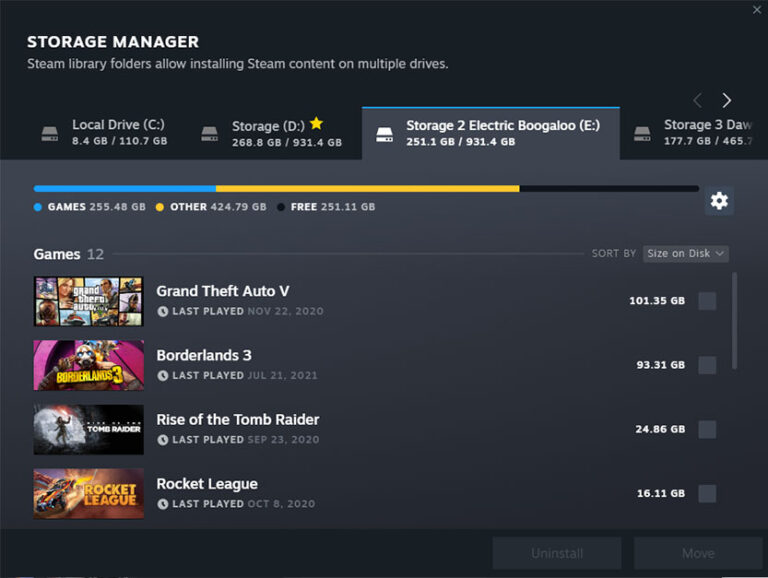
Valve-owned Steam will soon let users check out the size of titles on the ‘library’ page before they install them.

Normally, you would have to click install to see the required disk space and estimated download time (as seen in the image on the left), but with the upcoming update, these details will be available to view front and center (as seen in the image on the right).

While this isn’t a major update, it sure does make the process of scouring through games relatively easy. The feature is rolling out as part of a beta update, and should be available to all steam users in the coming weeks.

This comes shortly after Steam redesigned its downloads page to display more information on download and installation progress, along with an improved section to manage storage.

This latest update arrives almost half a month before Steam’s long-awaited Steam Deck goes on sale.  The handheld PC was delayed last year due to parts shortages but will be available starting February 25th, starting at $499 CAD.

Categories
Mobile Syrup

Netflix sizzle reel teases 2022 film slate with Knives Out 2, The Gray Man and more

Netflix has released a three-minute video offering the first looks at its 2022 film slate.

Altogether, the streamer is set to premiere 86 original movies this year, with at least one dropping every week. These include:

  • The Adam Project (directed by Montreal’s Shawn Levy) — a family sci-fi adventure starring Vancouver’s Ryan Reynolds and Mark Ruffalo
  • Enola Holmes 2 (directed by Harry Bradbeer) — a mystery starring Millie Bobbie Brown and Henry Cavill
  • The Gray Man (directed by Avengers: Endgame’s The Russo Brothers) — an action-thriller starring London, Ontario’s Ryan Gosling and Chris Evans
  • Hustle (directed by Jeremiah Zagar) — a sports-comedy starring Adam Sandler and Queen Latifah
  • Knives Out 2 (directed by Rian Johnson) — a new murder mystery starring Daniel Craig’s Benoit Blanc
  • Spiderhead (directed by Joseph Kosinski) — a sci-fi action movie starring Chris Hemsworth, Miles Teller and Jurnee Smollett

You can check out the full video below:

Release dates for individual titles weren’t mentioned in the video, although Knives Out 2 — arguably Netflix’s most anticipated 2022 film — is expected to drop in the fourth quarterThe Adam Project has also been confirmed to premiere in March.

Netflix reached nearly 222 million total paid subscribers globally in January, slightly below its projections. The company’s stock has also been down, leading co-CEO Reed Hastings to buy $20 million additional Netflix shares last month. It remains to be seen how this film slate might help drive growth.

In related news, Netflix recently raised its price in Canada to $21/month for the 4K tier — a second hike in under two years.

Source: Netflix

Categories
Mobile Syrup

Telus brings its PureFibre X internet to Lower Mainland and Fraser Valley area in B.C.

Telus’ PureFibre X internet tier, with download and upload speeds of 2.5Gbps, is now available for customers in Lower Mainland and the Fraser Valley area in British Columbia.

“TELUS PureFibre X gives entrepreneurs, start-ups, home-based businesses, students and workers access to the fastest Internet speeds available anywhere in Canada from a major provider,” reads Telus executive vice-president Zainul Mawji’s statement. “We look forward to connecting our fellow British Columbians to PureFibre X and supporting these communities as they continue to navigate the pandemic, and attract new industries and innovators to drive economic growth in British Columbia.”

The carrier claims its service offers the fastest speeds in Canada compared, and it is the only major provider in Western Canada to offer a 100 percent fibre optic connection to the home.

A Wi-Fi 6 compatible router is included with the PureFibre X internet connection, allowing for multiple connections and simultaneous 4K streaming, video conferencing, gaming, and more.

This comes soon after Ookla’s Q4, 2021 Canada Market report that named Telus the fastest mobile operator in Canada. However, the report named Shaw the fastest for broadband.

For more information about Telus’ PureFibre X 2.5Gbps connection, click here.

Source: Telus

Categories
Mobile Syrup

Bell added 109,726 mobile phone net subscribers in Q4 2021

BCE released its Q4 2021 earnings on February 3rd, adding 109,726 total net new postpaid and prepaid mobile phone subscribers. That’s up 77.8 percent from 61,716 added in Q4 2020.

For all of 2021, Bell reported total postpaid and prepaid mobile phone net additions were up 54.6% to 294,842.

Further, for Q4 2021, Bell said postpaid new subscriber activations accounted for 109,527, while prepaid only accounted for 199 additions.

Mobile postpaid churn — the rate at which customers stop subscribing to Bell — increased to 1.08 percent for Q4, which the carrier noted was “consistent” with an overall pick-up in market activity compared to last year. For all of 2021, churn was “essentially stable” at 0.93 percent compared to 0.92 percent in 2020.

At the end of 2021, Bell’s mobile phone base totalled 9,459,185, up 3.2 percent over 2020. That breaks down into 8,630,045 postpaid and 829,140 prepaid customers.

Bell reported a 3.3 percent increase to blended average revenue per user (ARPU), bringing it to $58.61 in Q4 2021. ARPU for full-year 2021 was $57.66. It’s also worth noting that as of Q4 2021, Bell will no longer report mobile phone blended average billing per user (ABPU) and switched to ARPU to “align with industry peers.”

Finally, BCE reported total operating revenue in Q4 was about $6.21 billion, up 1.8 percent over Q4 2020. For full-year 2021, BCE reported operating revenue of $23.45 billion. Wireless operating revenue was $2.48 billion in Q4 2021, and $8.99 billion for all of 2021.

You can find BCE’s full earnings page here, or check out the company’s Q3 2021 earnings here.

Categories
Mobile Syrup

Bell added 109,726 mobile phone net subscribers in Q4 2021

BCE released its Q4 2021 earnings on February 3rd, adding 109,726 total net new postpaid and prepaid mobile phone subscribers. That’s up 77.8 percent from 61,716 added in Q4 2020.

For all of 2021, Bell reported total postpaid and prepaid mobile phone net additions were up 54.6% to 294,842.

Further, for Q4 2021, Bell said postpaid new subscriber activations accounted for 109,527, while prepaid only accounted for 199 additions.

Mobile postpaid churn — the rate at which customers stop subscribing to Bell — increased to 1.08 percent for Q4, which the carrier noted was “consistent” with an overall pick-up in market activity compared to last year. For all of 2021, churn was “essentially stable” at 0.93 percent compared to 0.92 percent in 2020.

At the end of 2021, Bell’s mobile phone base totalled 9,459,185, up 3.2 percent over 2020. That breaks down into 8,630,045 postpaid and 829,140 prepaid customers.

Bell reported a 3.3 percent increase to blended average revenue per user (ARPU), bringing it to $58.61 in Q4 2021. ARPU for full-year 2021 was $57.66. It’s also worth noting that as of Q4 2021, Bell will no longer report mobile phone blended average billing per user (ABPU) and switched to ARPU to “align with industry peers.”

Finally, BCE reported total operating revenue in Q4 was about $6.21 billion, up 1.8 percent over Q4 2020. For full-year 2021, BCE reported operating revenue of $23.45 billion. Wireless operating revenue was $2.48 billion in Q4 2021, and $8.99 billion for all of 2021.

You can find BCE’s full earnings page here, or check out the company’s Q3 2021 earnings here.

Categories
Mobile Syrup

Bell added 109,726 mobile phone net subscribers in Q4 2021

BCE released its Q4 2021 earnings on February 3rd, adding 109,726 total net new postpaid and prepaid mobile phone subscribers. That’s up 77.8 percent from 61,716 added in Q4 2020.

For all of 2021, Bell reported total postpaid and prepaid mobile phone net additions were up 54.6% to 294,842.

Further, for Q4 2021, Bell said postpaid new subscriber activations accounted for 109,527, while prepaid only accounted for 199 additions.

Mobile postpaid churn — the rate at which customers stop subscribing to Bell — increased to 1.08 percent for Q4, which the carrier noted was “consistent” with an overall pick-up in market activity compared to last year. For all of 2021, churn was “essentially stable” at 0.93 percent compared to 0.92 percent in 2020.

At the end of 2021, Bell’s mobile phone base totalled 9,459,185, up 3.2 percent over 2020. That breaks down into 8,630,045 postpaid and 829,140 prepaid customers.

Bell reported a 3.3 percent increase to blended average revenue per user (ARPU), bringing it to $58.61 in Q4 2021. ARPU for full-year 2021 was $57.66. It’s also worth noting that as of Q4 2021, Bell will no longer report mobile phone blended average billing per user (ABPU) and switched to ARPU to “align with industry peers.”

Finally, BCE reported total operating revenue in Q4 was about $6.21 billion, up 1.8 percent over Q4 2020. For full-year 2021, BCE reported operating revenue of $23.45 billion. Wireless operating revenue was $2.48 billion in Q4 2021, and $8.99 billion for all of 2021.

You can find BCE’s full earnings page here, or check out the company’s Q3 2021 earnings here.

Categories
Mobile Syrup

Rogers to up roaming costs to $12/day for U.S., $15 for international in March

Rogers plans to increase the cost of its ‘Roam Like Home‘ travel package again in March 2022.

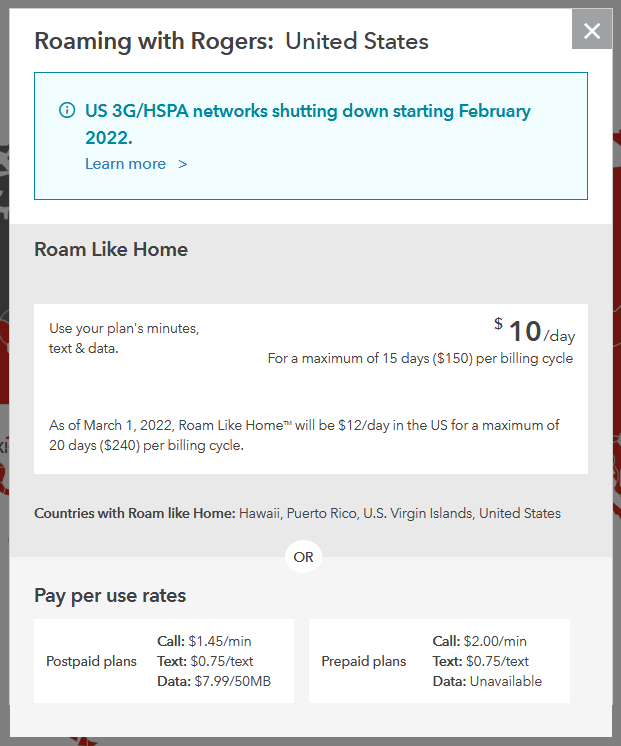
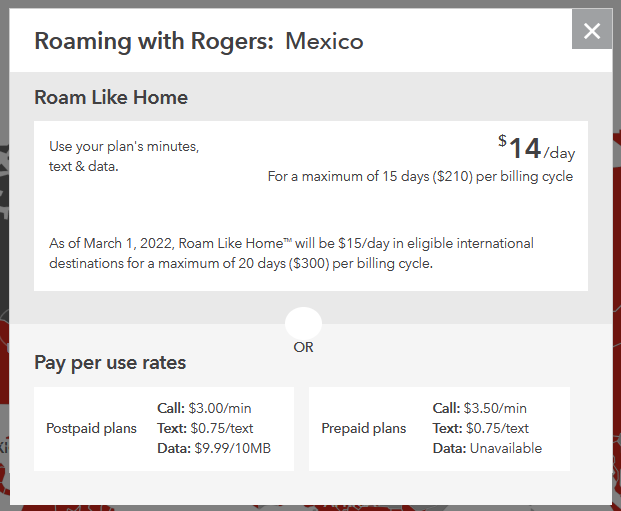
According to a notice on Rogers’ website spotted by a MobileSyrup reader, the Toronto-based national carrier will increase the cost of both its U.S. Roam Like Home and International Roam Like Home packages by $2 and $1, respectively.

Currently, U.S. roaming costs $10 per day for a maximum of 15 days per billing cycle, or $150 maximum per bill. That means if you were to travel to the U.S. for, say, 17 days, you’d pay roaming for the first 15 days and not be charged for roaming on the 16th and 17th days. Alternatively, you can choose to use your phone only on certain days and only be charged for those days of use.

With the upcoming price change effective March 1st, U.S. Roam Like Home will cost $12/day for a maximum of 20 days (or $240 total). While the price increase itself isn’t huge, coupled with the extra days’ customers can be charged, it makes Roam Like Home a far more expensive option.

Similarly, Rogers’ International Roam Like Home costs $14/day for up to 15 days per billing cycle ($210 total). Starting March 1st, it’ll cost $15/day for up to 20 days per billing cycle. ($300 total).

As before, Roam Like Home lets customers use the data, minutes, and texts included in their Rogers plan while travelling in other countries. If you’re someone who travels to the U.S. often (although with the pandemic, this likely doesn’t apply to most), Rogers also offers a Canada+U.S. option for $20/mo on top of any of its ‘Infinite’ plans — the lowest being $80/mo, so with the add-on, $100/mo total. This feature can be applied when selecting a plan and, according to a Rogers FAQ page, grants customers access to calls, texts, and data while in the U.S. without additional roaming fees.

At the time of writing, Telus charged $11/day for U.S. roaming with a cap of $120 per billing cycle and $14/day for international roaming with a cap of $180 per billing cycle. Telus also currently offers a special roaming deal that only charges customers $60 for 30 consecutive days of U.S. roaming (the offer ends March 31st).

Bell charges $10/day for U.S. roaming and $14/day for international roaming, both up to a maximum of 20 days ($200 total and $280 total respectively).

You can learn more about Rogers’ Roam Like Home package here.

Categories
Mobile Syrup

Feds introduce new Online Streaming Act, but critics say problems still exist

In an attempt to reintroduce legislation focused on online streaming, the Government of Canada has announced what it calls the Online Streaming Act or Bill C-11.

The Liberal’s first introduced a similar bill months ago, but it died on the bench when the 2021 federal election was called.

Like its former counterpart, Bill C-11 focuses on subjecting streaming companies to the same rules as Canadian broadcasters and being governed by the Canadian Radio-television and Telecommunications Commission (CRTC).

The bill has only just been reintroduced and has a long way to go before coming law. But if passed, it means streaming companies will be required to create Canadian programming that reflects the diversity in Canada.

The bill’s previous version saw any content uploaded to the internet subject to CRTC regulation. The aspect had many concerned it would sensor free speech as a government watchdog would govern user-generated content.

Canadian Heritage Minister Pablo Rodriguez said the new rules would only apply to large corporations, not individual content creators.

“So let me be extremely clear, no users, no online creators will be regulated, no digital-first creators, no influencers, no cat videos — only the companies themselves will have new responsibilities,” Rodriguez said at a press conference on February 2nd.

But critics say problems still exist.

OpenMedia, a non-profit that works to protect free expression and privacy online, says the act wrongly focuses on fitting rules from the broadcast era to regulate internet streaming.

It’s not clear what kind of user-generated CanCon, or Canadian content, will be spared from the watchful eyes of the CRTC, OpenMedia’s campaign director, Matt Hatfield, said in a statement.

The government is basing its separation of professional and amateur content on a foundation “that simply doesn’t exist,” Hatfield said.

“Major Canadian internet productions like podcasts could find themselves in the worst of all worlds — subject to CRTC regulation, while not able to seek CanCon funding. We believe any measures that are funded by internet streaming revenue should be fully available to all Canadian internet creators. And that won’t happen without a comprehensive update of CanCon definitions to include them.”

Image credit: Pablo Rodriguez/ Twitter

Source: Canadian Heritage

Categories
Mobile Syrup

Feds introduce new Online Streaming Act, but critics say problems still exist

In an attempt to reintroduce legislation focused on online streaming, the Government of Canada has announced what it calls the Online Streaming Act or Bill C-11.

The Liberal’s first introduced a similar bill months ago, but it died on the bench when the 2021 federal election was called.

Like its former counterpart, Bill C-11 focuses on subjecting streaming companies to the same rules as Canadian broadcasters and being governed by the Canadian Radio-television and Telecommunications Commission (CRTC).

The bill has only just been reintroduced and has a long way to go before coming law. But if passed, it means streaming companies will be required to create Canadian programming that reflects the diversity in Canada.

The bill’s previous version saw any content uploaded to the internet subject to CRTC regulation. The aspect had many concerned it would sensor free speech as a government watchdog would govern user-generated content.

Canadian Heritage Minister Pablo Rodriguez said the new rules would only apply to large corporations, not individual content creators.

“So let me be extremely clear, no users, no online creators will be regulated, no digital-first creators, no influencers, no cat videos — only the companies themselves will have new responsibilities,” Rodriguez said at a press conference on February 2nd.

But critics say problems still exist.

OpenMedia, a non-profit that works to protect free expression and privacy online, says the act wrongly focuses on fitting rules from the broadcast era to regulate internet streaming.

It’s not clear what kind of user-generated CanCon, or Canadian content, will be spared from the watchful eyes of the CRTC, OpenMedia’s campaign director, Matt Hatfield, said in a statement.

The government is basing its separation of professional and amateur content on a foundation “that simply doesn’t exist,” Hatfield said.

“Major Canadian internet productions like podcasts could find themselves in the worst of all worlds — subject to CRTC regulation, while not able to seek CanCon funding. We believe any measures that are funded by internet streaming revenue should be fully available to all Canadian internet creators. And that won’t happen without a comprehensive update of CanCon definitions to include them.”

Image credit: Pablo Rodriguez/ Twitter

Source: Canadian Heritage

Categories
Mobile Syrup

Microsoft scrapped HoloLens 3 plans, according to report

Despite success with the HoloLens, Microsoft may not plan to do a HoloLens 3.

According to a Business Insider report (via Windows Central), Microsoft scrapped plans for the HoloLens 3 and has left the HoloLens team in a state of perpetual confusion. Further, the team’s uncertain about the project’s future and existing long-term plans. Because of this, the HoloLens team has seen several members leave Microsoft to pursue augmented reality (AR) projects at rival companies, like Meta (Facebook). Windows Central previously documented cases of HoloLens team members jumping ship before the Business Insider report.

Problems also stem from divisions within the HoloLens team itself. Some members want to focus on hardware, particularly with the company’s Integrated Visual Augmentation System (IVAS) contract with the U.S. Army. Windows Central notes the contract can net Microsoft up to $22 billion USD (about $27.9 billion CAD) for delivery of soldier-attuned HoloLens variants. However, reports indicate Microsoft has failed to produce a combat-ready device, leading to the project being delayed.

The other group wants to focus on the metaverse, although Microsoft allegedly still doesn’t have a clear vision for that space. Business Insider’s source claimed that the split in focus resulted in several assignment and vision changes that have hampered progress.

Finally, Microsoft’s alleged partnership with Samsung on an AR project reportedly created further complications, namely by pulling the HoloLens team away from existing issues that need to be addressed. Moreover, one source said Samsung wants Microsoft to focus on the software side while it handles hardware, but that hasn’t sat well with the team.

Ultimately, it sounds like HoloLens 3 is dead. The report’s timeline indicates the Samsung partnership was the final nail in the coffin for HoloLens 3. However, maybe something can still come out of the Samsung partnership in the future.

Source: Business Insider, Windows Central