Catégories
Uncategorized

AI: The frantic race for performance

For several months now, tech giants have been developing and improving their artificial intelligence assistants. This race for performance is becoming increasingly frenetic, creating a tacit competition within companies. OpenAI, a month after launching GPT-5.1, unveiled a new version of ChatGPT, GPT-5.2, at the beginning of December, in response to the new version of the Google AI assistant, Gemini 3, revealed at the end of November this year.

A smartphone displays the Google Gemini 3 interface with on-screen options such as « Create image, » « Write anything, » and « Help me learn, » while the Gemini 3 logo appears on a larger screen in the background in San Ferdinando di Puglia, Italy, on December 4, 2025. The image highlights the user interface and branding of Google’s AI platform (Photo by Matteo Della Torre/NurPhoto via Getty Images)

These two giants have been battling it out for the title of AI assistant champion for several months now. This rivalry between Google and OpenAI has intensified since the respective unveiling of their new AI assistant versions: Gemini 3 for Google and ChatGPT-5.2 for OpenAI.

Data from Sensor Tower, which analyzes the behavior of 5 million consumers worldwide, shows rapid growth for Gemini since the launch of Gemini 3 at the end of November. The number of worldwide visits to the Gemini site is said to have doubled between August and November, while those to ChatGPT have only increased by around 1%. Over the same period, Gemini would have reached 346 million monthly active users, an increase of close to 30%, while ChatGPT peaked at 810 million, with an increase limited to just under 5%.

This discrepancy in dynamics explains Sam Altman’s decision to launch an internal « Code Red » operation to refocus teams on ChatGPT. This internal climate enabled the OpenAI teams to have the resources they needed to finalize the new version of the AI assistant. The unveiling of the new iteration of ChatGPT last December saw the birth of a version of GPT that is more efficient than ever, according to the company, reducing errors relating to the« thinking » version of the assistant by 38%.

ANKARA, TURKEY – DECEMBER 30: Logos of ChatGPT and OpenAI are displayed on cell phone screens in Ankara, Turkey on December 30, 2025. (Photo by Omer Taha Cetin/Anadolu via Getty Images)

Despite GPT’s developments and their 800 million operators every week, OpenAI has declared that it is losing money every month and only expects to be profitable in 2029. An entirely different scenario is being experienced on the Google side, where the company is generating billions of dollars every quarter from its other activities.

At this stage, the conversational robot competition is essentially based on two players, even if other competitors are well and truly in the game. Claude, Copilot, Deepseek, etc. are all key protagonists in this frantic race to improve artificial intelligence tools. A fundamental question remains: how far can artificial intelligence evolve without redefining the place of humans, and above all, will this frantic race for performance ever come to an end?

Catégories
Uncategorized

Beeple’s intriguing exhibition of robot dogs

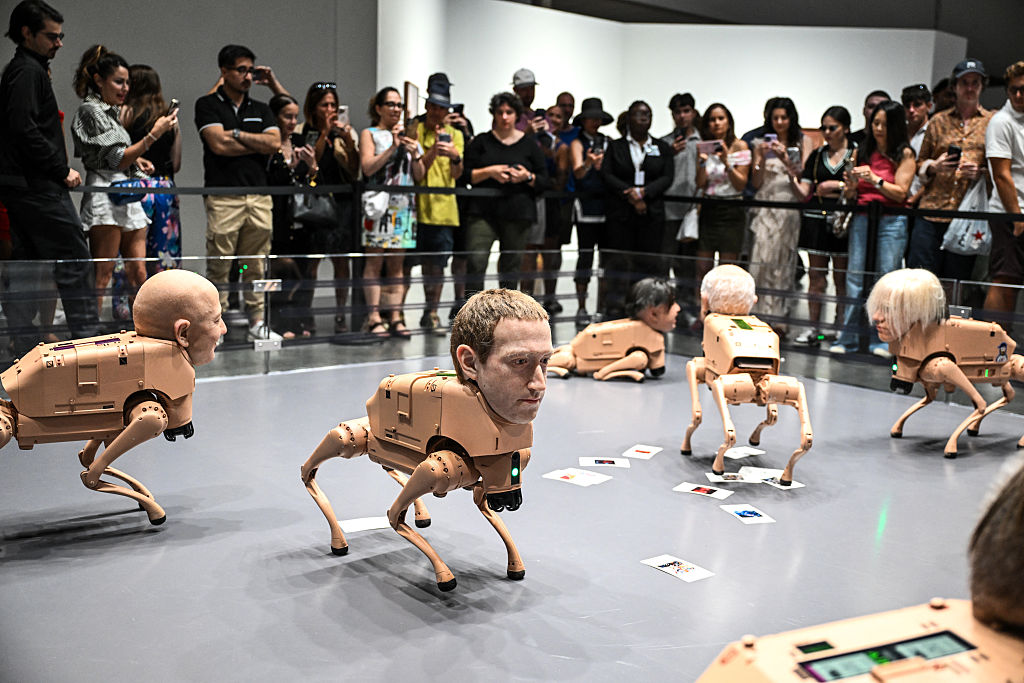
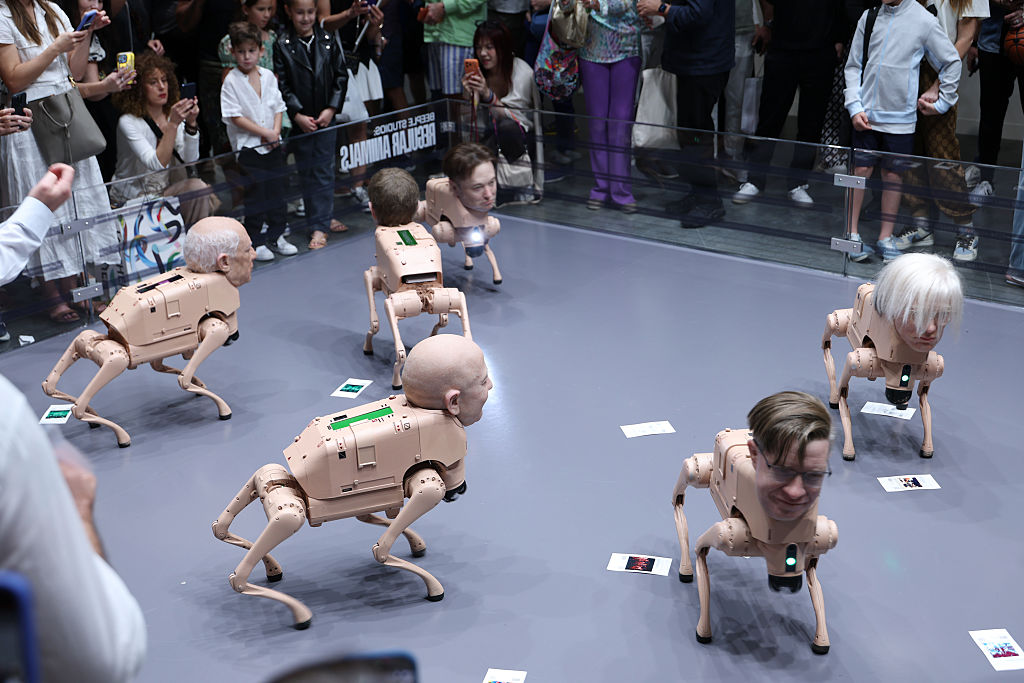
In Miami, one of the world’s richest art festivals, this year’s Art Basel Miami Beach hosts a more than intriguing art project. The performance art brings together a group of four-legged robots wearing hyper-realistic silicone faces of tech billionaires and world-famous artists. These half-human, half-canine creatures seem to have stepped straight out of a video game or a real-life nightmare, mixing dreams and reality. At the heart of this project is an artist by the name of Beeple, whose real name is Mike Winkelmann: on the very first day of the fair, he can be found in the robot enclosure, picking up works of art from the floor and handing them to visitors, as well as in his own project with two robots bearing his face.

MIAMI BEACH, FLORIDA – DECEMBER 05: EDITORIAL USE ONLY A view of Beeple Studios Regular Animals artwork at the Art Basel Miami Beach VIP Preview 2025 at Miami Beach Convention Center on December 05, 2025 in Miami Beach, Florida. (Photo by Arturo Holmes/Getty Images)

The name of the concept: « Regular Animals. » The behavior of these creatures is as fascinating as it is disturbing. They wander around an enclosure, sometimes nearly colliding with each other. Musk puckers his lips, Picasso stares into space. But the most provocative aspect lies in their creative process: at random, the robots tip backwards and, via a screen displaying poop mode, physically expel a work printed from their hindquarters. Beyond the scatological provocation, the work conceals a sophisticated critique of our relationship with technology and information. Each robot is equipped with cameras and operates autonomously. They capture images of their environment (visitors, the fair) and use artificial intelligence to reinterpret this visual data according to the personality they embody:

TOPSHOT – A wax head of Mark Zuckerberg is seen on a robot dog as part of an art installation called « Regular Animals » by digital artist Mike Winkelmann, also known as Beeple, during Art Basel 2025 at Miami Beach Convention Center in Miami Beach, Florida, December 7, 2025. (Photo by CHANDAN KHANNA / AFP via Getty Images) / RESTRICTED TO EDITORIAL USE – MANDATORY MENTION OF THE ARTIST UPON POSTING – TO ILLUSTRATE THE EVENT AS SPECIFIED IN THE CAPTION

Herein lies Beeple’s central message: the one-sided control of perception. The artist explains that these billionaires, via their super-powerful algorithms, decide what we see and influence our reality. They have become the main filters through which humanity consumes information. Beeple’s warning is clear: « We are not ready for the future. » The return of the NFT Beeple, who became the third most expensive living artist after his record sale of $69.3 million at Christie’s in 2021, is lucid about the evolution of the market. He acknowledges that the collapse of the NFT bubble was inevitable due to the massive production of uninteresting projects. However, Art Basel 2025 marks a resurgence of digital art. The prints « defecated » by the robot dogs are not mere papers: they are NFTs linked to the blockchain. Beeple plays with irony here, materializing the common criticism that NFTs are just bullsh**, by having his sculptures literally defecate these digital assets.

The public’s reception oscillates between disgust, unease, and admiration. The boundary between the real and the artificial was even tested when real dogs started barking at the robots, an interaction that delighted the artist. For Beeple, these dynamic sculptures foreshadow the future of art, where works will be alive with simulated emotions. However, the experiment has a programmed end: although the robots will continue to move, their creative capacity (generating and storing images on the blockchain) will stop after three years. Despite the grotesque nature of the installation, it was an immediate commercial success. Within the first hour of the fair, all the animals, including the little Musk, Zuckerberg, and Beeple, had found buyers, proving that provocation remains a sure bet in contemporary art.

Catégories
Uncategorized

Des vertus thérapeutiques contre la démence du vaccin contre le zona?

Une nouvelle étude dévoilée dans la revue scientifique Cell par le groupe de recherche du Dr Pascal Geldsetzer, professeur à l’université de Stanford, démontre que le vaccin contre le zona pourrait avoir des propriétés thérapeutiques contre la démence. Cette découverte suggère ainsi que les deux doses du vaccin contre le zona pourraient non seulement ralentir la progression de la démence mais également réduire le risque de décès reliés à ces troubles cognitifs. Selon Dr Geldsetzer, ces observations suggèrent que le vaccin contre le zona ne serait pas seulement préventif envers la démence, mais aurait aussi un potentiel thérapeutique : « C’était vraiment excitant et inattendu ! »

Close-up view of a pharmacist s hand holding a pre-filled syringe of flu vaccine before injection in a pharmacy in Pau, France, on December 8, 2025. The image highlights the hands and the needle, with the mention of the flu vaccine. It illustrates the problem of the virulent seasonal flu epidemic and the potential shortage of the medication or the vaccination campaign against the winter virus. Vue rapprochee d une main de pharmacienne tenant une seringue preremplie de vaccin contre la grippe avant l injection dans une pharmacie a Pau en France le 8 Decembre 2025. L image met en avant les mains et l aiguille avec mention relative au vaccin antigrippal. Elle illustre la problematique de l epidemie saisonniere virulente de la grippe ainsi que la potentielle penurie du medicament ou de la campagne de vaccination contre le virus hivernal. (Photo by Quentin Top / Hans Lucas / AFP via Getty Images)

Le zona est une maladie résultant de la contamination d’un virus nommé Varicelle-Zona et amenant à une éruption cutanée douloureuse. Le risque de zona et de complications graves reliées à celle-ci augmentent significativement avec l’âge en raison de l’affaiblissement du système immunitaire. De ce fait, la vaccination contre le zona est recommandée dès l’âge de 50 ans et serait efficace à plus de 90% pour la prévention de zona chez les personnes âgées. Mais comment ce vaccin pourrait également avoir une influence sur la démence ? L’étude publiées dans Cell n’a pas précisément déterminé pourquoi mais plusieurs pistes sont énoncées afin de répondre à ce questionnement. Selon Geldsetzer, le virus qui cause le zona reste présent dans le système nerveux, même lorsqu’il est dormant. Ainsi, il pourrait mener à des inflammations, qui sont des facteurs clés dans de nombreuses maladie chroniques dont la démence. Une autre piste proviendrait de la stimulation du système nerveux directement relié à la vaccination : en effet, un système immunitaire plus fort combat mieux les infections, pouvant être reliés à un risque accru de démence.

Elderly woman, 89 years old with adult coloring book to reduce anxiety and improve brain function, Dover, Delaware. (Photo by: Matthew Lovette/Jumping Rocks/Universal Images Group via Getty Images)

Cette étude est à l’origine de premiers travaux développés par la même équipe de recherche, montrant que le vaccin pourrait prévenir ou retarder la démence. Ces premiers développement ont été trouvés par l’analyse de dossier médicaux d’adultes âgés au pays de Galles, où un programme de vaccination contre le zona avait été lancé pour le septuagénaires en septembre 2013. Dans ce programme, une limite d’âge en dessous de 80 ans avait été imposée : c’est cette règle qui a permis aux chercheurs de comparer deux groupes de personnes âgées très similaires mais avec des chances très différentes d’être vaccinés. Leur première découverte a ainsi montré que recevoir le vaccin réduisait la probabilité d’être diagnostiqué avec une nouvelle démence de 3,5% sur une période de sept ans. Dans la découverte plus récente, les chercheurs ont réutilisés les données galloises de plus de 282 500 adultes, comparées avec des données en Australie, afin d’analyser les différences concernant les diagnostics de troubles cognitifs légers, et le taux de décès liés aux troubles cognitifs pour les personnes diagnostiquées démentes. Les résultats de cette article démontre que le vaccin réduit de 3,1 % le risque d’être diagnostiqué avec un trouble cognitif léger sur 9 ans, avec un effet protecteur plus grand chez le sexe féminin. Pour les personnes déjà diagnostiquées de démence, le vaccin abaisserait de 29,5% le risque de décès de démence au cours des 9 ans suivant, suggérant un ralentissement dans la progression des troubles cognitifs.

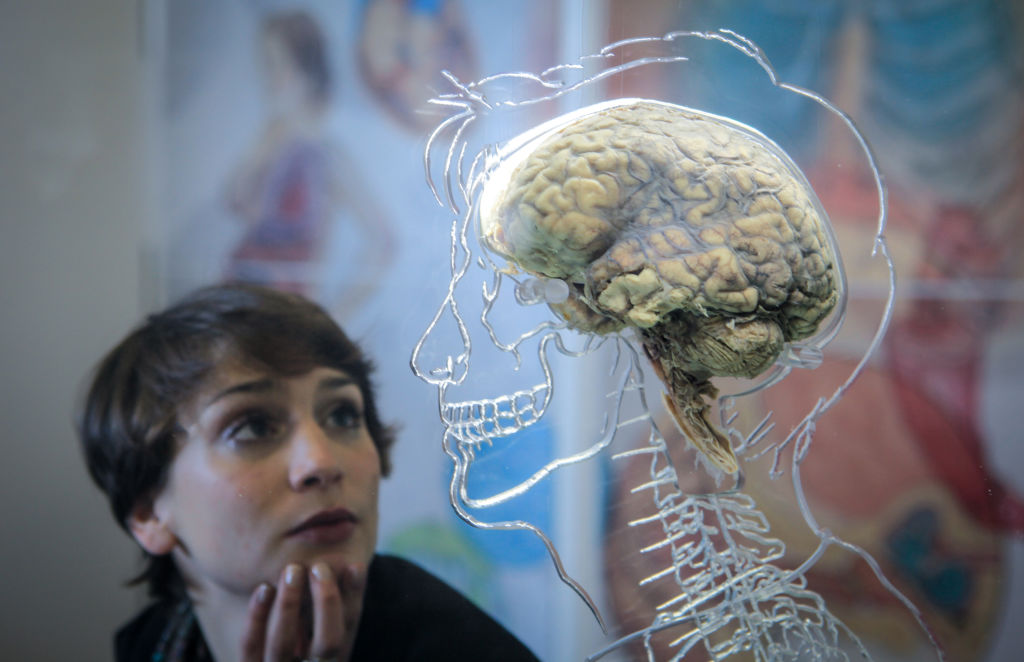
BRISTOL, UNITED KINGDOM – MARCH 10: (EDITORS NOTE; This image contains graphic content) A real human brain is displayed as part of a exhibition at the @Bristol attraction on March 10, 2011 in Bristol, England. The Real Brain exhibit – which comes with full consent from a anonymous donor and needed full consent from the Human Tissue Authority – is suspended in a large tank engraved with a full scale skeleton on one side and a diagram of the central nervous system on the other and is a key feature of the All About Us exhibition. (Photo by Matt Cardy/Getty Images)

La poursuite de cette recherche mènerait vers un essai clinique réalisé de manière aléatoire pour améliorer la compréhension de ce lien entre vaccin contre le zona et démence. La communauté scientifique met cependant en garde le public : cette étude démontre en effet une protection des capacités cognitives du patient mais sa raison exacte en reste inconnue. Plusieurs professeurs déclarent que ces études ne visent pas à établir une recommandation de vaccination pour réduire le risque de démence. La poursuite de la recherche est essentielle, notamment parce que l’étude actuelle porte sur d’anciennes versions du vaccin contre le zona.

Catégories
Uncategorized

IA: La course frénétique à la performance

Depuis maintenant quelques mois, les géants de la tech développent et améliorent leurs assistants d’intelligence artificielle. Cette course à la performance devient de plus en plus frénétique, en créant une concurrence tacite au sein des entreprises. OpenAI, un mois après avoir lancé GPT-5.1, a dévoilé au début du mois de décembre une nouvelle version de ChatGPT, GPT-5.2, en réponse à la nouvelle version de l’assistant IA Google, Gemini 3, révélée en fin novembre de cette année.

A smartphone displays the Google Gemini 3 interface with on-screen options such as  »Create image, »  »Write anything, » and  »Help me learn, » while the Gemini 3 logo appears on a larger screen in the background in San Ferdinando di Puglia, Italy, on December 4, 2025. The image highlights the user interface and branding of Google’s AI platform. (Photo by Matteo Della Torre/NurPhoto via Getty Images)

Ces deux géants se disputent le titre de champion d’assistant IA depuis maintenant plusieurs mois. Cette rivalité entre Google et OpenAI s’intensifie depuis le dévoilement respectif de leurs nouvelles versions d’assistants IA : Gemini 3 pour Google et ChatGPT-5.2 pour OpenAI.

Les données de Sensor Tower, qui analyse le comportement de 5 millions de consommateurs dans le monde, montrent une progression rapide de Gemini depuis le lancement de Gemini 3 à la fin novembre. Le nombre de visites mondiales sur le site de Gemini aurait été multiplié par deux entre août et novembre, tandis que celles de ChatGPT n’auraient augmenté que d’environ 1 %. Sur la même période, Gemini aurait atteint 346 millions d’utilisateurs actifs mensuels, soit une progression proche de 30 %, quand ChatGPT culminait à 810 millions, avec une hausse limitée à près de 5 %.

Cet écart de dynamique expliquerait la décision de Sam Altman de lancer en interne une opération dite « code rouge » afin de recentrer les équipes sur ChatGPT. Ce climat à l’interne a donc permis aux équipes d’OpenAI d’avoir les ressources nécessaires pour finaliser la nouvelle version de l’assistant IA. Le dévoilement de la nouvelle itération de ChatGPT en décembre dernier voit naître une version de GPT plus performante que jamais, selon l’entreprise, réduisant de 38% les erreurs relatives à la version « thinking » de l’assistant.

ANKARA, TURKIYE – DECEMBER 30: Logos of ChatGPT and OpenAI are displayed on mobile phone screens in Ankara, Turkiye on December 30, 2025. (Photo by Omer Taha Cetin/Anadolu via Getty Images)

Malgré les développements de GPT et leurs 800 millions d’opérateurs chaque semaine, OpenAI a déclaré perdre de l’argent chaque mois et ne prévoit qu’une rentabilité en 2029. Un scénario tout autre est vécu du côté de Google où l’entreprise génère des milliards de dollars chaque trimestre grâce à ses autres activités.

À ce stade, la compétition des robots conversationnels repose essentiellement sur deux acteurs, même si d’autres compétiteurs font bels et bien parti de la partie. Claude, Copilot, Deepseek, … sont autant de protagonistes clés dans cette course effrénée vers l’amélioration des outils d’intelligence artificielle. Reste alors une question fondamentale : jusqu’où l’intelligence artificielle peut-elle évoluer sans redéfinir la place de l’humain, et surtout, cette course effrénée à la performance finira-t-elle un jour par s’arrêter ?

Catégories
Uncategorized

Senator predicts Cuban government will be overthrown soon

In an interview on Tuesday, January 6, Republican Senator Rick Scott (R-FL) predicted that the Cuban government will be overthrown as early as this year. The comments come after US President Donald Trump predicted Cuba would fall, and as the U.S. blockade of oil exports from Venezuela is ramping up pressure on the communist Cuban regime. According to Scott, who is a close ally of Donald Trump, the Cuban government will be overthrown this year or next, and a democratic leader will be installed. According to Scott, current Cuban President Miguel Díaz-Canel Bermúdez’s regime will end, and democracy will follow.

Donald Trump began talking about Cuba just hours after capturing Venezuelan President Nicolas Maduro. Maduro was charged with Cocaine Importation Conspiracy, Possession of Machine guns and Destructive Devices, Narco-Terrorism Conspiracy and Conspiracy to Possess Machine guns and Destructive Devices against the United States after dozens of US air strikes on naval vessels leaving Venezuela. Maduro pleaded ‘not guilty’ to all charges, and is currently in a prison in the US alongside his wife.

Why Cuba?

NEW YORK, NEW YORK – SEPTEMBER 19: President of Cuba, Miguel Díaz-Canel Bermúdez, addresses the 78th session of the United Nations General Assembly (UNGA) at U.N. headquarters on September 19, 2023 in New York City. World heads of state and representatives of government will attend amidst multiple global crises such as Russia’s illegal war against Ukraine, and the climate emergency. (Photo by Adam Gray/Getty Images)

There are many layers to why Donald Trump and the U.S. want to overthrow the Cuban government. To start, Cuban President Miguel Díaz-Canel Bermúdez operated a communist government, a style of government America has been historically diametrically opposed to. Communism is still viewed as a threat to America by many American voters and politicians. Bermúdez also condemned the U.S. attack on Venezuela and capture of Maduro, calling the action ‘acts of state terrorism.’ U.S. control of Venezuelan oil exports seriously impacts Cuba, which imports nearly a third of its oil from Venezuela. With Donald Trump threatening to cut off supply to Cuba, the country is potentially facing a dangerous lack of power.

Energy shortages and power blackouts have become common in Cuba. In September, Cuba’s entire electrical grid failed, affecting nearly 10 million people, and over the past 12 months, it has suffered a dozen nationwide outages. Its malfunctioning energy network has taken another hit thanks to the U.S. naval blockade on Venezuela, which has limited shipments to Cuba. Now, with the U.S. completely in control of Venezuela’s oil, Venezuelan citizens are worried the country’s energy shortage will only worsen. Venezuelan President Nicolas Maduro had a close relationship with Cuba, with Venezuela frequently aiding the nearby nation during power outages and blackouts.

Next steps for Trump

After his operation in Venezuela was successful, it’s safe to assume Trump won’t be opposed to taking similar action in Cuba, a country with a long history of tensions with the U.S. In Venezuela, the U.S. began with airstrikes on the capital city before dropping into Maduro’s residence and taking the leader and his wife. It’s likely Trump would be willing to employ similar tactics in Cuba, especially with the obvious pride that Trump has taken in the successful operation. Trump has claimed that the U.S. could run Venezuela for the next five years, and it’s safe to say that his focus will remain on Venezuela for most of the year.

Catégories
Uncategorized

Una erupción volcánica en los albores de la peste negra

Un nuevo estudio publicado en la revista Communications Earth & Environment ha reabierto el debate sobre el origen y la aparición de la peste negra, la mortal enfermedad que diezmó a la mitad de la población europea en el siglo XIV. Aunque los científicos conocen bien los mecanismos de la peste, en particular su agente patógeno y su transmisión por ratas y pulgas, este reciente descubrimiento aporta una primera explicación sobre el momento de su llegada a Europa, comparándolo con la devastación que ya había causado en comunidades de Asia Central. La investigación sugiere que la aparición de esta epidemia podría atribuirse a una erupción volcánica alrededor de 1345, unos dos años antes del inicio de la pandemia, que enfrió el clima, provocando hambrunas y, en consecuencia, importaciones de grano que podrían haber introducido la peste.

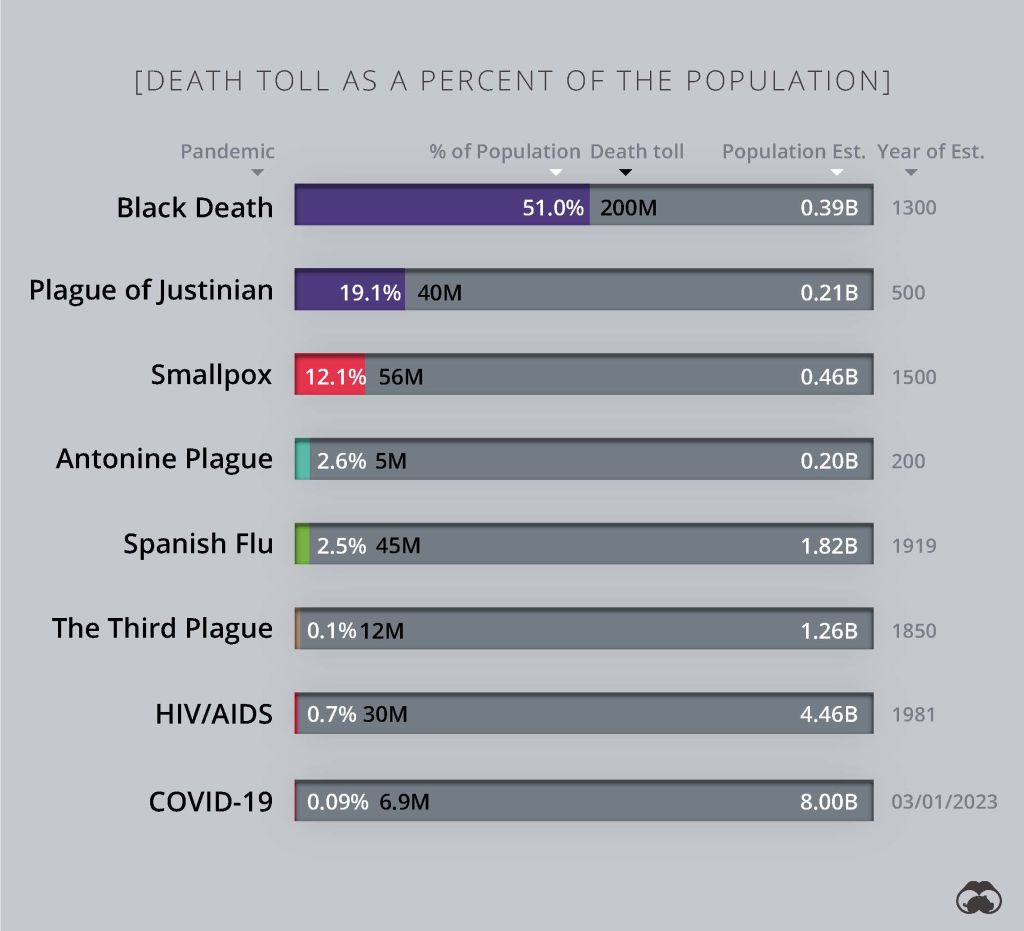
Esta infografía visualiza la magnitud de las pandemias a lo largo de la historia, incluida la COVID-19. Fuentes de datos: CDC, OMS, BBC, Wikipedia, Registros históricos, Enciclopedia Británica, Universidad Johns Hopkins (Gráfico de Visual Capitalist vía Getty Images)

El trabajo de investigación realizado por Ulf Büntgen y sus colegas se basó en indicios extraídos de los anillos de los árboles, que permitieron al equipo reconstruir con notable precisión la historia de la temperatura y las precipitaciones en Europa durante los últimos 2000 años. Ulf Büntgen observó que las temperaturas en toda la cuenca mediterránea fueron ligeramente inferiores a la media entre 1345 y 1357. Esta anomalía climática llamó inmediatamente su atención, lo que le llevó a investigar más a fondo sus orígenes y mecanismos. El enfriamiento de un clima puede atribuirse a varios factores: su hipótesis era que una erupción volcánica había provocado la liberación de aerosoles, enfriando así el clima. Para confirmarlo, examinó núcleos de hielo de Groenlandia y la Antártida que databan de 1345. Los resultados fueron unánimes: los núcleos mostraban altos niveles de azufre, indicativos de erupciones volcánicas.

En una conferencia, Martin Bauch, historiador del clima medieval que investigaba el desarrollo de la peste negra, conoció a Ulf Büntgen. Ambos estaban interesados en los mismos años climáticos anormales considerados decisivos para la aparición de la Peste Negra. Para reconstruir el contexto social de estos años clave, Martin Bauch ya había analizado documentos administrativos, cartas, tratados sobre la peste, poemas e inscripciones. El historiador del Instituto Leibniz de Historia y Cultura de Europa Oriental de Leipzig también ha descubierto huellas de actividad volcánica en estos archivos. También ha descubierto extraños relatos, sobre todo en China y Bohemia, de eclipses lunares que, según el cálculo de las órbitas, no pudieron haber tenido lugar en aquella época. En su opinión, es posible que un cielo cargado de partículas (potencialmente volcánicas) alterara la apariencia de la Luna vista desde la Tierra y diera lugar a estas insólitas descripciones lunares.

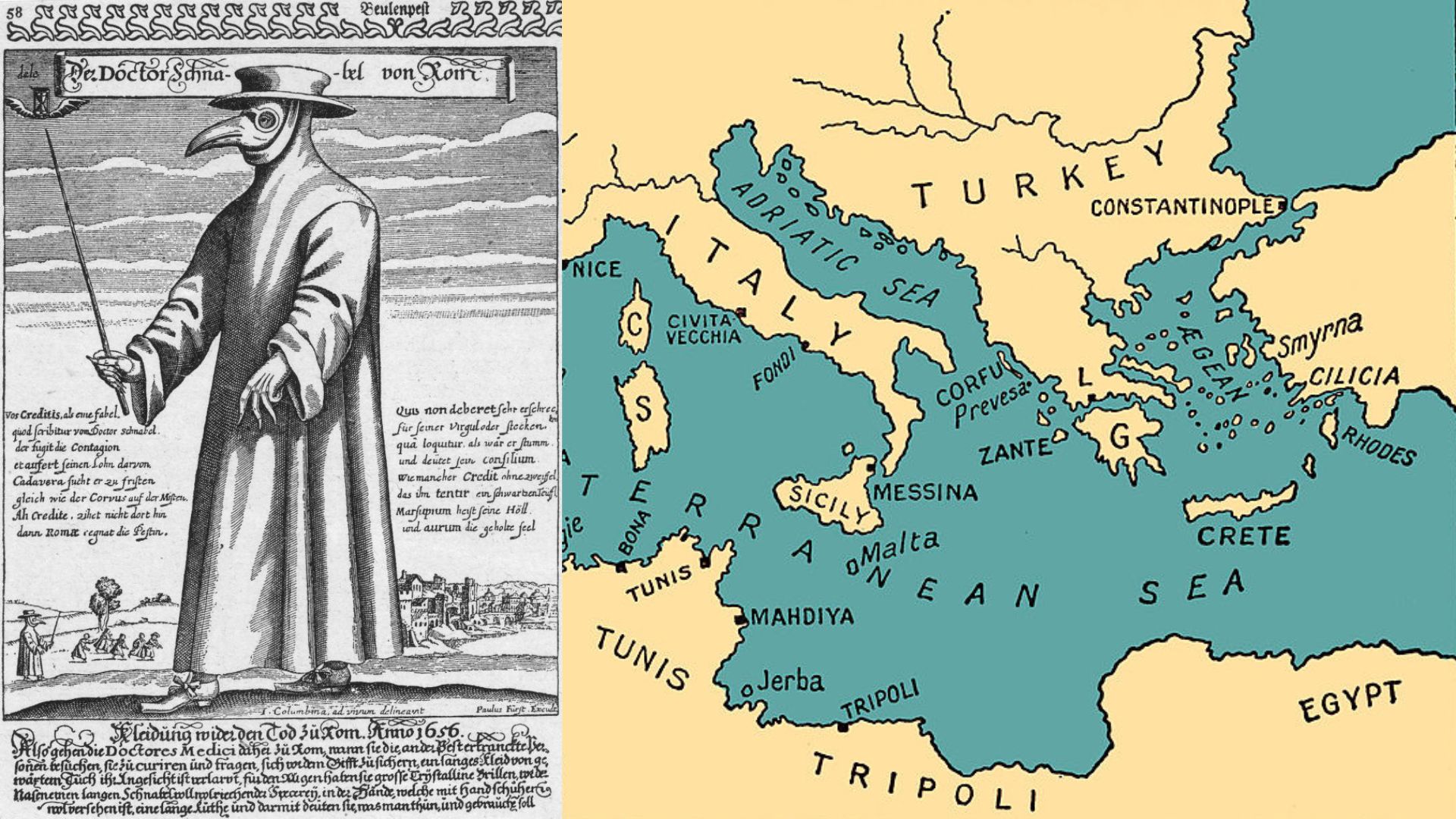
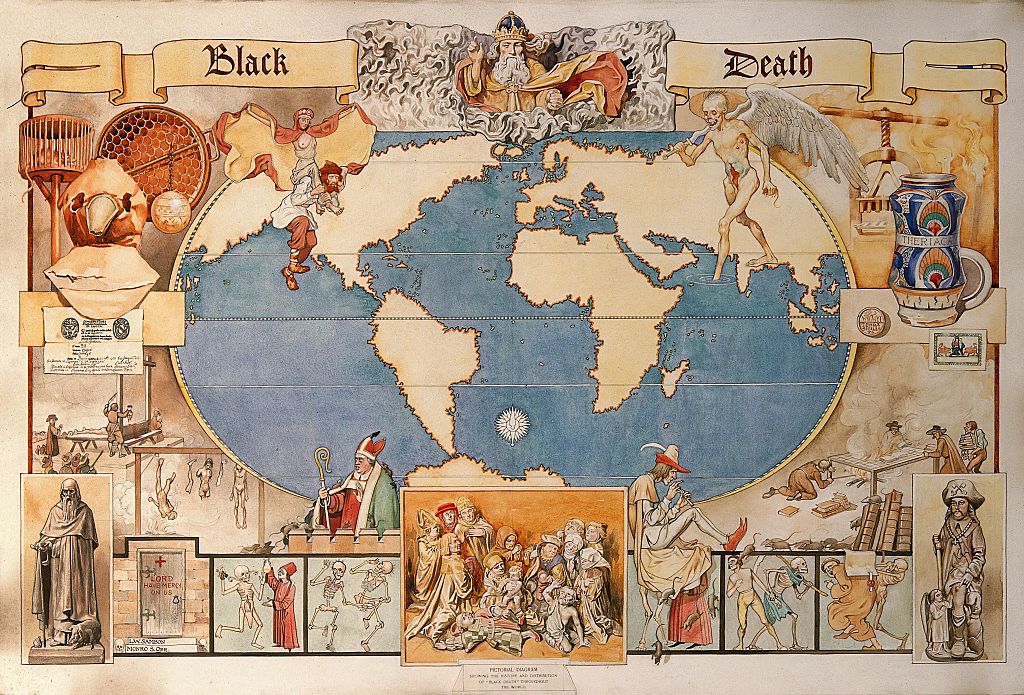
La peste negra – diagrama pictórico que muestra la historia y la distribución de la «peste negra» por el mundo, finales del siglo XIX-principios del XX? Mapa del mundo, con viñetas que representan acontecimientos históricos; el Ángel de la Muerte; un frasco de Theriaca; San Roque levantándose la túnica para mostrar la llaga de la peste, o bubón, en su muslo; ratas negras; la máscara del médico de la peste, etc. La peste negra fue una pandemia de peste bubónica que se produjo en Europa entre 1346 y 1353. Fue una de las pandemias más mortíferas de la historia de la humanidad; perecieron hasta 50 millones de personas. Creador: Monro Scott Orr (Foto de Heritage Art/Heritage Images vía Getty Images)

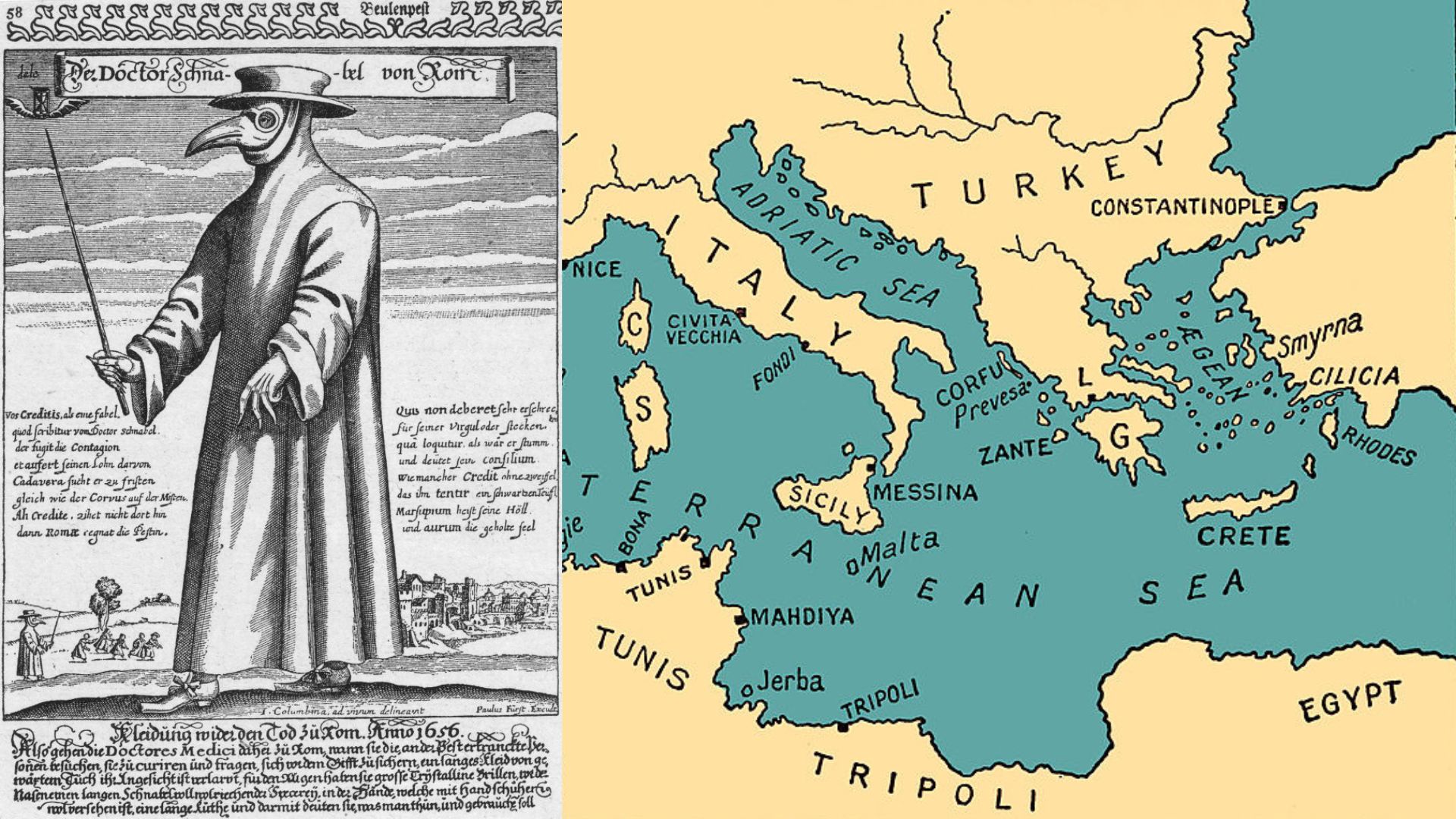
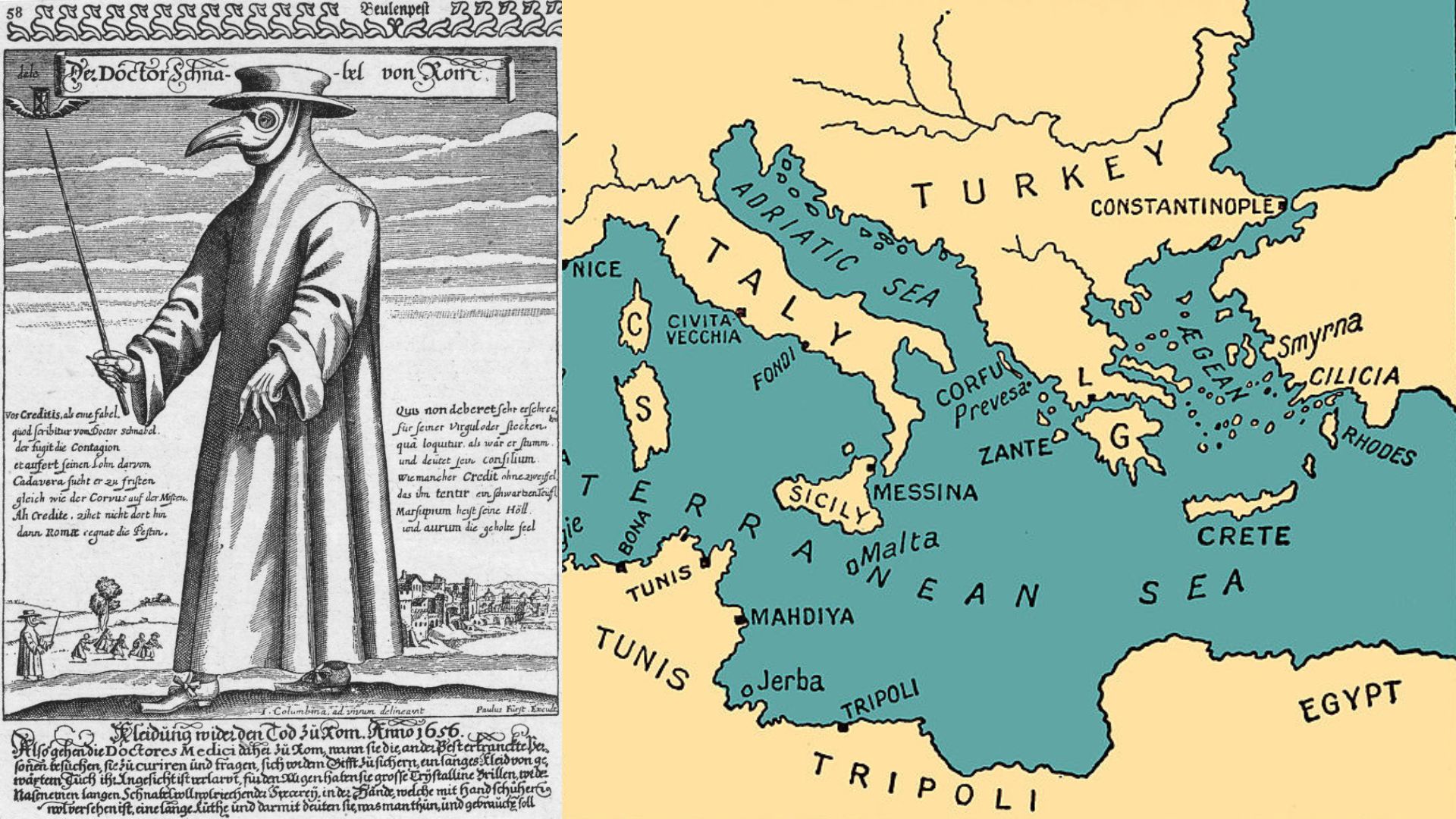
Estos acontecimientos se combinaron en una cadena causal que acabó desencadenando la pandemia de peste negra. A la erupción volcánica siguió una ola de frío que duró varios años y que tuvo un impacto devastador en las cosechas de toda la cuenca mediterránea. Esta crisis agrícola dio lugar a acciones humanas que aceleraron involuntariamente la propagación de la peste. Para contrarrestar la hambruna causada por la caída de las cosechas, las principales ciudades-estado italianas, como Venecia y Génova, se vieron obligadas a importar urgentemente trigo de la región del Mar Negro. Pero estos preciados cargamentos estaban infestados de la bacteria mortal responsable de la peste, la Yersinia pestis. Las pulgas de rata, vectores de la enfermedad, se sienten especialmente atraídas por las reservas de grano y eran capaces de sobrevivir durante meses en el polvo del grano. Esto les permitía soportar el largo viaje por mar desde el Mar Negro hasta Italia. Una vez que el grano llegaba a su destino, el almacenamiento y la redistribución de la mercancía provocaban la propagación de las pulgas y, en consecuencia, del agente patógeno por todo el continente. Las consecuencias fueron catastróficas: antes de la pandemia, la población mundial se estimaba en menos de 450 millones de habitantes. Entre 1347 y 1351, la peste negra mató al menos a 25 millones de personas. La onda expansiva de esta catástrofe dejó repercusiones sociales, económicas y culturales que se dejaron sentir durante décadas.

Catégories
Uncategorized

Uma erupção vulcânica no início da Peste Negra

Um novo estudo publicado na revista Communications Earth & Environment reabriu o debate sobre a origem e o início da Peste Negra, a doença mortal que dizimou metade da população da Europa no século XIV. Embora os cientistas conheçam bem os mecanismos da peste, em particular o seu agente patogénico e a sua transmissão por ratos e pulgas, esta recente descoberta fornece uma primeira explicação sobre o momento da sua chegada à Europa, comparando-o com a devastação que já tinha causado em comunidades da Ásia Central. A investigação sugere que o aparecimento desta epidemia pode ser atribuído a uma erupção vulcânica por volta de 1345, cerca de dois anos antes do início da pandemia, que arrefecou o clima, provocando fomes e, consequentemente, importações de cereais que poderiam ter introduzido a peste.

Esta infografia visualiza a escala das pandemias ao longo da história, incluindo a COVID-19. Fontes de dados: CDC, OMS, BBC, Wikipedia, registos históricos, Enciclopédia Britânica, Universidade Johns Hopkins (Gráfico da Visual Capitalist via Getty Images)

O trabalho de investigação realizado por Ulf Büntgen e os seus colegas baseou-se em pistas retiradas dos anéis das árvores, o que permitiu à equipa reconstruir a história da temperatura e da precipitação na Europa nos últimos 2000 anos com uma precisão notável. Ulf Büntgen observou que as temperaturas em toda a bacia do Mediterrâneo estavam ligeiramente abaixo da média entre 1345 e 1357. Esta anomalia climática chamou imediatamente a sua atenção, levando-o a aprofundar a investigação sobre as suas origens e mecanismos. O arrefecimento de um clima pode ser atribuído a vários fatores: ele levantou a hipótese de que uma erupção vulcânica teria provocado a libertação de aerossóis, arrefecendo assim o clima. Para confirmar este ponto de vista, examinou núcleos de gelo que datam de 1345 na Gronelândia e na Antártida. Os resultados foram unânimes: os núcleos apresentavam níveis elevados de enxofre, indicativos de erupções vulcânicas.

Numa conferência, Martin Bauch, um historiador do clima medieval envolvido na investigação sobre o desenvolvimento da Peste Negra, conheceu Ulf Büntgen. Ambos estavam interessados nos mesmos anos climáticos anormais considerados decisivos para o aparecimento da Peste Negra. Para reconstituir o contexto social desses anos-chave, Martin Bauch já tinha analisado documentos administrativos, cartas, tratados sobre a peste, poemas e inscrições. O historiador do Instituto Leibniz de História e Cultura da Europa Oriental, em Leipzig, também descobriu vestígios de atividade vulcânica nesses arquivos. Descobriu também relatos estranhos, sobretudo na China e na Boémia, de eclipses lunares que, de acordo com o cálculo das órbitas, não poderiam ter ocorrido nessa época. Na sua opinião, é possível que um céu carregado de partículas (potencialmente vulcânicas) tenha alterado o aspeto da Lua vista da Terra e tenha dado origem a estas descrições lunares invulgares.

Peste Negra – diagrama pictórico que mostra a história e a distribuição da « Peste Negra » pelo mundo, no final do século XIX e início do século XX? Mapa do mundo, com vinhetas representando acontecimentos históricos; o Anjo da Morte; um frasco de Theriaca; São Roque levantando a sua túnica para mostrar a ferida da peste, ou bubão, na sua coxa; ratos pretos; máscara de médico da peste, etc. A Peste Negra foi uma pandemia de peste bubónica que ocorreu na Europa de 1346 a 1353. Foi uma das pandemias mais fatais da história da humanidade; cerca de 50 milhões de pessoas morreram. Criador: Monro Scott Orr (Fotografia de Heritage Art/Heritage Images via Getty Images)

Estes acontecimentos combinaram-se numa cadeia causal que acabou por desencadear a pandemia da Peste Negra. A erupção vulcânica foi seguida de um período de frio que durou vários anos e que teve um impacto devastador nas colheitas em toda a bacia do Mediterrâneo. Esta crise agrícola levou a ações humanas que, involuntariamente, aceleraram a propagação da peste. Para combater a fome causada pela queda das colheitas, as principais cidades-estado italianas, como Veneza e Génova, foram obrigadas a importar urgentemente trigo da região do Mar Negro. Mas estas preciosas cargas estavam infestadas com a bactéria mortal responsável pela peste, a Yersinia pestis. As pulgas dos ratos, vetores da doença, são particularmente atraídas pelas reservas de cereais e conseguiam sobreviver durante meses no pó dos cereais. Isto permitiu-lhes suportar a longa viagem marítima do Mar Negro até Itália. Quando os cereais chegaram ao seu destino, o armazenamento e a redistribuição da mercadoria levaram à propagação das pulgas e, consequentemente, do agente patogénico por todo o continente. As consequências foram catastróficas: antes da pandemia, a população mundial era estimada em menos de 450 milhões de habitantes. Entre 1347 e 1351, a Peste Negra matou pelo menos 25 milhões de pessoas. As ondas de choque desta catástrofe tiveram repercussões sociais, económicas e culturais que se fizeram sentir durante décadas.

Catégories
Uncategorized

Ein Vulkanausbruch zu Beginn der Schwarzen Pest

Eine neue Studie, die in der Zeitschrift Communications Earth & Environment veröffentlicht wurde, belebt die Debatte über den Ursprung und den Ausbruch des Schwarzen Todes, jener tödlichen Krankheit, die im 14. Jahrhundert die Hälfte der europäischen Bevölkerung dezimierte. Die Wissenschaftler sind zwar mit den Mechanismen der Pest vertraut, insbesondere mit ihrem Erreger und ihrer Übertragung durch Ratten und Flöhe, doch diese jüngste Entdeckung liefert eine erste Erklärung für den zeitlichen Ablauf ihrer Ankunft in Europa und vergleicht sie mit den Verwüstungen, die sie bereits in den zentralasiatischen Gemeinden angerichtet hatte. Die Forschungsergebnisse legen nahe, dass der Ausbruch der Pandemie auf einen Vulkanausbruch um 1345 zurückzuführen sein könnte, der das Klima abkühlte und zu Hungersnöten führte, was wiederum Getreideimporte zur Folge hatte, die die Pest eingeschleppt haben könnten.

Diese Infografik veranschaulicht das Ausmaß von Pandemien im Laufe der Geschichte, einschließlich COVID-19. Datenquellen: CDC, WHO, BBC, Wikipedia, Historical records, Encyclopedia Britannica, Johns Hopkins University (Grafik von Visual Capitalist via Getty Images)

Die Forschungsarbeit von Ulf Büntgen und seinen Kollegen stützte sich auf Indizien aus Baumringen: Anhand der Baumringe konnte das Team die Temperatur- und Niederschlagshistorie der letzten 2000 Jahre in Europa mit bemerkenswerter Genauigkeit rekonstruieren. Ulf Büntgen beobachtete, dass die Temperaturen im gesamten Mittelmeerraum zwischen 1345 und 1357 leicht unter dem Durchschnitt lagen. Diese Klimaanomalie erregte sofort seine Aufmerksamkeit und veranlasste ihn, seine Forschungen zu vertiefen, um den Ursprung und die Mechanismen dieser Anomalie zu verstehen. Die Abkühlung eines Klimas kann auf verschiedene Faktoren zurückgeführt werden: Er stellte die Hypothese auf, dass ein Vulkanausbruch zum Ausstoß von Aerosolen geführt habe, die das Klima abkühlten. Um seine These zu bestätigen, untersuchte er anschließend Eisbohrkerne aus dem Jahr 1345 aus Grönland und der Antarktis. Die Ergebnisse waren eindeutig: Die Bohrkerne wiesen hohe Schwefelwerte auf, die auf Vulkanausbrüche hindeuten.

Auf einer Konferenz traf Martin Bauch, ein mittelalterlicher Klimahistoriker, der in die Forschung im Zusammenhang mit der Entwicklung des Schwarzen Todes investiert hatte, auf Ulf Büntgen. Beide interessierten sich für dieselben abnormalen Klimajahre, die als ausschlaggebend für die Entstehung des Schwarzen Todes galten. Um den sozialen Kontext dieser Schlüsseljahre zu rekonstruieren, hatte Martin Bauch bereits Verwaltungsdokumente, Briefe, Abhandlungen über die Pest, Gedichte und Inschriften analysiert. Der Historiker vom Leibniz-Institut für Geschichte und Kultur Osteuropas in Leipzig entdeckte in diesen Archiven übrigens auch Spuren vulkanischer Aktivität. Er wies auch auf seltsame Zeugenaussagen hin, insbesondere in China und Böhmen, die von Mondfinsternissen berichteten, die nach der Berechnung der Umlaufbahnen zu diesem Zeitpunkt nicht hätten stattfinden können. Seiner Meinung nach ist es möglich, dass ein mit (möglicherweise vulkanischen) Partikeln gefüllter Himmel das Aussehen des Mondes von der Erde aus gesehen verändert und zu diesen ungewöhnlichen Mondbeschreibungen geführt hat.

Black Death – bildliche Darstellung der Geschichte und Verbreitung des „Schwarzen Todes” in der ganzen Welt, spätes 19. bis frühes 20. Weltkarte mit Vignetten, die historische Ereignisse darstellen; der Todesengel; ein Krug aus Theriaca; der Heilige Rochus hebt seinen Mantel, um die Pestbeule oder Bubo in seiner Brust zu zeigen; schwarze Ratten; Plague Doctor’s Mask etc. Der Schwarze Tod war eine Beulenpestpandemie, die von 1346 bis 1353 in Europa auftrat. Es war eine der tödlichsten Pandemien in der Geschichte der Menschheit; so viele wie 50 Millionen Menschen starben. Erfinder: Monro Scott Orr (Foto von Heritage Art/Heritage Images via Getty Images)

Diese Ereignisse fügten sich zu einer Kausalkette zusammen, die schließlich die Pandemie des Schwarzen Todes auslöste. Auf den Vulkanausbruch folgte eine mehrjährige Kältewelle, die sich verheerend auf die Ernten im gesamten Mittelmeerraum auswirkte. Diese Krise in der Landwirtschaft führte zu menschlichen Handlungen, die unbeabsichtigt die Ausbreitung der Pest beschleunigten. Um der durch die sinkenden Erträge verursachten Hungersnot zu begegnen, sahen sich wichtige italienische Stadtstaaten wie Venedig und Genua gezwungen, dringend Weizen aus der Schwarzmeerregion zu importieren. Diese wertvollen Lieferungen waren jedoch mit dem tödlichen Bakterium Yersinia pestis, das die Pest verursacht, verseucht. Rattenflöhe, die die Krankheit übertragen, werden besonders von Getreidevorräten angezogen und konnten dank des Getreidestaubs monatelang überleben. Dadurch konnten sie die lange Seereise vom Schwarzen Meer nach Italien überstehen. Nachdem das Getreide am Zielort angekommen war, kam es durch die Lagerung und Umverteilung der Ware zur Verbreitung der Flöhe und damit des Erregers auf dem Kontinent. Die Folgen waren katastrophal: Vor der Pandemie wurde die Weltbevölkerung auf weniger als 450 Millionen geschätzt. Zwischen 1347 und 1351 tötete der Schwarze Tod mindestens 25 Millionen Menschen. Die Schockwelle dieser Katastrophe hinterließ soziale, wirtschaftliche und kulturelle Auswirkungen, die noch jahrzehntelang spürbar waren.

Catégories
Uncategorized

Is AI causing a RAM shortage?

The price of RAM modules, an essential component of every computer and smartphone, has risen exponentially in recent months. Why? Not because of a sudden shortage of raw materials, but because of the arrival of new customers in the RAM market: the giants of artificial intelligence. Manufacturers of RAM modules are now turning to the more lucrative HBM memory for data centers practicing large-scale AI models.

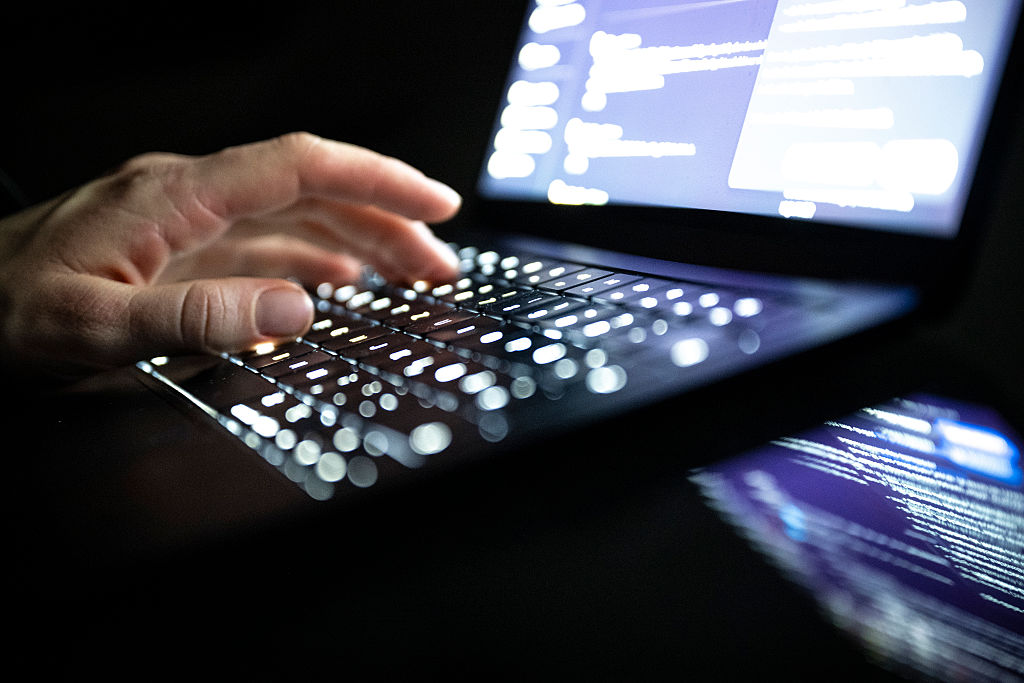
ILLUSTRATION – December 14, 2025, Berlin: A person types with his fingers on an illuminated laptop keyboard (posed scene). Photo: Philip Dulian/dpa (Photo by Philip Dulian/picture alliance via Getty Images)

Behind this shortage of RAM lie various components demanded by the tech industry. First of all, the piece of RAM used by the majority of our PCs, smartphones, and consoles is a very specific type of RAM called DDR4/DDR5 DRAM. This component represents the computer’s temporary memory, which stores what it’s currently using and empties when it’s switched off. DRAM production is mainly controlled by three companies – Samsung, SK Hynix and Micron – which together hold 93% of the world market. These manufacturers are diverting their production interests towards another type of RAM: HBM(High Bandwidth Memory). This is essential for the production of data centers practicing large-scale AI models.

A group of PC memory units, including Corsair, HyperX, Ballistix, and G.Skill hardware, taken on July 5, 2019. (Photo by Phil Barker/Future Publishing via Getty Images)

More complex to manufacture and considerably more expensive than the RAM used for PCs, HBMs are now the manufacturing priorities of RAM production companies, putting consumer RAM manufacturing on the back burner. This bottleneck, caused by limited RAM production capacity, is leading to an increase in the price of RAM modules. According to PCPartPicker, a set of 2 x 32 GB DRAM strips has risen from US$229.99 in October to US$629.99 on Amazon’s website for the same retailer. This price increase per unit will also affect new products such as PCs, smartphones, and tablets, with RAM representing 10-20% of the overall price of a PC.

Electronics manufacturers will therefore be faced with two choices: absorb the RAM price increase, or pass it on to the consumer. This decision will depend on how much margin the manufacturer wants to keep. A final option could be to reduce the number of bytes—the unit defining a computer system’s storage capacity—within RAM. On the other hand, this option would be a retrograde step towards lower-performance devices, but one that would ensure the same price as today’s higher-performance devices.

Le président allemand accuse Trump de transformer l’ordre mondial en un «repaire de voleurs»

Le président allemand a lancé un avertissement sévère quant aux implications plus larges pour le système international. Steinmeier a déclaré : « Il s’agit d’empêcher que le monde ne devienne un repaire de voleurs, où les plus sans scrupules s’emparent de tout ce qu’ils veulent, où des régions ou des pays entiers sont traités comme la propriété de quelques grandes puissances ».