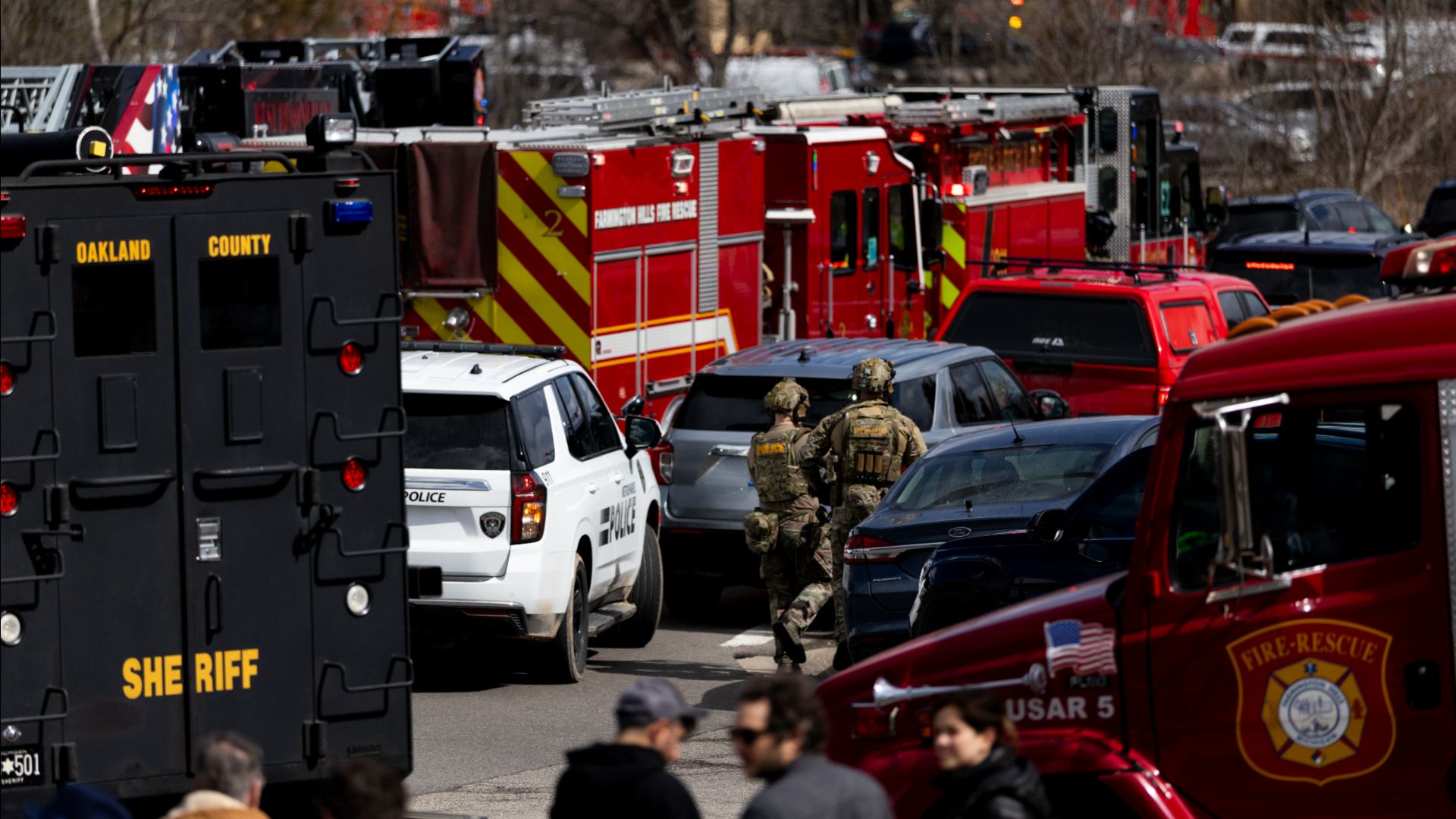
Defense Secretary Pete Hegseth is facing allegations over claims that he issued a scandalous order to «kill everybody» during the second strike of an attack on a suspected cartel drug boat last September. At the time of the second strike, the occupants of the boat were reportedly already stranded, and many experts say that this follow-up strike is considered a «war crime».
Getty Images
Defense Secretary Pete Hegseth is facing one of his toughest tests yet over boat strikes in the Caribbean and Pacific.
Damian Paletta brings you the latest news, information and analysis on what’s driving D.C. in the WSJ Politics newsletter. https://t.co/GekmTrWnN5
Republican and Democratic lawmakers have launched inquiries into allegations that U.S. forces, acting on an order from Defense Secretary Pete Hegseth, targeted survivors of an initial strike on an alleged drug-smuggling boat.
Getty Images
The scrutiny centers on a follow-up strike carried out against individuals who had already survived the first attack on the vessel, which was suspected of involvement in cartel-linked trafficking.
The White House on Monday defended a U.S. admiral’s decision to conduct multiple strikes on the alleged Venezuelan drug-smuggling vessel in September, stating that he had authorization from Defence Secretary Pete Hegseth.
«We’ll look into it, but no I wouldn’t have wanted that, a second strike. The first strike was very lethal. It was fine.»
CaptureXSecWar
A potential war crime
However, critics are questioning the legality of striking survivors, with many describing the operation as a potential war crime.
Getty Images
The second strike is considered by many experts to be a war crime because it allegedly targeted stranded survivors who were already out of combat, which would violate international humanitarian law by breaching the principles of distinction and proportionality, ignoring the special protection granted to shipwrecked persons and other individuals hors de combat under the Geneva Conventions, and potentially failing to respect the obligation to spare and, where possible, rescue those who no longer pose a military threat.
Getty Images
When asked by reporters whether he had authorized or supported such a follow-up strike, Trump responded:
«We’ll look into it, but no I wouldn’t have wanted that, a second strike. The first strike was very lethal. It was fine.»
Getty Images
Republican Rep. Don Bacon, a member of the House Armed Services Committee, said the allegations warranted scrutiny, declaring:
«We should get to the truth. I don’t think he would be foolish enough to make this decision to say, kill everybody, kill the survivors because that’s a clear violation of the law of war. So, I’m very suspicious that he would’ve done something like that because it would go against common sense.»
14 strikes
Based on currently available media counts, as of December 2, 2025 the Trump administration has publicly acknowledged or been reported as carrying out roughly 14 U.S. military strikes on alleged drug-smuggling boats in the Caribbean and Pacific since early September, meaning at least that many vessels have been hit.
Getty Images
Estimated deaths range from a minimum of 61 people in 14 strikes according to FactCheck.org to more than 70–80 alleged traffickers killed in «more than a dozen» strikes according to NPR and an ABC News timeline.
Congress is now demanding access to any audio or video recordings of the controversial second boat strike, as the Trump administration moves to deflect blame away from Pete Hegseth.
The publisher of the Franklin the Turtle books condemned Defense Secretary Pete Hegseth’s use of the beloved children’s character in a meme making light of his department’s deadly strikes on boats in the Caribbean. https://t.co/4LmkOp5UCj
WASHINGTON DC, UNITED STATES - NOVEMBER 26: Security forces take measures after two members of the US National Guard were shot and 'critically wounded' near the White House in Washington DC, United States on November 26, 2025. A suspect was in custody. (Photo by Celal Gunes/Anadolu via Getty Images)
The United States’ Department of State has paused all visas for individuals travelling with Afghan passports after the attack on two National Guard members in Washington, D.C., on Wednesday that killed Specialist Sarah Beckstrom and severely injured Guardsman Andrew Wolfe.
An Afghan National, Rahmanullah Lakanwal, was arrested in connection with the shooting.
IMMEDIATELY paused visa
« The Department of State has IMMEDIATELY paused visa issuance for individuals travelling on Afghan passports, » the agency wrote in an announcement on Twitter.
The statement added that « The Department is taking all necessary steps to protect U.S. national security and public safety. »
The Department of State has IMMEDIATELY paused visa issuance for individuals traveling on Afghan passports.
The Department is taking all necessary steps to protect U.S. national security and public safety.
Lakanwal came to the U.S. in 2021 and was granted asylum in April 2025 under the Trump administration. Donald Trump has blamed the Biden administration for Lakanwal’s presence in the U.S., but it was his administration that granted Lakanwal asylum.
When FBI director Kash Patel was asked about the vetting process, he refused to answer.
Prior to his arrival in the US, Lakanwal worked with the CIA “as a member of a partner force in Kandahar,” John Ratcliffe, CIA Director, said in a statement.
In a statement on Friday, US Citizenship and Immigration Services (USCIS) director Joseph Edlow said his agency had paused all asylum decisions in the interest of the “safety of the American people”.
“USCIS has halted all asylum decisions until we can ensure that every alien is vetted and screened to the maximum degree possible.”
USCIS has halted all asylum decisions until we can ensure that every alien is vetted and screened to the maximum degree possible. The safety of the American people always comes first.
Edlow also called for “a full-scale, rigorous re-examination of every green card for every alien from every country of concern.”
There are currently 19 countries labelled as « high-risk » by the USCIS, including Afghanistan, Burma, Chad, the Republic of the Congo, Equatorial Guinea, Eritrea, Haiti, Iran, Libya, Somalia, Sudan, Yemen, Burundi, Cuba, Laos, Sierra Leone, Togo, Turkmenistan and Venezuela.
A poor vetting process
The arrest and subsequent visa restrictions have sparked questions about why Lakanwal received a visa at all, and critics on both sides of the political spectrum are calling for an investigation into the vetting process used by the United States under Donald Trump.
Additionally, it was revealed that prior to his arrival in the US, Lakanwal worked with the CIA “as a member of a partner force in Kandahar,” according to CIA Director John Ratcliffe.
“He went cuckoo. I mean, he went nuts. It happens too often with these people. You see them. But look, this is how they come in, they’re standing on top of each other,”
-Donald Trump
Lakanwal now faces charges of assault with intent to kill while armed and possession of a firearm during a crime of violence.
Trump has now promised to send 500 more National Guard troops to Washington, D.C., though it’s unclear where the additional troops would come from.
Rocking the administration
US President Donald Trump speaks while signing the bill package to reopen the federal government in the Oval Office of the White House in Washington, DC, on November 12, 2025. Congress on Wednesday ended the longest government shutdown in US history, 43 days that paralyzed Washington and left hundreds of thousands of workers unpaid while Republicans and Democrats played a high-stakes blame game. The Republican-led House of Representatives voted largely along party lines to approve a Senate-passed package that will reopen federal departments and agencies, as many Democrats fume over what they see as a capitulation by party leaders. (Photo by Brendan SMIALOWSKI / AFP) (Photo by BRENDAN SMIALOWSKI/AFP via Getty Images)
The shooting of Wolfe and Beckstrom has rocked the Trump administration over the last week. Just days ago, on November 27, Donald Trump snapped at a reporter who questioned Lakanwal’s vetting process, calling her “a stupid person.”
“Are you stupid? Are you a stupid person? They came in on a plane along with thousands of other people that shouldn’t be here, and you’re just asking questions because you’re a stupid person.”
Lakanwal came to the US as part of the Biden-era program “Operation Allies Welcome,” which came after the US extracted its troops from Afghanistan. Lakanwal was not granted asylum until 2025, after Donald Trump was elected.
AfghanEvac comments
Nonprofit group AfghanEvac denounced the visa pausing, calling the administration’s decision a « violation of federal law. »
AfghanEvac President Shawn VanDiver released a statement on November 28 calling the decision unlawful.
It appears Secretary Rubio is attempting to shut down the Afghan Special Immigrant Visa program in direct violation of federal law and standing court orders. He is seemingly acting at the direction of President Trump and Stephen Miller, and there is no doubt this is the outcome they have been driving toward for months
Today’s announcement from @SecRubio appears to be an unlawful attempt to shut down the Afghan Special Immigrant Visa program.
Using one violent individual as justification punishes an entire community, and the veterans who served beside them.
It’s unclear how the US government will enact these new directives, or how quickly it will happen. Donald Trump said on Thursday, “You can’t get them out once they come in. »
At least 400,000 people have been deported from the U.S. since Donald Trump took office.
US President Donald Trump speaks while signing the bill package to reopen the federal government in the Oval Office of the White House in Washington, DC, on November 12, 2025. Congress on Wednesday ended the longest government shutdown in US history, 43 days that paralyzed Washington and left hundreds of thousands of workers unpaid while Republicans and Democrats played a high-stakes blame game. The Republican-led House of Representatives voted largely along party lines to approve a Senate-passed package that will reopen federal departments and agencies, as many Democrats fume over what they see as a capitulation by party leaders. (Photo by Brendan SMIALOWSKI / AFP) (Photo by BRENDAN SMIALOWSKI/AFP via Getty Images)
The president of the United States has added another classy remark to his resume of reporter communications, less than a week after calling a woman “piggy”.
Donald Trump lashed out at a reporter on Thursday after being asked about the vetting of the suspect in the shooting of two National Guardsmen in Washington, D.C.
Trump pressed by reporter
During the press conference at Mar-a-Lago on Thursday, Donald Trump was asked about the shooting of two members of the National Guard on Wednesday in D.C. The shooter, who was a suspected Afghan National, had reportedly been vetted by the state.
“U.S. officials say that the suspect worked very closely with the VIA in Afghanistan for years, that he was vetted, and the vetting came up clean.”
Trump claimed the asylum process used by the U.S. forces on asylum seekers coming from Afghanistan via plane was ineffective and had failed to vet the shooter properly.
“He went cuckoo. I mean, he went nuts. It happens too often with these people. You see them. But look, this is how they come in, they’re standing on top of each other,”
Trump continued to say that “There was no vetting or anything. They came in unvetted, and we have a lot of others in this country, and we’re going to get them out.”
The reporter tried pressing Trump, correcting him, “Actually, your DOJ IG [Department of Justice Inspector General] just reported this year that there was thorough vetting by DHS and by the FBI of these Afghans who were brought into the U.S.,”
Trump cut off the reporter angrily.
“Because they let them in. Are you stupid? Are you a stupid person? They came in on a plane along with thousands of other people that shouldn’t be here, and you’re just asking questions because you’re a stupid person.”
He then claimed that it was impossible to remove the people who came in as part of the immigration policies of former U.S. President Joe Biden.
At least 400,000 people have been deported from the U.S. since Donald Trump took office.
Washington, D.C. shooting
WASHINGTON, DC – NOVEMBER 26: Members of the U.S. Secret Service and other law enforcement agencies respond to a shooting near the White House on November 26, 2025 in Washington, DC. At least two uniformed military personnel, appearing to be National Guardsmen, have been shot blocks from the White House. (Photo by Anna Moneymaker/Getty Images)
Just after 2 PM on Wednesday, November 26, two members of the U.S. National Guard were shot near Farragut Square in downtown Washington, DC.
The soldiers, both hailing from West Virginia were on a high-visibility patrol near the corner of 17th and I street, an area that services lunchtime needs for White House staff.
Washington Metropolitan Police Assistant Chief Jeff Carroll said the shooter « came around the corner » and « immediately started firing ». He claimed the soldiers were ‘ambushed’.
Washington Mayor Muriel Bowser called the shooting a targeted attack.
The victims were 20-year-old Sarah Beckstrom and 24-year-old Andrew Wolfe.
Specialist Beckstrom died from her injuries on Thursday; Wolfe remains in critical condition.
Who was the shooter?
The suspected gunman has been identified by law enforcement as 29-year-old Rahmanullah Lakanwal. He will be charged with three counts of assault with the intent to kill while armed and criminal possession of a weapon.
Lakanwal is believed to come from Afghanistan. He came to the U.S. in 2021 and was granted asylum in April 2025 under the Trump administration.
When FBI director Kash Patel was asked about the vetting process, he refused to answer, instead referencing a post on X from Kristi Noem.
The suspect who shot our brave National Guardsmen is an Afghan national who was one of the many unvetted, mass paroled into the United States under Operation Allies Welcome on September 8, 2021, under the Biden Administration.
I will not utter this depraved individual’s name.…
Donald Trump has blamed the Biden administration for Lakanwal’s presence in the U.S., but it was his administration that granted Lakanwal asylum.
Prior to his arrival in the US, Lakanwal worked with the CIA “as a member of a partner force in Kandahar,” John Ratcliffe, CIA Director, said in a statement.
Lakanwal currently faces charges of assault with intent to kill while armed and possession of a firearm during a crime of violence.
Soon after the shooting, Trump said he would send 500 more National Guard troops to Washington, D.C., though it’s unclear where the additional troops would come from.
Canadian Prime Minister Mark Carney (L) and US President Donald Trump pose for a family photo during the Group of Seven (G7) Summit at the Kananaskis Country Golf Course in Kananaskis, Alberta, Canada on June 16, 2025. (Photo by Brendan SMIALOWSKI / AFP) (Photo by BRENDAN SMIALOWSKI/AFP via Getty Images)
After threatening Canada more than a month ago with another tariff hike, it seems Trump has lost his taste for the trade war, or maybe he’s forgotten.
It’s like nobody wants to remind the teacher that the homework is due.
Tariff threat in October
US President Donald Trump speaks to the press as he meets Canadian Prime Minister Mark Carney during the Group of Seven (G7) Summit at the Pomeroy Kananaskis Mountain Lodge in Kananaskis, Alberta, Canada on June 16, 2025. (Photo by Brendan SMIALOWSKI / AFP) (Photo by BRENDAN SMIALOWSKI/AFP via Getty Images)
Donald Trump announced on Truth Social that he would be raising the tariffs on Canadian goods by 1 percent after the Ford administration ran an ad during Game One of the World Series.
“Canada was caught, red-handed, putting up a fraudulent advertisement on Ronald Reagan’s Speech on Tariffs.“
The ad in question featured clips from a Reagan speech where he was heard saying, “ When someone says, let’s impose tariffs on foreign imports, it looks like they’re doing the patriotic thing by protecting American products and jobs… But over the long run, such trade barriers hurt every American worker and consumer. High tariffs inevitably lead to retaliation by foreign countries and the triggering of fierce trade wars.”
Trump almost immediately had a temper tantrum, posting “TARIFFS ARE VERY IMPORTANT TO THE NATIONAL SECURITY, AND ECONOMY, OF THE U.S.A. Based on their egregious behavior, ALL TRADE NEGOTIATIONS WITH CANADA ARE HEREBY TERMINATED.”
Trump claimed he told the government of Ontario to pull the ad, but they didn’t listen.
“Their Advertisement was to be taken down, IMMEDIATELY, but they let it run last night during the World Series, knowing that it was a FRAUD,”
Yes, it’s a sad look for a world leader to throw a temper tantrum over a fairly tame attack ad (has he ever watched the ones his administration puts out?), but this is the reality in America.
A forgotten threat
It appears as though Trump has forgotten about the threat entirely, and it doesn’t seem like anyone is in a rush to remind him. American reporters haven’t prodded him (as a Canadian, I thank you), and according to reports by Politico, no official paperwork has been created regarding the 10% hike.
Maybe all is forgiven after Carney apologized to Trump at the Asia-Pacific Economic Cooperation summit in South Korea.
“I have a very good relationship [with Carney]. I like him a lot, but what they did was wrong. He was very nice. He apologized for what they did with the commercial.”
Maybe Carney can tap into whatever charm newly elected NYC mayor, Zohran Mamdani, hypnotized Trump with over the weekend.
On his side, Doug Ford was unapologetic for the ad, “They’re talking about it in the U.S., and they weren’t talking about it before I put the ad on. I’m glad that Ronald Reagan was a free trader,” Ford said.
According to experts, the 10% hike could seriously jeopardize Canada’s steel-reliant auto manufacturing industry even further than the existing tariffs already have.
One U.S. official suggested the Trump administration had opted to hold off on additional duties—and instead choose to dangle the threat — as the two sides gear up for future talks.
Le vice-président américain JD Vance s'exprime lors d'une discussion à la réunion des dirigeants de Munich organisée par la Conférence de Munich sur la sécurité à l'hôtel Willard à Washington, DC, le 7 mai 2025. (Photo by Mandel NGAN / AFP) (Photo by MANDEL NGAN/AFP via Getty Images)
Sans surprise, JD Vance continue de colporter l’idée que le Canada est un enfer glacé peuplé de migrants dangereux, tandis que les États-Unis sont une utopie rentable.
The wholesale retail giant Costco has filed a lawsuit against the Trump administration over the so-called Trump tariffs, seeking to claw back what it says are unlawful costs. The case comes as the Supreme Court is weighing the legality of those tariffs and whether Trump has the authority to impose sweeping duties on most imports under the 1977 International Emergency Economic Powers Act.

Costco’s lawsuit, filed in the U.S. Court of International Trade in New York on Nov. 28, asks the court to rule that Trump’s use of the International Emergency Economic Powers Act to impose broad tariffs was unlawful.
Costco joins a growing list of corporations racing to protect themselves as Trump’s tariff gambit faces a skeptical Supreme Court.https://t.co/X8aoBkcgUq
The wholesale retailer is seeking a full refund of the tariffs it paid and is also suing the Trump administration for an unspecified amount of damages linked to those duties.
Getty Images
In its complaint, Costco argues that importers have no assurance they will be refunded tariffs already paid, even if the Supreme Court ultimately strikes them down as unlawful, unless they bring their own lawsuits.
By going to court now, Costco is effectively trying to secure its place in line, ensuring it can recover what it views as improperly collected tariff payments if the high court rules that Trump overstepped his legal authority.
Getty Images
No deadline for a ruling
Now before the justices in the consolidated cases Learning Resources v. Trump and V.O.S. Selections v. Trump, the Supreme Court heard arguments on November 5 over whether Donald Trump can use a 1977 emergency-powers law to levy sweeping tariffs on most imports, but has set no firm deadline for a ruling, which court watchers expect sometime later this term.
Several companies, including Bumble Bee Foods, Kawasaki Motors, EssilorLuxottica, Revlon and Yokohama Tire, have already gone to court over the Trump tariffs, but Costco — with more than $275 billion in annual revenue and a business heavily reliant on imports — is by far the largest corporate challenger so far.
Wholesale giant Costco has filed a lawsuit against the Trump administration for a "full refund" on import duties the company says it paid this year under global tariffs imposed by President Trump. https://t.co/2PfUnyEAez
LA MALBAIE, CANADA - MARCH 12: Minister of Foreign Affairs of Canada Melanie Joly waits for Minister for Europe and Foreign Affairs of France Jean-Noel Barrot to arrive for a bilateral meeting at the Fairmont Manoir Richelieu for the G7 Foreign Ministers Meeting on March 12, 2025 in La Malbaie, Canada. The foreign ministers of the Group of Seven major democracies - Britain, Canada, France, Germany, Italy, Japan and the United States, will meet on March 12-14. (Photo by Andrej Ivanov/Getty Images)
In a committee meeting on Tuesday, November 25th, regarding investments into Stellantis, Conservative MP Jeremy Patzer managed to pry out the fact that Melanie Joly, Minister of Canada Economic Development for Quebec Regions, never read the contracts she claimed that Stellantis breached.
The issue stems from Stellantis’ announcement they would be moving production of the Jeep Compass to the U.S., laying off 3000 Canadians. Minister Melanie Joly claims that Stellantis breached the contract by doing this, but was unable to provide any proof of the claim.
The meeting came to a head when witnesses shared that neither Joly, the Privy Council Office (PCO), nor the government’s legal team had read the entirety of the $15bn contract before signing it.
The kicker?
Stellantis was supposed to be at the meeting, but failed to tune in due to « IT issues ».
The Minister didn't see the contract. The legal team didn't see it. Members of Parliament can't see it.
A redacted contract and a Stellantis no-show at committee.
What kind of agreement did the Liberals sign, if they won't show it, and Stellantis won't talk about it? pic.twitter.com/406iPy5YgF
Present in the meeting were Philip Jennings, Deputy Minister of Innovation, Science and Economic Development (ISED); Stephanie Tanton, Assistant Deputy Minister of Innovation Canada; Denis Martel, Director General of Innovation Canada; and Benoit Tessier, Director General of the Industry Sector—all appointed officials.
What are the Stellantis contracts?
The Government of Canada signed a multi-billion-dollar deal with automaker Stellantis to build a battery plant in Windsor, Ont. In total, the government of Canada has three contracts signed with Stellantis, all of which can reportedly be voided if Stellantis breaches any clauses.
The problem is that we don’t know what’s in the contracts, and the Minister who signed them might not know either. The government of Canada released 70 pages of documents, but they were heavily redacted, leaving other government officials wondering about the details.
In total, the contracts have avenues for $15bn in Canadian investment using public funds.
Joly never read the contract?
In the meeting on November 25, a meeting that a representative from Stellantis was supposed to be at but failed to show, Jeremy Patzer found out that nobody had read the contract.
When it was time for the MP from Swift Current – Grasslands – Kindersley, Saskatchewan, to question witnesses, he first asked whether Joly approved all the redactions, to which Jennings replied, “We did not interact with the minister’s office about this, related to the redactions.”
When Patzer pushed further, asking, “Has the minister seen the fully redacted contract?”
“If she has, it certainly wouldn’t be through my office, so my sense is no.”
Jennings then continued to seemingly tell on himself and the minister.
“I have actually not seen the fully unredacted version myself.”
The answer clearly took Patzer by surprise, and he took a beat before continuing, asking, “You’re saying only four, maybe six other people have seen this contract? Has the Privy Council (PCO) seen the contract?
“My sense is no, they would not have seen it, we really treat these documents with a lot of care so at the end of the day its on a need to know basis.”
Apparently, the elected officials signing off on the document don’t “need to know”.
Jennings did go on to clarify, “these were negotiated before I was deputy… Had it been negotiated when I was deputy, I would have seen the documents,” but could not confirm whether the previous deputy had seen the contracts.
Jennings was then asked whether any sort of legal department had seen the contracts, to which he asked to convene with Tanton, Martel, and Tessier.
Tanton responded, saying that legal oversaw certain clauses of the contract, but “do they see the whole thing? Denis? No I don’t think so.” Denis Martel shook his head when she turned to him mid-sentence.
Patzer sat open-mouthed and shocked. Yes, that’s right, the legal team for a contract estimated at $15bn wasn’t overseen in full by any legal team before being signed by elected government officials at the directive of appointed department employees.
“[The legal team] would be pulled in where clauses are deviating from what we would normally negotiate.”
It leaves the question, how does Minister Melanie Joly know what clauses Stellantis has breached, and how many other items are in the contract that let the corporations cut Canadian jobs?
Breaching a contract you’ve never seen
Suspicion about the $15bn deal began in a meeting on November 3rd, where Minister Joly herself was present.
The meeting began with a speech from Joly, who claimed that Stellantis had breached its contract through job guarantees and that the government would take action to rectify the situation.
When Joly was asked about the specifics of the job guarantee in the contract, she was unable to give any solid numbers. Since the Government has only released a heavily redacted version of the contract, there was no way for Committee members to dispute her claim.
“You will see in the contract, you will see that there’s job numbers – the government will be acting in good faith.”
Joly cited that one reason for the redaction was “commercially sensitive” matters. Still, the government had no problem releasing unredacted versions of a similar contract signed with NextStar Energy to fund a battery plant, sparking questions in Parliament.
Joly then failed to answer a follow-up about a specific clause linking the three Stellantis contracts.
“Maybe Charles [Vincent], if you want to be able to address the question?”
Charles Vincent is the Senior Assistant Deputy Minister of the Industry Sector.
Contrasting claims
LA MALBAIE, CANADA – MARCH 14: Canadian Minister of Foreign Affairs Melanie Joly talks to the press in closing remarks at the G7 Foreign Ministers Meeting at the Fairmont Manoir Richelieu on March 14, 2025 in La Malbaie, Canada. The foreign ministers of the Group of Seven major democracies – Britain, Canada, France, Germany, Italy, Japan and the United States, will meet on March 12-14. (Photo by Andrej Ivanov/Getty Images)
Shortly after trying to deflect to Vincent, Joly gave a conflicting statement, claiming that “[the contract] is linked to the fact that the Brampton facility must be operating – if the Brampton facility ceases production, there will be a violation of a contract.”
Charles Vincent claimed that there are “regular commitments around jobs, around the maintenance of activities.”
Once again, no details.
Joly was then asked whether she would withdraw the funding (up to $15bn) if they don’t “properly equip” the 3,000 laid-off employees in Brampton.
Joly said they would “continue to hold [Stellantis] accountable,” but refused to confirm whether the government would cut funding.
“You’ve kind of been quite evasive about the numbers, whether there’s a real guarantee. It should be explicit if you’re going to give a historic amount of taxpayer funding. I’m not sure you understand the amount of money you have committed.”
-Raquel Dancho
Dancho broke down the sheer volume of wealth, saying that it would take 647,000 two-member households a full year of work to fund this bill.
Not understanding
It’s more than likely that MP Dancho is correct; Minister Joly does not understand the amount of money because she hasn’t read an unedited version of the contract she signed.
According to Patzer, the government has already paid out almost half a billion dollars of this contract, and apparently, not a single elected official has seen the details. A contract designed to create Canadian jobs may end up paying for factories in America.
BERLIN, GERMANY - AUGUST 26: Canadian Prime Minister Mark Carney listens as German Chancellor Friedrich Merz speaks to the media following talks at the Chancellery on August 26, 2025 in Berlin, Germany. Carney is visiting Germany, Poland and Latvia this week to reportedly speak with leaders on issues including trade, defence and energy. (Photo by Omer Messinger/Getty Images)
Ottawa and Alberta signed a brand new energy deal on Thursday that has sent positive and negative feelings throughout every actor involved in Canadian politics.
The deal promises a new bitumen that will run from Alberta all the way to the coast of British Columbia. The decision has sent climate supporters reeling and has left Indigenous groups furious.
The deal also confirmed that Carney’s government will not impose the proposed cap on oil and gas emissions and will amend the “greenwashing” provisions, which his government first announced in the Liberals’ Nov. 4 budget.
The deal outlines both Ottawa’s and Alberta’s commitments to achieving net-zero emissions by 2050.
The new pipeline will be in addition to the extension being built to the Trans Mountain pipeline.
What does Carney think?
PM Carney was all smiles as he shook hands with controversial Alberta Premier Danielle Smith. Premier Smith has been heavily criticized for her stance on climate change, immigration, vaccines, and social programs that Canadians rely on.
“At the core of the agreement, of course, it’s a priority to have a pipeline to Asia. That’s going to make Canada stronger, more independent, more resilient, more sustainable,”
-Mark Carney
Carney claims the deal will “set the stage for an industrial transformation.” And that the deal is “multifaceted”.
Problems in BC
The government of British Columbia has rejected the deal, which would give Alberta an exemption to a federally imposed ban that stops oil tankers from carrying more than 12,500 tonnes of crude oil and other persistent oil products as cargo off B.C.’s North Coast.
First Nations groups in the area want the tanker ban to remain, with the Heiltsuk Nation stating that coastal First Nations communities are “ground zero for the dangers of marine accidents, including oil spills, and we shoulder the burden of risk of expanded marine traffic.”
BC Premier David Aby has also made his thoughts known.
“The vast majority of those projects rely on the support of coastal First Nations, for whom the oil tanker ban is the sole reason they’re able to tolerate those other projects, »
First Nations say it will ‘never happen’
The president of the Coastal First Nations in B.C. made her stance clear. Marilyn Slett said her group, which represents nearly a dozen First Nations, has been completely left in the dark and that an oil pipeline to the province’s North Coast « will never happen ».
« While the details of this MOU remain to be seen, under no circumstances can it override our inherent and constitutional rights and title, or deter our deep interconnection of mutual respect for the ocean. »
First Nations groups in Alberta are also opposing the deal,
« It’s frustrating when people are having talks, and we’re absent from the table, » said Cold Lake First Nations Chief Kelsey Jacko.
Liberal MP resigns
OTTAWA, CANADA – MAY 13: Steven Guilbeault, Minister of Canadian Identity and Culture and Minister responsible for Official Languages, is sworn in at Rideau Hall for the cabinet’s swearing-in ceremony on May 13, 2025 in Ottawa, Canada. Newly elected Prime Minister Mark Carney unveiled his cabinet and promised « decisive action » on his ambitious economic agenda as the country faces strained relations with the U.S. over trade tariffs. (Photo by Andrej Ivanov/Getty Images)
Possibly the most dramatic reaction came from Steven Guilbeault, a Liberal MP from Quebec, who resigned his seat in protest of the deal.
In a lengthy statement posted to Twitter, Guilbeault said he informed the prime minister of his decision on Thursday, noting he is also departing from his role as Carney’s Quebec lieutenant.
This afternoon, I informed the Prime Minister of my decision to resign as Minister of Canadian Identity and Culture, Minister responsible for Official Languages, Minister of Nature and Parks Canada, as well as his Lieutenant in Quebec.
“I chose to enter politics to champion the fight against climate change and the protection of the environment.”
Guilbeault outlined a myriad of reasons why the deal goes against his beliefs.
“There was no consultation with the Indigenous Nations of the West Coast of BC, or with the provincial government.”
He also cited how lifting the tanker ban in BC could “significantly increase the risk of accidents in the region.”
The tanker ban was unanimously passed by the House of Commons in 1972 due to the treacherous nature of the Hecate Strait, the route tankers need to take. The Hecate Strait is known as the most dangerous body of water in Canada.
There are no set plans for the construction of this pipeline, but Carney claims they will “build big, we will build fast.
TORONTO, CANADA - NOVEMBER 7 : Canadian Prime Minister Mark Carney participates in a featured conversation on Budget 2025 with the Canadian Club Toronto on November 7, 2025 in Toronto, Ontario, Canada. (Photo by Mert Alper Dervis/Anadolu via Getty Images)
As the competition for Canada’s lucrative submarine project winds to a close, it looks like Germany might be the candidate to run away with it after a Norwegian defence company is using its country’s Arctic link to persuade Canada.
“We like to lose to Canada in ice hockey. It’s one of the countries we like to lose to. The cultural fit, being Arctic-centric nations, being NATO members — there’s so much alignment.”
-Kjetil Myhra, executive vice president of defence systems at Kongsberg
Myhra told media outlets that his firm is already an expert in creating submarine infrastructure in Arctic conditions, something this project would certainly entail.
Kongsberg is supporting Germany’s ThyssenKrupp Marine Systems, or TKMS, in the bid. If successful, they would be rewarded with the multi-billion dollar contract to build a fleet of submarines designed to patrol Canada’s Arctic coast.
An international effort
Jacques Esser, investor relations manager at ThyssenKrupp’s naval unit ThyssenKrupp Marine Systems (TKMS), walks past his company’s logo prior to TKMS’ initial public offer at the stock exchange in Frankfurt am Main, western Germany, on October 20, 2025. (Photo by Kirill KUDRYAVTSEV / AFP via Getty Images)
What makes this particular bid interesting is that it’s a merger of Germany’s and Norway’s respective governments. It appears that TKMS, backed by Kongsberg, are presenting itself as part of a group of nations and private companies working toward the same goal.
With TKMS bringing in a company whose expertise lies in building advanced submarine technology, Germany is potentially suggesting a linked international submarine fleet.
With Russia continually threatening northern waters, it’s an offer the Canadian government may be inclined to take.
Kongsberg, which was already contracted by TKMS, will be lending the TKMS 212CD subs its combat system, dubbed ORCCA, which will operate in the Norwegian and German subs. It will also operate in Canadian subs if TKMS wins the contract.
In need of a marine fleet
The H.M.C.S. Victoria, one of Canada’s recently acquired diesel and electric submarines, tied up at the dock at the Canadian Navy base Esquimalt. The Victoria is one of four submarines which, bought used from the British government, were grounded when one member of the submarine crew died on board the HMCS Chicoutimi during a fire that crippled the submarine while returning from England. | Location: Esquimalt, British Columbia, Canada. (Photo by Christopher Morris/Corbis via Getty Images)
Canada is currently in a race to replace its aged fleet of submarines: the Victoria class. The Victoria subs are scheduled for retirement in 2035, but three of the four ships have already been retired.
The Canadian government is looking to purchase a fleet of 12 submarines from foreign suppliers. Only TKMS and South Korea’s Hanwha Oceans remain in contention for the contract.
Kongsberg executives have been meeting in Canada regularly over the last month, trying to push their case. Part of their argument is resume: Konsberg has been receiving Canadian contracts for decades and exporting defence tech into international markets.
The company is currently under contract for the Royal Navy, outfitting naval River-class destroyers with key operating components and naval strike missiles.
LONDON, ENGLAND – SEPTEMBER 10: The Kongsberg company logo is displayed during the Security Equipment International (DSEI) at London Excel on September 10, 2025 in London, England. The Defence and Security Equipment International (DSEI) hosts defence equipment manufacturers from around the world at a 4-day exhibition in London. Anti-war protesters gather outside in the hope of preventing the event from going ahead. (Photo by John Keeble/Getty Images)
Kongsberg is also looking to purchase a factory in Newfoundland. Kjetil Myhra told the media that “The message that we’re also carrying here to Canada is, make sure that you build long-term relationships that build sustainable jobs for Canada and not just something that comes in for a particular program, and when the program ends, the jobs goes away,”
Ottawa privately sent bid instructions to the two sub makers on Nov. 14. The Canadian government has refused to release those instructions, citing concerns for national security.
“Given the sensitive nature of procuring an advanced submarine capability, the bid instructions will not be made public, given the national security and sovereignty context,”
-Nicole Allen, Public Services and Procurement Canada spokesperson.
Reportedly, the instructions said the government’s scoring of the bids will place most of the emphasis on the boats’ long-term maintenance.