Categories
Mobile Syrup

Globalive launches new public push against Rogers-Shaw merger

Globalive has launched a new avenue for people to share their concerns about the Rogers-Shaw merger with members of the federal government.

NoMerger.ca provides a template message opposing the merger and allows Canadians to share it with their Member of Parliament based on the postal code they provide.

“The Rogers-Shaw merger will only reduce competition and increase prices. Tell [Minister François-Philippe Champagne] to follow the advice of the Competition Commissioner and the Standing Committee on Industry and Technology and reject this merger,” the template reads.

Anthony Lacavera is the founder of Globalive and has been one of the many persistent voices against the merger.

Globalive had previously offered to buy Freedom Mobile when Rogers and Shaw agreed to sell it. The company’s $3.75 billion offer was rejected in favour of Vidéotron’s $2.85 billion offer. Lacavera was the founder and CEO of Wind Mobile before the company was sold to Shaw and rebranded to Freedom.

The $26 billion Rogers-Shaw merger needs approval from three parties. The Competition Bureau sought to block it through a hearing with the Competition Tribunal, which backed the telecoms. The bureau will present its case to the Federal Court of Appeal Tuesday.

The Canadian Radio-television and Telecommunications Commission (CRTC) approved the broadcasts aspect of the merger in March 2022. However, a recent application from TekSavvy asks the CRTC to examine Rogers’ plans to lease its broadband network to Vidéotron at a lower price than wholesale rates, which it alleges violates the Telecommunications Act. The CRTC has yet to respond to the application.

Innovation Minister François-Philippe Champagne must provide the third avenue of approval.

This isn’t the only time Lacavera has pushed for the Innovation Minister to stop the merger. He launched a similar measure on his personal website last year, asking Minister Champagne and Prime Minister Justin Trudeau to end “the fake competition in wireless.”

Lacavera told MobileSyrup the original measure on his personal website was in response to many of the early concerns he heard for Canadians on the merger. But it only targeted Minister Champagne and Prime Minister Trudeau. He was also getting similar requests on how people could contact their MPs directly, resulting in the creation of NoMerger.ca.

While both websites are similar, Lacavera said he wouldn’t get rid of one or the other. “We are checking the form inputs to ensure there are no bots or duplicates.”

The new website launched Tuesday, and 4,000 Canadians have sent emails in the first 24 hours.

Categories
Mobile Syrup

New Instagram tools give back control to the user

Meta-owned Instagram has added a few new tools that would allow users to gain more control over the app, avoid content and help parents supervise their kids’ Instagram with updated parental tools.

Starting off with “Quiet Mode,” Instagram is making it easier for users to focus and set boundaries with their friends and followers. The feature, which will be available to users in Canada, the U.S., the United Kingdom, Ireland, Australia New Zealand starting now, will allow users to turn off notifications, change their profile’s activity status to “In Quiet Mode,” and send an automatic reply when someone sends you a direct message.

Once you’re done with your ‘Quiet’ time, and turn the feature off, Instagram will give you a quick summary of all the missed notifications.

In addition to being available to all users, Instagram will also prompt teens to use Quiet Mode when they spend a significant amount of time on the platform late at night. The company hopes to expand the feature to more countries in the future.

Next up are new ways for users to manage their recommendations.

The new recommendations tool allows users to personalize the content they see on Instagram’s Explore page, and avoid content they aren’t interested in and don’t want recommended to them in other areas of the platform, such as Reels, Search and more.
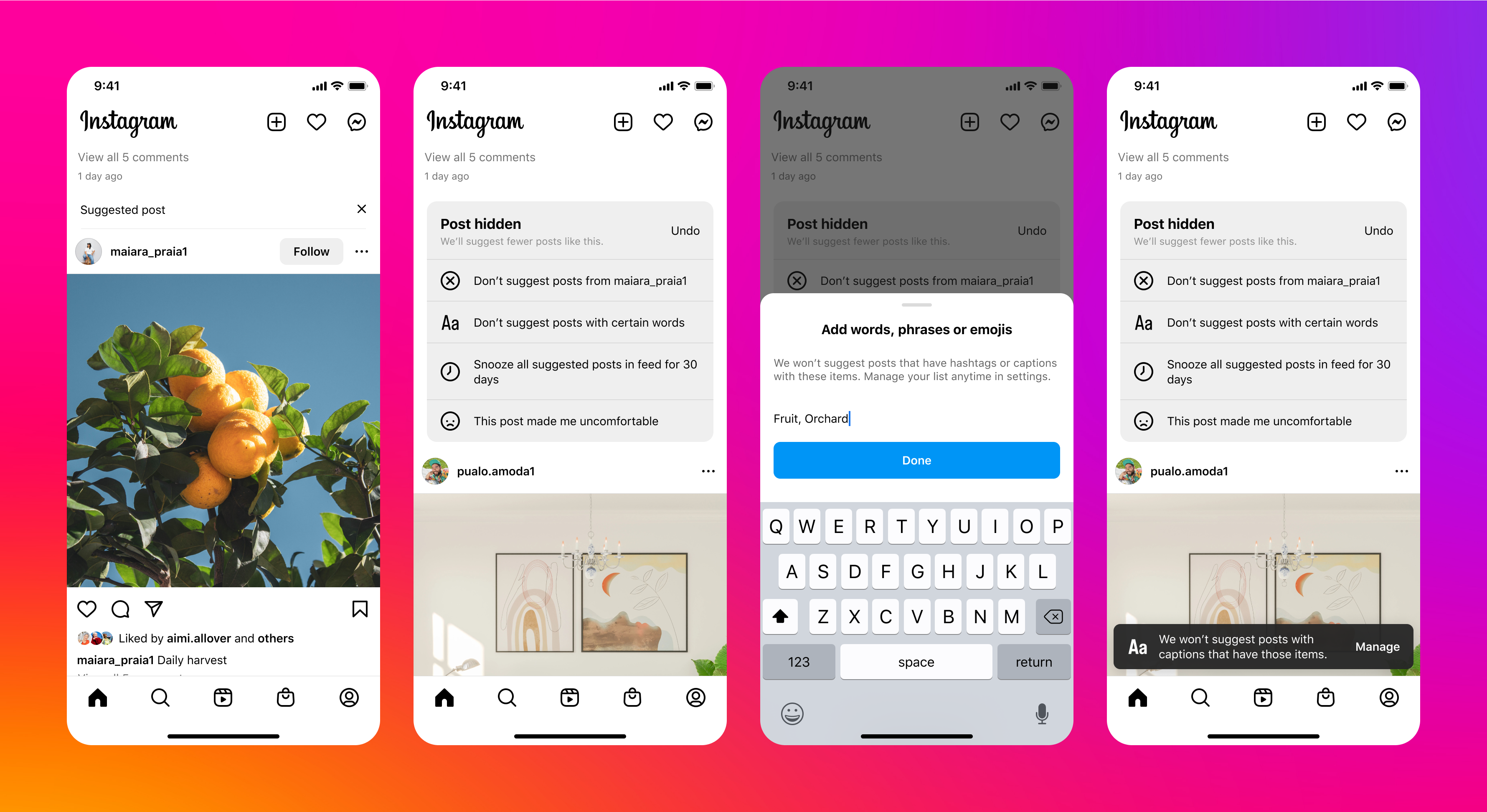
Users can click on the three dots on top of a post on the Explore page and tap ‘Not Interested,’ and Instagram will avoid showing similar content in other places where it makes recommendations, like Reels, Search and more.

Instagram is also expanding its existing feature that allows users to hide comments and direct messages containing specific words. Now, users can apply this feature to recommended posts across Instagram. Users can add a word or list of words, emojis or hashtags that they want to avoid on Instagram and the platform will no longer recommend content with those words in the caption or the hashtag.

To add keyword to avoid, head to your profile and tap on the hamburger icon on the top right. Tap on Settings > Privacy and then Hidden Words to access the feature.

Lastly, while the above-mentioned features are useful for users to take control of their Instagram accounts, the other tool is for parents to take over control, at least to some degree.

Instagram, already has the option for parents to see their teen’s Instagram settings, including their privacy and account settings. The new update lets parents know if their teen updates a setting on their Instagram account. Instagram will send a notification indicating the change in settings. Further, parents can also view accounts that the teen has blocked.

The Parental tools are available via Family Center.

Image credit: Instagram

Source: Instagram

Categories
Mobile Syrup

3rd-Gen Apple TV 4K users report connection problems with Siri Remote

3rd-Gen Apple TV 4K owners are reporting connection issues with the Siri Remote, even when located in close proximity to the set-top box.

As reported in several Reddit threads and MacRumours‘ forum, the issue seems to stem from the Siri Remote’s inconsistent Bluetooth connection with the set-top box.

The only fix users have been able to find is by either re-pairing or restarting the Siri remote, or by unplugging and plugging the set-top box in again. Further, using the remote app on an iPhone, or controlling Apple TV with a TV remote via HDMI-CEC seems to be working as intended, which means the issue definitely stems from the Siri Remote’s Bluetooth capabilities.

It is currently unclear whether the problem is caused by a software bug or a hardware issue, but some users have reported that the issue began after updating to tvOS 16.2.

According to MacRumours, users have even gone through multiple Apple TV 4K replacement units to try and resolve the problem, with mixed results. Apple has not yet publicly acknowledged or addressed the issue, but is likely aware of it.

Are you facing the same issue with the third-gen Apple TV 4K? Let us know in the comments below. Learn more about the third-gen Apple TV here.

Source: MacRumours

Categories
Mobile Syrup

Apple could be working on an iPad-like smart home control display

Apple might be developing an iPad-like display designed nearly solely for managing smart home devices.

According to Bloomberg’s Mark Gurman, the device will operate like a low-end iPad with a few key purposes — controlling HomeKit-enabled devices, making FaceTime calls, streaming video and more.

Like Amazon’s Echo Show 15, the smart home display is reportedly designed to be mounted to a wall or magnetically to another object like a fridge. In the past, this device has been rumoured to be more of a HomePod/Apple TV hybrid device, but if these rumours are accurate, that direction seems to have shifted.

What’s strange about this rumour is that at one point you could effectively do the same thing with Apple’s entry-level iPad. Apple even once allowed you to use the iPad as a home hub, though the company removed that functionality following the release of iPadOS 16.

According to Gurman, Apple is aiming for a 2024 launch for its smart home display. Earlier this week, Apple revealed its new 14-inch and 16-inch M2 Pro/Max-powered MacBook Pro (2022) and refreshed 2nd-Gen HomePod.

Source: Bloomberg Via: The Verge 

Categories
Mobile Syrup

Verizon works with Centech, Bell, to foster 5G technology development

Verizon and Centech have selected their first cohort of companies for the 5G Development Hub.

Launched in May 2022, the hub provides startups with tools to realize 5G and Mobile Edge Compute (MEC).

Seven Canadian startups are part of the first cohort, and some of these companies were able to test their solutions on Bell’s 5G network. The startups specialize in applying 5G to manufacturing, transportation and energy.

“The 5G DevelopmentHub brings together Canada’s booming startup ecosystem and the expertise of leading 5G and MEC providers,” Richard Chénier, Centech’s general director, said.“5G is important for the future of innovation and this first cohort has proven to be successful.

Image credit: Shutterstock 

Source: Verizon

Categories
Mobile Syrup

Five months post launch, Android 13 is on 5.2 percent of all devices

Android 13 has achieved a 5.2 percent adoption rate on all devices in less than six months since launch, as revealed in the official Android distribution numbers from Google (via 9to5Google).

It’s worth noting that Google used to share the distribution numbers almost every month but has become irregular with updates more recently. For example, the last Android distribution numbers from Google came in August 2022, just before Android 13 launched.

The latest figures show that devices running Android 13 now account for 5.2 percent of all devices, while Android 12 and 12L account for 18.9 percent of the total, a significant increase from the 13.3 percent reported in August. Notably, the chart does not distinguish between Android 12 and 12L.

Looking at older versions of Android, usage of Android Oreo has dropped below 10 percent, with similar declines in usage for other versions. Android Jelly Bean, which previously accounted for 0.3 percent of devices, is no longer listed, while KitKat has dropped from 0.9 percent to 0.7 percent.

The rapid adoption of Android 13 is likely due to the swift rollout of updates by phone manufacturers such as Google, Samsung, OnePlus, Sony, and others, prompting users to upgrade.

Google calculates the numbers by compiling the number of Android devices that accessed the Play Store during a seven-day period. The Android distribution numbers aren’t available through any of Google’s official web pages; however, they are available to developers via Google’s Android Studio.

Source: 9to5Google

Categories
Mobile Syrup

You can now subscribe to Twitter Blue on Android

Over a month after Twitter relaunched its Blue subscription on iOS and the web, Android users now have the privilege of overpaying for a blue checkmark.

Like on iOS, Twitter Blue costs $15/mo if you subscribe to it on Android (importantly, the app notes the price is a “limited time offer,” implying it will get more expensive in the future). Meanwhile, Blue still costs $10/mo if you subscribe through the web, or $105 if you go with the new annual subscription option that’s also only available through the web.

Unfortunately, Blue’s benefits remain scarce for subscribers. Aside from the Blue checkmark, Blue’s other benefits — like reduced ads — are listed as coming soon. Twitter’s Blue page also lists the priority feature as coming soon, despite it rolling out a couple days before Christmas.

To subscribe to Twitter Blue on Android, open the app and tap your profile icon in the top-left corner. Then tap ‘Twitter Blue,’ and tap ‘Subscribe,’ then follow the steps to pay through Google’s in-app payment system. With tax, you’ll end up paying $16.95/mo.

However, if Blue is really something you want to pay for, you’d be better off subscribing through the Twitter website and paying annually. So far, that’s the absolute cheapest way to get Blue.

Via: 9to5Google

Categories
Mobile Syrup

Someone bought a foam Twitter logo statue for $100,000

In today’s recap of people that have way too much money, someone bought a floor statue of Twitter’s blue bird logo for $100,000.

The price, listed in U.S. dollars, is equivalent to roughly $134,800 Canadian.

The statue is part of 631 items Twitter CEO Elon Musk sold in an online auction consisting of “surplus corporate office assets.” Yes, there are some cool things (like a full-sized pizza oven) in there, depending on what you’re looking for.

But I can almost assure you none of them are worth $100,000.

The statue is 46 inches wide and has a height of 41 inches, according to the auction site. Its material isn’t specified, but various news articles, including this one from Gizmodo, indicate the starting price was $25. So it’s clear the statue isn’t made of any valuable materials. Reporter Kali Hays tweeted it’s made of foam board.

So the fact that it fetched 4,000 times its opening bid is beyond words.

Other logo-inspired products also appeared to be big-ticket items. A neon bluebird sign sold for $40,000. A planter sculpted in an “@” symbol sold for $15,500.

Gizmodo reports chairs, tables, and TVs were also on sale. 68 power strips and 107 cases of KN95 face masks were also up for grabs because, apparently, COVID doesn’t impact Twitter employees.

The sale follows a series of struggles for the social media platform. Ever since Musk took over, the company laid off hundreds of employees and saw advertisers back out as the platform continues to face times of unpredictability.

Image credit: Shutterstock 

Source: Bid Spotter Via: Gizmodo

Categories
Mobile Syrup

Amazon has scattered deals on tech, with these being up to 49 percent off

The savings are slim, but at least it’s something, right?

If you’re in the market new tech, including Apple’s AirPods, headphones from Sony, or even select Chromebooks, then check out a collection of deals from Amazon below:

MobileSyrup utilizes affiliate partnerships. These partnerships do not influence our editorial content, though we may earn a commission on purchases made via these links that helps fund the journalism provided free on our website.

Source: Amazon Canada

Categories
Mobile Syrup

Verizon leak confirms U.S. pricing for S23 series to remain the same as S22

Samsung’s Galaxy S23 series is yet to be officially announced, but recent leaks and rumours have already given us a pretty good idea of what to expect from the flagship devices.

Up until now, we’ve heard leaks and rumours about the phone’s display, cameras, specs and chips. Now, we have an idea about how much the phone might cost through a leaked carrier spec sheet shared by 9to5Google.

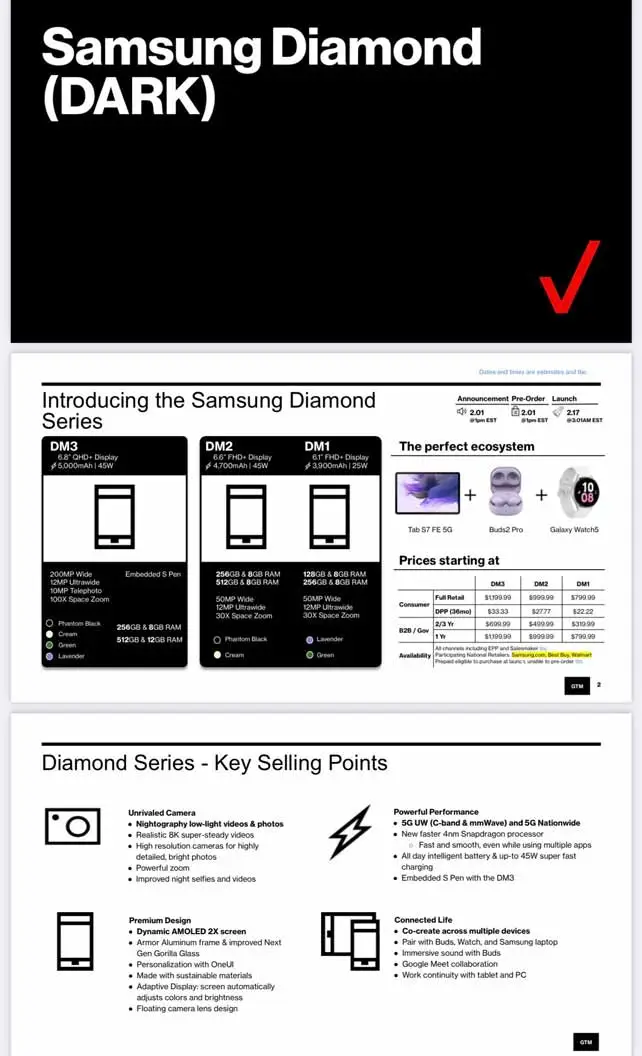
The carrier in question is Verizon. According to the leaked spec sheet, the Galaxy S23 is set to start at a price of $799.99 USD for the base mode, while the Galaxy S23+ will come in at $999.99 USD. The S23 Ultra would reportedly start at $1,199.99 USD. These prices are the same as last year’s S22 series.

With the similarity in mind, the phones in Canada are likely to start at $1,099.99, $1,399.99 and $1,649.99 for the S23, S23+ and S23 Ultra, respectively.

It’s worth noting that previous leaks and rumours have suggested that the S23 series might cost $100 more than the S22 series, but that debate can be put to rest if the leaked Verizon spec sheet is accurate.

The spec sheet also suggests that on a 36-month contract with Verizon, the S22 will cost $22.22 USD per month, while the high-end S23 Ultra will cost $33.33 USD per month. The S23+ will cost $27.77 USD per month. All three devices would be available in Cream, Green, Lavender, and Phantom Black colourways.

Further, in terms of specs, the leaked sheet reiterates some of the leaks we already know about. The S23 starts with a 128GB base model paired with 8GB of RAM. The S23+ starts at 256GB with 8 GB of RAM, and the S23 Ultra will begin at 256GB with 8GB of RAM as well. Additionally, the leaked spec sheet also alludes to the fact that the S23 series would be available starting February 17th, at around 3:01am ET.

Find other leaked S23 series specs here.

Image credit: 9to5Google

Source: 9to5Google