Categories
Mobile Syrup

Nintendo’s next ‘gaming system’ won’t release until 20XX

Even though the Switch OLED model isn’t a month old yet, Nintendo is already talking about its successor — well, sort of.

During its recent presentation to investors, Nintendo stated that it plans to “continue to expand its business around the core concept of creating unique integrated hardware-software products.” Reading between the lines, this likely means that the company plans to release more video game consoles in the future — surprise.

However, the actual release window when this successor to the Switch will release remains unknown. In the presentation (which you can find here), Nintendo says that its “next gaming system” will drop at an undefined date in “20xx.” Other than stating it has plans to create another video game console in the future, the company doesn’t let any further details slip.

Though the OLED Switch is a decent refresh to the original Switch, it’s far from a true successor. It features the same overall design as the OG Switch, and, more importantly, it isn’t an internal hardware upgrade. For months, reports swirled that Nintendo planned to release a new version of the Switch capable of playing 4K titles when docked, but those rumours have yet come to fruition.

While the Switch is a great console, it’s nearly five years into its life cycle, and especially in the face of the Xbox Series X and PlayStation 5, its hardware is starting to show its age.

Source: Nintendo Via: IGN

Categories
Mobile Syrup

Nvidia reveals upcoming GeForce Now additions for November

Nvidia has just announced the 17 games it will be adding to its GeForce Now cloud streaming service over the course of November.

Check out games releasing this week below and scroll further to check titles releasing later in November:

Releasing this week

Releasing later in November

Nvidia’s cloud gaming service offers two membership options. The first is the free route that will give you standard access to the platform with a one-hour gaming limit per session. Once the hour passes, you can queue again to get another hour of free gaming in, although you may have to wait a while.

Nvidia also offers a paid membership option that gives you priority access to gaming servers without any session length limit. This subscription will cost you $12.99/month or $129.99/year.

Learn more about Nvidia GeForce and its subscription options here.

Image credit: Nvidia 

Source: Nvidia 

Categories
Mobile Syrup

Stadia users can finally allow friends to join their game without an invite

Stadia is rolling out the ability for your friends to join your Far Cry 6 campaign run without an invite.

For now, according to Google, the feature is available for “select games,” with the only compatible title so far being Far Cry 6. Support for more multiplayer games is likely to come soon.

Stadia users have been waiting for the essential feature for almost two years now, so waiting a little longer for more games to support the feature isn’t a biggie.

According to Google, the feature is disabled by default, and to enable it, you’ll need to head to the privacy settings under ‘Your activity.’ Navigate to ‘Current game,’ and enable ‘Join your current game.’

Users can set who can automatically join their co-op session by selecting ‘All Players,’ or only ‘Friends.’ And if you want to be left alone, which is a likely outcome if you’re a Stadia user, you can disable the feature or select ‘Only you’ or ‘Private’ in the dropdown menu.

The Stadia app for Android and the online version for iOS both support the new join-without-an-invite feature.

This comes soon after Stadia introduced new mobile-focused touch controls on Android, with support for iOS coming soon.

Source: Google

Categories
Mobile Syrup

DJI’s new Mavic 3 features two cameras and nearly every feature imaginable

DJI — which also just released a new action camera and a 4D cinema camera — is back again with a new flagship Mavic 3 drone that’s just as impressive as the other devices the company launched this year.

While I’ve only taken the Mavic 3 out for a quick flight twice so far, the excellent pictures and videos it’s capable of shooting have me excited. I’ll also mention that the drone is very fast once it’s up in the sky, and of course, you’ll need a basic drone license to fly this drone legally in Canada.

Before getting too deep into the Mavic 3’s specs, I’ll mention that there are two versions of the drone and three buying options. The top of the line Cini version that comes with a better controller, 15km range, compatibility with Apple’s ProRes 422 HQ codec and features 1TB of internal storage. The regular Mavic 3 offers 8GB of internal storage, a more standard controller and can only shoot D-Log.

I’ve been testing the ‘Fly More’ bundle, which includes the basic Mavic 3 + controller but also features a surprisingly custom carrying bag, four ND filters for flying during the day, two extra batteries and a battery charging station. If you plan to fly for more than the 46 minutes, I’d recommend stepping up to this bundle since the extras are pretty useful.

The main draw with the Mavic 3 is its new 4/3 CMOS camera sensor. In my brief tests so far, the drone is capable of capturing amazing images and video. That said, I’m coming from the Mavic Mini 2, so if you already own a Mavic 2 or an Air 2S, you might not need to upgrade it as much. The main lens is the equivalent to a 24mm full-frame lens on a camera and can shoot in full 12-bit RAW to capture the maximum amount of colours. It can also record in 5.7k at 50fps or 4k at 120fps. That said, all of the test footage (seen) is shot at regular speed 30fps.

This image has been cropped in 2x.

Similar to OnePlus, DJI has partnered with Hasselblad to bring the legacy camera maker’s famous colour science to the drone. This means that if you’re just shooting with the standard picture profile, the colours will still look punchy and accurate. This is how the demo video above was filmed.

To make the drone easier to fly, DJI has loaded it with sensors that provide better obstacle avoidance and object tracking. However, the tracking feature isn’t available yet and will release in January. This version will be able to track the user on more x/y/z planes and can use obstacle avoidance sensors to track the object when it moves out of the main camera’s frame. This could be the real draw of this drone if it allows one-man-band style filmmakers to video themselves with more ease.

All of the other DJI tricks and modes from previous drones are packed in here as well. The standard bundle costs $2,049 USD (roughly $2, 551 CAD). The Fly More combo is $2,799 USD (about $3,484 CAD) and the Cine package rings in at $4,649 USD ( approximately $5,788 CAD).

Categories
Mobile Syrup

Best Buy’s Black Friday pricing is applicable on these TVs

Best Buy Canada is currently offering several 2021-released 4K and 8K TVs at discounted ‘Black Friday’ pricing.

You can find some of the notable deals below:

32-inch and smaller TVs

33 to 55-inch TVs

Find all 33 to 55-inch TVs on sale here.

55 to 65-inch TVs

Find all 55 to 65-inch TVs on sale here.

70 to 79-inch TVs

Find all 70 to 79-inch TVs on sale here.

80-inch and bigger TVs

Find all 80-inch and bigger TVs on sale here.

MobileSyrup utilizes affiliate partnerships. These partnerships do not influence our editorial content, though MobileSyrup may earn a commission on purchases made via these links.

Image credit: Best Buy

Source: Best Buy

Categories
Mobile Syrup

Feds claim ‘progress’ on reducing wireless prices, carriers didn’t meet any targets

The federal government released its latest quarterly wireless price reduction report claiming there’s “progress on reducing prices.”

Not that it matters.

Here’s the thing — the report shows pricing data for July, August and September 2021, but carriers actually started implementing plans that meet the targets in October (and thus, those plans aren’t in this report).

I’d argue the other value of these quarterly reports would be a historical record of wireless plan prices. Unfortunately, the report fails there too since almost every section is marked with a tilde (~) — as the legend notes, that indicates a carrier didn’t advertise that data plan on their website at the time of sampling. The report also fails to document plans that fall outside of the specific data buckets the government chose to target.
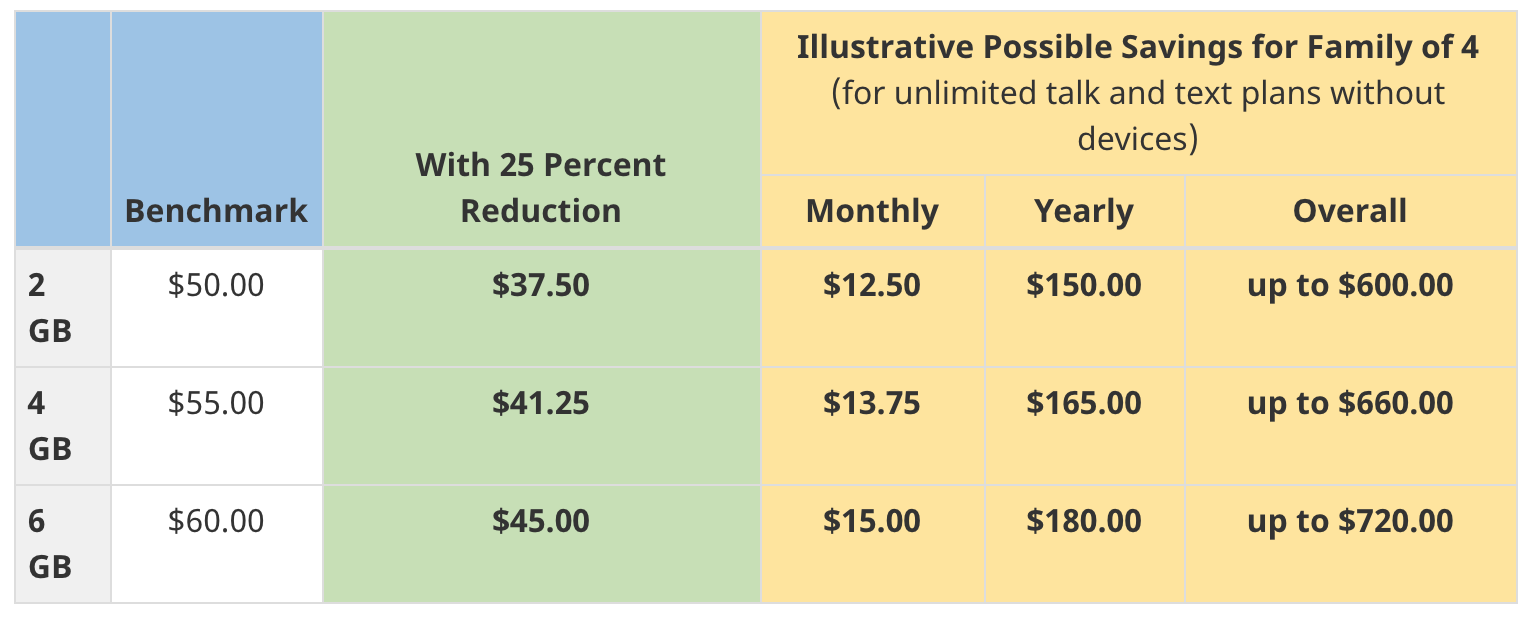
As a reminder, the government’s goal was to see a 25 percent reduction in price based on benchmarks set in 2020. Those benchmarks would see a $50/mo plan with 2GB of data drop to $37.50/mo, a $55/4GB plan drop to $41.25/mo and a $60/6GB plan drop to $45/mo.

“Progress” is when no carriers meet your targets

With the exception of Quebec, every province has an almost identical chart (I’ve included the Ontario one below for reference).
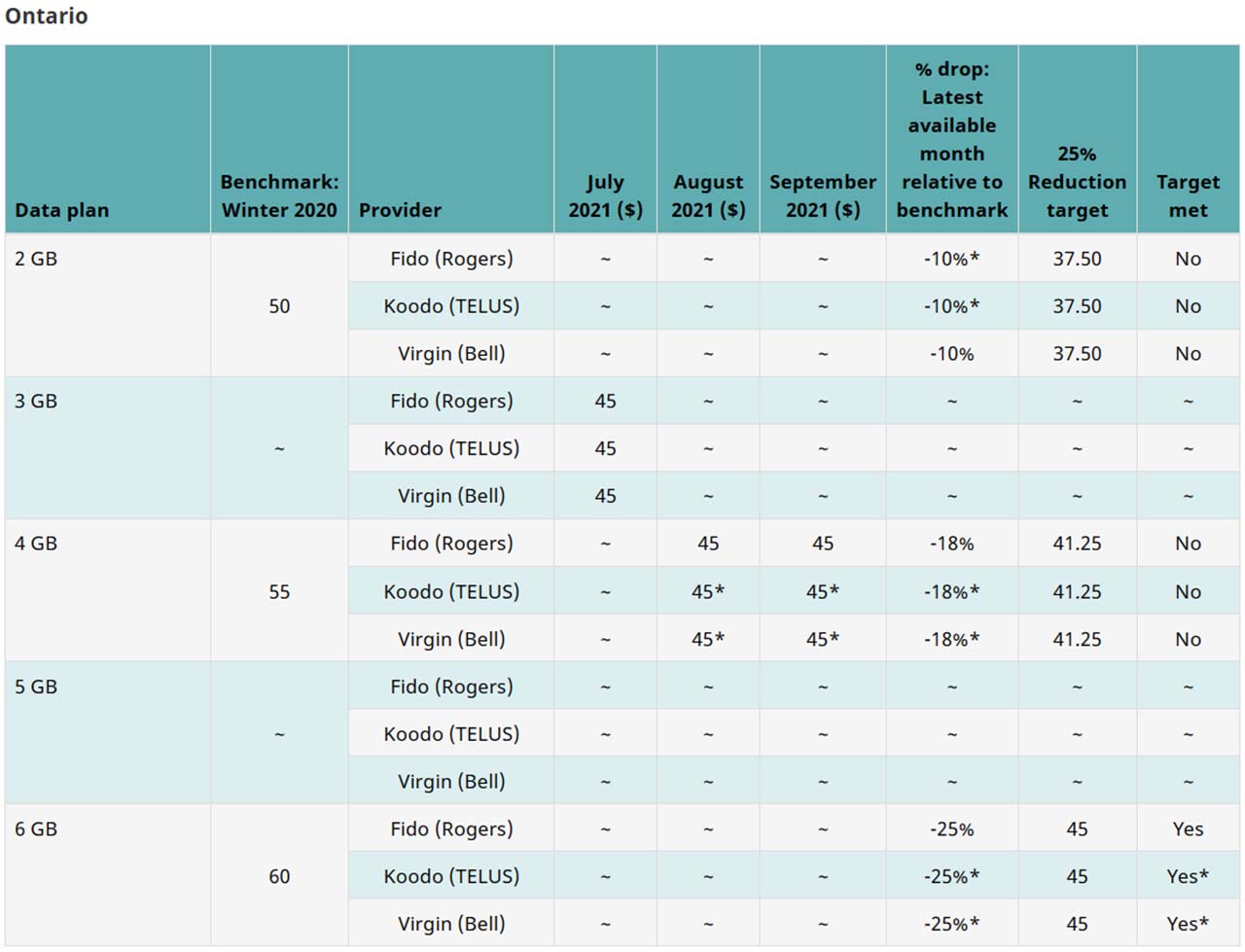
A few important things to note about the chart. First, it doesn’t show anything outside of the listed data amounts. That means that arguably decently priced plans, such as the $50/10GB plans offered by Koodo, Virgin Plus and Fido in August, aren’t included. Second, the chart only shows pricing from Koodo, Virgin Plus and Fido, which are flanker brands of Telus, Bell and Rogers respectively. That has allowed the big three carriers to effectively offload the 25 percent price reduction requirement on the flanker brands while continuing to charge high prices (plans start at $80/mo at all three).

Third, the chart claims that the $45/6GB target was met despite none of the sampled carriers offering a $45/6GB plan during the quarter. Fido was the only carrier to previously meet that requirement and it only did so in June 2021. Really, the Rogers flanker brand should be the only carrier marked as meeting the $45/6GB target, and even then I’d argue it shouldn’t get the privilege since it removed the plan. What’s the point if carriers only have to meet the 25 percent price reduction target one time, and can then go back to charging high prices?

Again, none of this really matters that much given that Koodo, Virgin and Fido have since introduced plans that meet (or at least come close to meeting) price reduction targets. The three flanker brands have a $38/2GB plan (Virgin’s is actually the required $37.50 price), a $41/4GB plan (again, Virgin matches the price exactly with a $41.25/mo plan) and a $45/6GB plan. However, this change won’t be reflected by the government’s reports until it releases the next quarterly report.

Although the flanker brands have technically met those targets, all have done so resentfully by restricting these plans so that anyone who wants to get a new phone with one of these carriers cannot also get one of these lower-cost plans.

Quebec has the only different chart, but it’s not really that different
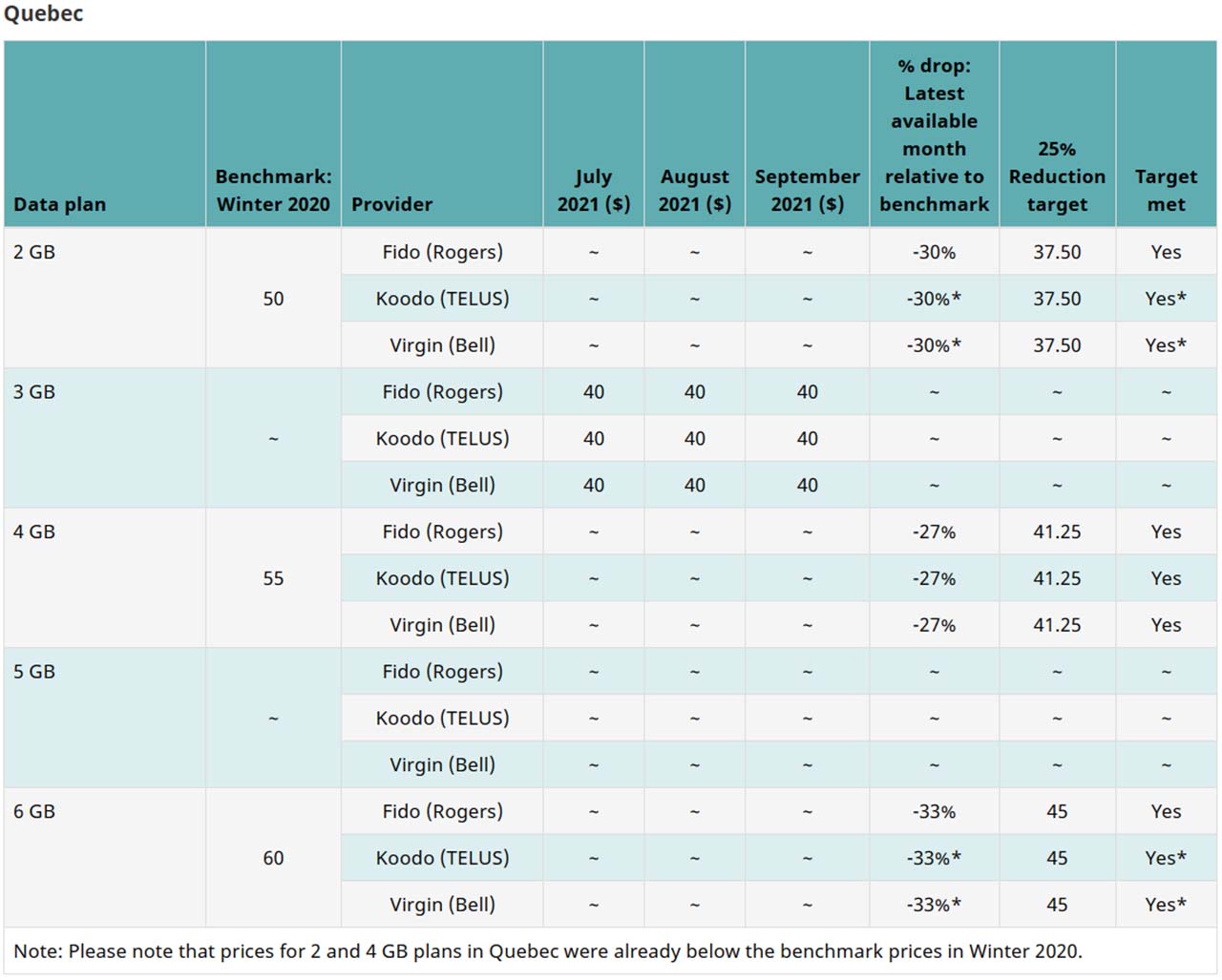
As for Quebec, the most recent quarterly chart shows that Koodo, Virgin and Fido don’t offer any plans in any of the target data buckets. Again, the chart lists all the price reduction targets as being met despite that none of the carriers have offered plans that meet or beat the price goal since June 2021.

Finally, as I pointed out with the last quarterly report, the government’s charts don’t incorporate other costs involved with carriers, some of which can discourage customers from switching. One excellent example is the connection fee (which leapt to $50 earlier this year at most major carriers). There are often ways to waive the fee, but that doesn’t stop it from acting as a deterrent for switching.

Ultimately, this latest quarterly report is another example that the Canadian government has failed to address wireless pricing. Sample carriers do not consistently meet the price reduction targets, and when they do, it’s through promotions or heavily restricted plans designed to deter customers. Prices have gotten better, but it’s hardly enough. Worse, the government has so far refused to implement changes that would help the situation. For example, mandating MVNO access, something favoured by Canadians and independent players and fought vehemently by the Big Three and other larger regional telecom companies.

You can view the previous reports at the links below:

Categories
Mobile Syrup

Google’s Pixel foldable will reportedly feature Pixel 5-like camera shooters

Unfortunately, it looks like Google’s foldable Pixel smartphone that is rumoured to launch in 2022 will lack the Pixel 6 and 6 Pro’s high-end cameras.

The upcoming foldable Pixel, codenamed ‘Pippit,’ will feature the Pixel 5’s 12.2-megapixel IMX363 sensor, instead of the 50-megapixel primary shooter included in 2021’s Google phones. 9to5Google’s APK insight team discovered this information through Google’s Camera app.

Previously, Google’s Pixel foldable was linked to the ‘Passport’ codename, but at some point, the tech giant seems to have changed it to ‘Pipit.’ It’s unclear why, but this has happened in the past and it’s not unusual for internal project codenames to shift mid-production.

According to 9to5Google, the foldable Pixel’s camera will be accessible when the phone is folded, suggesting you can also still likely use it when the smartphone is closed.

Additionally, the Pixel Fold will also come with two 8-megapixel IMX355 sensors on the inside and outside of the device. Likely, these 8-megapixel shooters will both be used for selfies, including one above the external display and another for the inner screen.

While disappointing, including a lower-grade camera in a foldable device isn’t uncommon. For example, Samsung’s Galaxy Z Fold 3 features camera specs worse than its Galaxy S21 Ultra.

9to5 also uncovered code that references the foldable as “isPixel2022Foldable” within the Google Camera app, hinting that the device could launch as early as next year.

However, if Google’s Android 12L release schedule is accurate, the Pixel Fold won’t launch until at least March.

Source: 9to5Google

Categories
Mobile Syrup

Some Pixel 6/6 Pro devices are randomly calling contacts

Google’s fancy Pixel 6 and 6 Pro only started arriving in customers’ hands last week (mostly a lucky few who managed to place pre-orders so far). However, in that short time, users have reported several strange issues. There’s been a screen flicker issue, problems with the Always-On display and now some claim their Pixel 6/6 Pro randomly called contacts.

Several users on Reddit (via Android Police) and Google’s Pixel Phone Help site (via Android Authority) report that Pixel 6 and 6 Pro devices are placing calls to random contacts, sometimes in the middle of the night.

The main culprit so far seems to be Google Assistant. Some users report that the ghost calls appear in Assistant’s activity history page. Additionally, disabling Google Assistant on the lock screen has resolved the issue for some. What’s particularly concerning is that many users reported the issue happening when there wasn’t background chatter that could have mistakenly triggered Google Assistant (for example, people reported calls were placed while they slept).

The Pixel Phone Help user also reported that a call was triggered one time while they spoke Farsi, a language that Google Assistant doesn’t support.

Neither MobileSyrup staff reporter Dean Daley nor I have experienced this issue on our respective Pixel 6 Pro and Pixel 6 devices. Daley confirmed to me that he has Assistant enabled on the lock screen. I do as well, but I keep the ‘Hey Google’ hotword turned off on phones (including the Pixel 6) because I hate when my phone intercepts a command I intend for one of my smart speakers.

For those that encounter this problem, it may be worth temporarily disabling Assistant on the lock screen (or the ‘Hey Google’ hotword). You can do that by opening the Google app > tapping your profile in the top-right corner > Settings > Google Assistant > then tap ‘Hey Google & Voice Match’ to turn off the hotword on your phone or tap ‘Lock screen’ to disable Assistant on the lock screen. Other users have avoided the issue by deleting contacts that Assistant calls.

Hopefully Google pushes out a fix for this problem soon.

Source: Reddit, Pixel Phone Help Via: Android Police, Android Authority

Categories
Mobile Syrup

Philips Hue products heavily discounted for ‘Early Black Friday’

Leading up to Black Friday, which is on November 26th, Amazon Canada already showed off some of the ‘early’ tech deals you can score. The list is here, however, daily deals keep popping up and today its a slew of discounts on Philips Hue products.

These deals might help you get into the festive mood this season:

Check out all the Black Friday deals here.

MobileSyrup utilizes affiliate partnerships. These partnerships do not influence our editorial content, though MobileSyrup may earn a commission on purchases made via these links.

Categories
Mobile Syrup

Telus reports 135,000 mobile phone net additions in Q3 2021 earnings

Vancouver-based national telecom Telus announced its Q3 2021 earnings on November 5th, reporting 135,000 mobile phone net additions.

The number marked an increase of 24,000 from the same period last year and was part of the company’s overall 320,000 total net additions, up 43,000 from last year. That also included 46,000 internet net additions, 10,000 TV net additions, 30,000 security net additions and 110,000 connected device net additions. Telus characterizes connected devices as anything other than a mobile phone with a SIM or IMEI — for example, tablets, internet keys, internet of things (IoT) devices, wearables and more.

However, Telus also reported 11,000 net losses of residential voice subscribers in Q3, up from 8,000 in 2020. The company noted that fixed voice services revenue decreased by $14 million in Q3 2021 but says it mitigated losses through product bundles and “successful retention efforts.”

Telus’ mobile phone churn rate came in at 0.90 percent in Q3 2021, down from 0.99 percent in Q3 2020.

Telus reported Average billing per user (ABPU) was $70.99. Further, the company said it was “relatively unchanged” compared to the same time last year. Similarly, Telus reported average revenue per user (ARPU) at $58.13 in Q3 2021, again “relatively unchanged” from the same time last year.

Finally, the carrier reported consolidated operating revenue of $4.3 billion, up 6.8 percent. Earnings before interest, income taxes, depreciation and amortization (EBITDA) increased by 7.6 percent to $1.5 billion.

You can view the full results from Telus here, Q3 2020 results here and Q2 2021 results here.

Source: Telus