Catégories
Uncategorized

Major U.S. City Sees 42% Drop in Canadian Tourism During Trump’s Second Term

onald Trump’s renewed attacks against Canada after returning to the White House are now producing major economic consequences across the United States, especially in cities and states traditionally dependent on Canadian tourists. Since beginning his second term, Trump has imposed tariffs on Canadian goods, reignited trade disputes and repeatedly floated the idea of Canada becoming the “51st state,” remarks that generated anger among many Canadians. As tensions between the two countries intensified, travel patterns rapidly shifted. Border crossing statistics already revealed a near 30 percent decline in Canadian tourism into the United States, but new research now suggests the damage to major American cities is far more severe than previously estimated. Researchers analyzing cellphone data found Canadian tourism in major U.S. metropolitan areas has dropped by roughly 42 percent since Trump returned to office.

The research, based on cellphone mobility data analyzed by researchers from the University of Toronto, revealed sharp declines in several American destinations traditionally popular among Canadians during vacations, shopping trips and winter travel. Florida, New York, California, Vermont and New Hampshire were among the states most heavily affected by the collapse in Canadian visitors. While official border crossing data measures entries into the United States overall, the cellphone analysis tracked movement patterns directly inside American cities, offering a clearer portrait of where Canadians are no longer traveling. Researchers found the losses extended far beyond seasonal tourism, affecting large metropolitan economies that have historically benefited from a steady flow of Canadian visitors throughout the year.

Getty Images

Among the cities hardest hit by the decline, Myrtle Beach, South Carolina recorded the steepest drop with a 65 percent decrease in Canadian cellphone presence. Yuma, Arizona followed with a 62 percent decline, while Panama City, Florida lost 60 percent of its Canadian visitors. Brownsville, Texas and Orlando, Florida both registered declines of 58 percent. Several major tourism and entertainment destinations also suffered dramatic losses. Las Vegas and New York City each saw Canadian tourism fall by 55 percent, while San Francisco recorded a 57 percent decline. Miami dropped by 58 percent, Tampa by 53 percent and Los Angeles by 52 percent. Boston also registered a 52 percent decline, while San Diego fell 53 percent, Colorado Springs 51 percent and Nashville exactly 50 percent according to the mobility analysis.

«We have seen a near-total collapse of U.S. business.»

-Consultant with Vancouver-based agency The Travel Group, McKenzie McMillan

Researchers said the scale of the declines surprised them because many of the affected cities are not solely dependent on vacation tourism but are also major centers for finance, technology, retail and business activity. Karen Chapple, director of the University of Toronto’s School of Cities and one of the report’s authors, told Business Insider: «The top 20 cities were a number of big metros that aren’t exactly known as, you know, big tourist areas.» Researchers also pointed to «the marked decline in visits to large metropolitan economies.» The findings suggest Canadians are not only canceling holidays but are also reducing business travel into the United States amid growing political and economic tensions. Grand Rapids, Michigan, which saw a 53 percent decline, was highlighted as an example of a city closely connected to Ontario’s automotive sector that historically benefited from constant cross-border business movement.

Getty Images

While nearly every major American destination included in the analysis experienced significant declines, researchers identified only three U.S. cities that appeared largely impervious to the broader downturn in Canadian travel. Cleveland, Ohio recorded a surprising 35 percent increase in Canadian cellphone presence compared to previous years. Gainesville, Florida also saw a 31 percent increase, while Portland, Oregon registered a 21 percent rise. Outside of those three exceptions, every other city measured in the report experienced declines in Canadian visitors. Even cities with comparatively smaller decreases still remained in negative territory. Albuquerque, New Mexico recorded a 5 percent decline, Pensacola, Florida fell by 12 percent, Columbus, Georgia by 14 percent, Burlington, North Carolina by 17 percent and Iowa City, Iowa by 18 percent according to the cellphone data analysis.

«The top 20 cities were a number of big metros that aren’t exactly known as, you know, big tourist areas.»

-Director of the University of Toronto’s School of Cities, Karen Chapple

Canadian travel advisors and tourism operators say the political climate surrounding the United States has fundamentally altered how many Canadians now approach travel south of the border. McKenzie McMillan, a consultant with Vancouver-based agency The Travel Group, described the collapse in demand bluntly, saying: «We have seen a near-total collapse of U.S. business.» He added: «Probably about a 90% drop since February.» Calgary-based travel executive Lesley Keyter also explained that some Canadians are now avoiding American airports and transit hubs entirely. «Even if they’re going on a Caribbean cruise, they don’t want to go down to Fort Lauderdale to get on the cruise ship,» she said. As tensions surrounding tariffs, border security and Trump’s repeated rhetoric toward Canada continue escalating, economists increasingly warn that the sharp reduction in Canadian visitors could cost major American cities and states billions in lost tourism revenue during Trump’s second term.


Getty Images

15 desserts that are easy to make in under 15 minutes

When guests show up unannounced, you really aren’t in the mood to spend hours in the kitchen. But you don’t want to disappoint them by serving just a simple fruit salad or yogurt. So, to save you from such an awkward situation, here are our 15 recipes for exquisite desserts that take less than 15 minutes to make. They’re simple, quick, but absolutely delicious! Your guests are sure to be impressed!

7 Interior Design Tricks That Create Calm & 7 That Increase Stress

You know that feeling when you walk into a room and something just feels… off? The walls look fine, the couch is comfortable, yet the space somehow feels louder than it should. It’s not you—it’s the design quietly messing with your mood.

Interestingly, our surroundings have more power over us than we realize. The colors, the light, even the placement of furniture can affect how our brains process calm or chaos. What feels cozy to one person might make another feel trapped. And sometimes, the smallest detail can tilt the balance completely.

10 Common Parenting Hacks That Cause More Stress Than They Solve

Advice on kids comes at you from every direction. Every blog, app, and well-meaning relative offers shortcuts promising easier days and peaceful nights. Yet somehow, your house still feels like chaos central, and you’re more exhausted than ever.

Comment la désinformation exploite directement les besoins émotionnels

La personne la plus intelligente que vous connaissiez vient de partager une théorie du complot qui vous a fait grincer des dents. C’était peut-être votre professeur d’université ou ce parent à l’esprit vif qui voit généralement clair dans tout. Vous fixez votre écran, vous demandant comment quelqu’un d’aussi perspicace a pu gober quelque chose d’aussi manifestement faux, et pourtant, voilà, c’est là, publié avec une conviction totale.

Cancelled or renewed? RJ Decker, Murder in a Small Town and more!

Which series are coming to an end or being cancelled in 2026? Is your favorite returning for a new season? Between expected renewals, surprise cancellations, and series bowing out after several years, 2026 promises to be a pivotal year for many productions. From streaming platforms to major American networks, announcements are multiplying and reshaping the television landscape.

Some series are continuing their success with new seasons, while others are closing the curtain for good. Discover in our complete recap all the series renewed, canceled, or ending in 2026, with essential information to remember so you don’t miss any of the upcoming releases.

How Disinformation Taps Directly Into Emotional Needs

The smartest person you know just shared a conspiracy theory that made you cringe. Maybe it was your college professor or that sharp-witted relative who usually sees through everything. You stare at your screen, wondering how someone so perceptive could fall for something so obviously false, yet there it is, posted with complete conviction.

15 Cars That Are Way Overrated on the Market

Some cars have built up an impressive reputation through marketing, social media, or their image of prestige. However, once behind the wheel, many models don’t always live up to the hype surrounding them. Exorbitant prices, disappointing performance, questionable reliability, or lackluster technology: some cars are sometimes admired more for their image than for their actual qualities.


Catégories
Uncategorized

What’s Canada’s status on the Hantavirus outbreak?

This article will be a detailed analysis of the MV Hondius’ storied voyage and Canada’s involvement in the incident. It is extremely important to note that the World Health Organization (WHO) has clarified that hantaviruses are not comparable to COVID-19. The WHO has announced that there is almost no risk of a global outbreak.

While the Andes strain of Hantavirus can be deadly to humans, transmission remains extremely unlikely and only possible given the perfect conditions for the virus to spread.

A cruise ship is an example of an environment conducive to the spread of Hantavirus.

Where are the Canadians who were aboard?

In total, there were six Canadians aboard the MV Hondius when it departed from a port in Ushuaia, Argentina, on April 1, 2026. Two Canadians were evacuated on April 24, when the Dutch-flagged cruise ship stopped at a port in Saint Helena. Both Canadians were from Ontario, and reports suggest that they are partners. A third Canadian was also brought from Saint Helena back to Canada, though they were not on the cruise ship. The WHO claimed that the third Canadian came into brief contact with infected individuals and was brought back to Quebec, where they live, in order to isolate.

The remaining four Canadians aboard were evacuated on May 10. The MV Hondius arrived at the Port of Granadilla in Tenerife, Canary Islands, Spain, early in the morning, and the four remaining Canadians disembarked after being screened by a team of WHO and Spanish doctors. The Canadians could be seen wearing protective equipment while leaving the ship. The passengers were transported under controlled conditions from the port to Tenerife South Airport, avoiding contact with the public before boarding a privately chartered plane bound for Canada. The flight was organized by the Public Health Agency of Canada (PHAC), Global Affairs Canada, and the Canadian armed forces. A PHAC was reportedly onboard the aircraft, enforcing social distancing, masking, and other infection-prevention procedures.

The aircraft first landed at Saguenay–Bagotville Airport, a military base in Quebec. The media were prevented from accessing the base during the transfer. From Bagotville, the passengers boarded another flight to Victoria International Airport, British Columbia. The four individuals are currently isolating somewhere in British Columbia. All four are under the active supervision of doctors, and all are isolating in individual lodgings, not public hospitals. The individuals are expected to stay isolated until at least May 27, assuming all remain asymptomatic. The quarantine could possibly last 42 days if an individual begins to display symptoms, but as of now, all four have tested negative for Hantavirus. Four additional Canadians in Quebec, Alberta, and Ontario are isolating after possible exposure during air travel; all are asymptomatic and have tested negative for the virus.

Timeline of MV Hondius

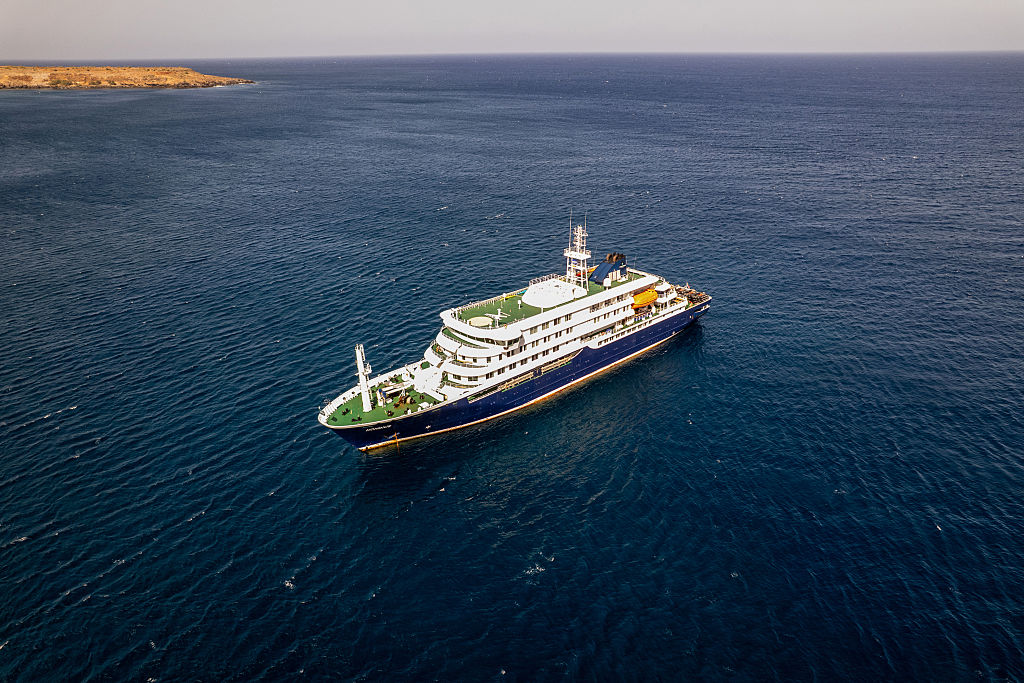
TOPSHOT – This aerial picture shows a general view of the cruise ship MV Hondius stationary off the port of Praia, the capital of Cape Verde, on May 3, 2026. An outbreak of « severe acute respiratory illness » on board a cruise ship in the Atlantic has left two people dead and a third in intensive care in Johannesburg, South Africa’s health ministry told AFP on May 3, 2026. The outbreak occurred on the MV Hondius, travelling from Ushuaia in Argentina to Cape Verde. The patient being treated in Johannesburg tested positive for a hantavirus, a family of viruses that can cause hemorrhagic fever, South African spokesperson Foster Mohale said. (Photo by AFP via Getty Images)

On April 1, the MV Hondius, a Dutch cruise ship operated by Oceanwide Expeditions, departed a port in Ushuaia, Argentina. The ship planned on stopping in Antarctica, South Georgia, Tristan da Cunha, Saint Helena, Ascension Island, Cabo Verde, and the Canary Islands. The ship departed port with 88 passengers and 59 crew members. The expedition was planned to last until at least May 12. Instead, the ship became the biggest story in the world, with a deadly Hantavirus detected on board. On April 6, a man began displaying symptoms, including a headache, nausea, and mild diarrhea. The World Health Organization would later confirm that this was the first positive case of Hantavirus on the ship. The WHO announced that the passenger was likely infected before boarding the ship.

On April 2, the ship stopped in Antarctica for three days, with passengers undergoing an Antarctic expedition segment with zodiac landings and wildlife excursions. While crossing the South Atlantic, Case 1 begins displaying symptoms. While the infected individual was ill, the ship stopped in South Georgia for three days, leaving port on April 10. On April 11, Case 1 turned for the worse. Case 1 died on April 11 between South Georgia and Tristan da Cunha. On April 13, the ship stopped in Tristan da Cunha, with passengers visiting the city. On approximately April 20, the wife of Case 1 began showing symptoms of Hantavirus, beginning with nausea and quickly experiencing respiratory decline.

The next stop came on April 24, with the ship stopping in Saint Helena. In Saint Helena, the body of Case 1 was removed from the ship, and Case 2 was transported to a medical centre. More than 25 passengers permanently disembarked out of fear of illness. The WHO has cited this mass disembarkment as a potential global exposure event. Shortly after the ship left port in Saint Helens, Case 3 was discovered as a British man began experiencing Hantavirus symptoms. Outside of the ship, Case 2 deteriorates on a flight from Saint Helena to Johannesburg. Case 2 later dies in South Africa. Testing in South Africa confirms Hantavirus as the source of the illness and subsequent death. This is the first lab-confirmed case.

On April 27, the first medical evacuation happens, with Case 3 airlifted from the ship to Johannesburg. Medical staff quickly confirm that Case 3 is suffering from Hantavirus, most likely the Andes strain. In the following days, the ship announces that multiple serious illnesses were on board, with two crew members and multiple passengers showing symptoms. On May 2, Case 4, a German woman dies aboard the MV Hondius. This is when international investigations began. On May 5, the cruise ship stops in Cape Verde, with multiple evacuations occurring. It is announced that the ship’s doctor is showing symptoms, raising concerns about the risk to doctors treating patients. The ship departed Cape Verde and docked in Tenerife, Canary Islands, early morning on May 10. All remaining passengers were evacuated, including 22 British passengers, 17 Americans, 14 Spanish passengers, and other passengers hailing from the Netherlands, France, Germany, Australia, New Zealand, Ireland, and Belgium.

What is Hantavirus?

Hantaviruses are zoonotic viruses that naturally infect rodents and are occasionally transmitted to humans. Infection in people can result in severe illness and often death, although the diseases vary by type of virus and geographical location. To date, human-to-human transmission has been documented only for the Andes virus in the Americas and remains uncommon. This is the strain of the virus present on MV Hondius. Symptoms begin between one and eight weeks after exposure, depending on the type of virus, and typically include fever, headache, muscle aches and gastrointestinal symptoms (pain, nausea, vomiting).

There is no licensed specific antiviral treatment or vaccine for hantavirus infection, but the WHO stresses that there is little to no risk of further infection after the MV Hondius incident.

Americans strongly opposes new ballroom, poll shows

A new poll sponsored by the Washington Post, ABC News and Ipsos has been released showing that Americans do not approve of Donald Trump’s new ballroom, with some surveyed before the announcement that the $400 million ballroom will now be funded by taxpayer dollars. The poll surveyed 1,292 U.S. adults via online interview, and claims the margin of error is only 2.8 per cent.